By Artem Panasiuk · 13 November 2026 · 10 min read
How Much Emergency Fund Does a Family Need? What the Fed Data Shows
There is no single dollar amount that fits every family, but there is a common yardstick: three months of expenses. This guide uses the Federal Reserve’s 2026 survey to show how many households reach it and how parents compare, then works out a starting number from your own spending. It covers US households and uses dollars. It is general information and not financial advice.
The short version
- In October 2025, 55% of US adults said they had set aside three months of expenses in an emergency or rainy day fund, the same share as in 2024 and down from a high of 59% in 2021 (Federal Reserve, May 2026).
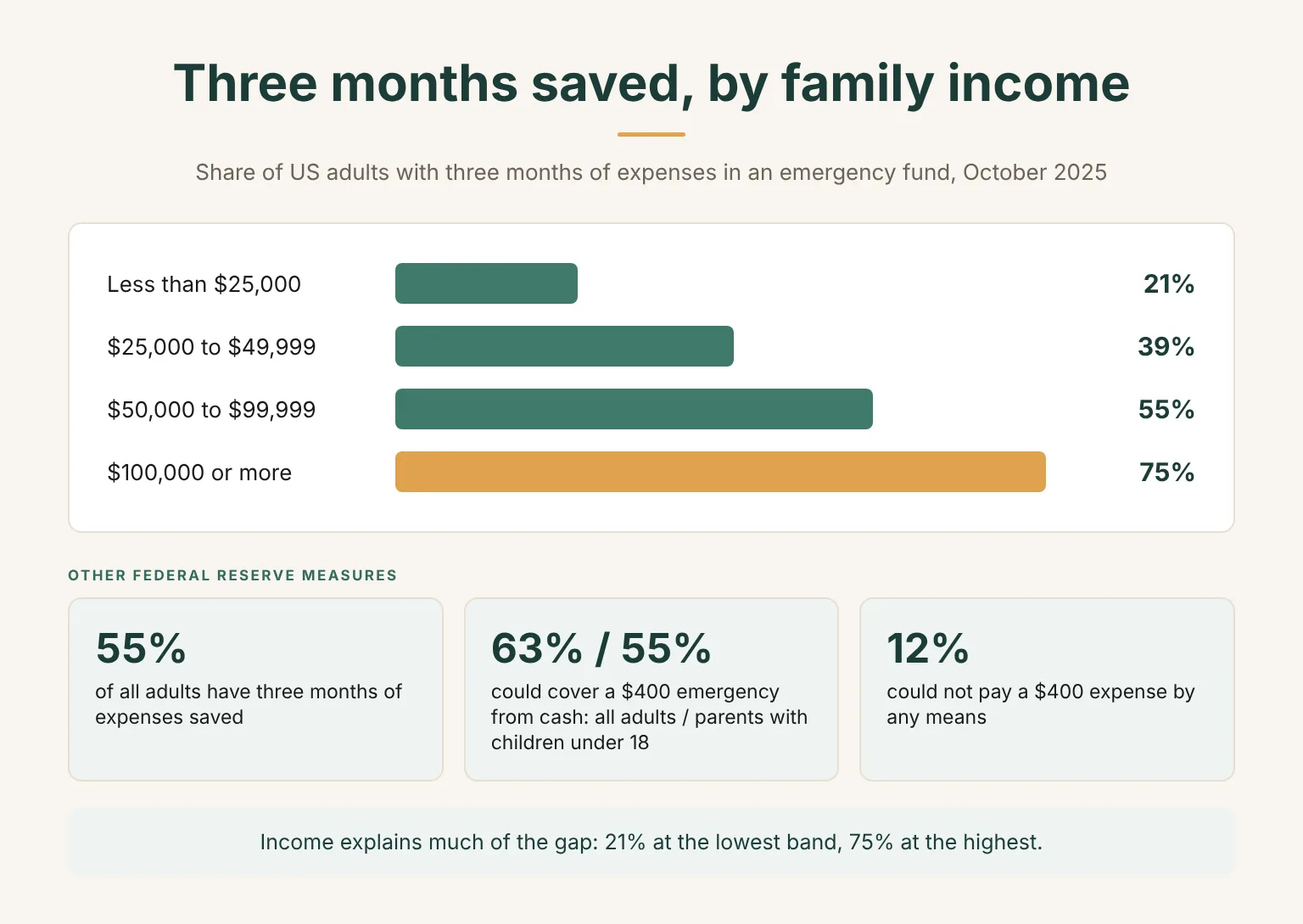
- The share with three months saved rose with family income: 21% below $25,000, 39% at $25,000 to $49,999, 55% at $50,000 to $99,999 and 75% at $100,000 or more.
- Parents living with their own children under 18 were less likely to cover a $400 emergency from cash or its equivalent: 55%, against 66% of other adults and 63% of all adults.
- Among adults who said they always have money left at the end of the month, 86% had a three-month fund. Among those who never do, 13% did, so the monthly gap matters more than the fund’s size.
- BLS data for 2025 puts average US household spending at $81,905 a year, about $6,825 a month, so three months of average spending is roughly $20,500. Your own figure will differ, and that is the one to use.
A family emergency fund is cash set aside for expenses that arrive without warning, such as a car repair, a medical bill or a month with no pay. The most common target is three months of expenses, and it is the measure the Federal Reserve uses in its annual survey of household finances. The sections below show where families stand, how to turn the yardstick into a number for your own household and how to build toward it.
How much emergency fund does a family need?
A family needs enough to cover its essential spending for the length of time it would take to recover from a lost income, and three months is the usual yardstick. The Federal Reserve’s Survey of Household Economics and Decisionmaking asks adults whether they have set aside “money for three months of expenses in an emergency savings or ‘rainy day’ fund”. It is a benchmark, not a rule. The Consumer Financial Protection Bureau (CFPB) puts it differently: the amount “depends on your situation”, and it suggests looking at the unexpected costs you have actually had and what they cost.
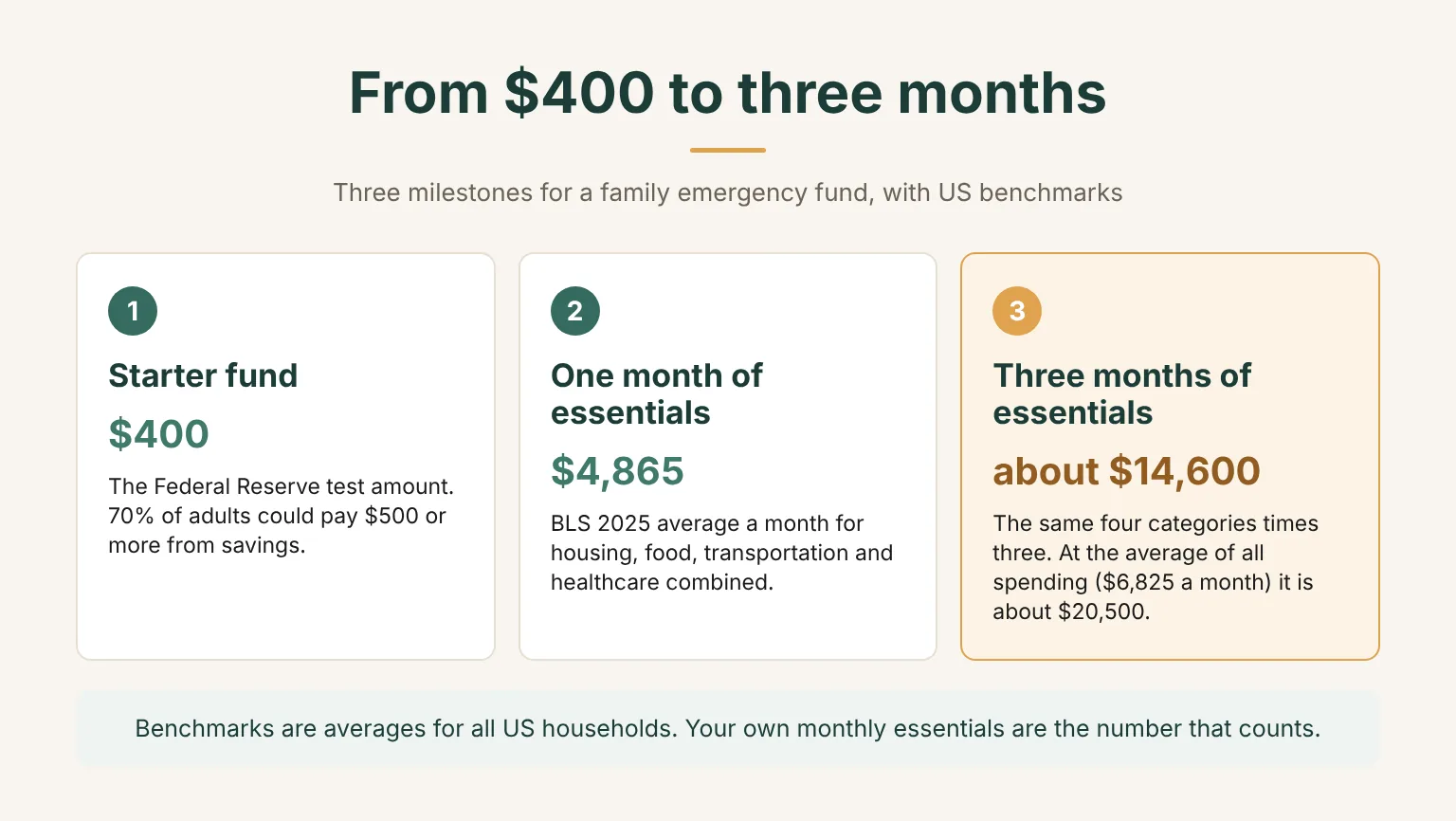
With children, housing, food and childcare costs keep running when income stops, so the fund has more to cover. Think of it as three steps, each with its own number.
| Step | What it covers | How to get the number |
|---|---|---|
| Starter fund | A single surprise bill, such as a repair or a copay | The Fed’s test amount is $400. Seventy percent of adults could pay $500 or more from savings |
| One month of essentials | A gap between paychecks or a short spell of lost hours | Add up housing, food, transport, utilities, insurance, childcare and minimum debt payments for one month |
| Three months of essentials | A job loss or a long illness | Multiply your essentials by three. The Fed counts this level as a rainy day fund |
How many families actually have three months of savings?
Just over half of US adults do. The Federal Reserve’s report on 2025, published on 13 May 2026 and based on a survey fielded from 17 to 28 October 2025, found that 55% of adults had three months of expenses set aside. That was unchanged from 2024 and below the 59% high of 2021. The gap by income is wide.
| Family income | Adults with three months of expenses saved |
|---|---|
| Less than $25,000 | 21% |
| $25,000 to $49,999 | 39% |
| $50,000 to $99,999 | 55% |
| $100,000 or more | 75% |
| All adults | 55% |
Age matters too. In the same survey, 37% of adults aged 18 to 29 had three months saved, 49% of those aged 30 to 44, 55% of those aged 45 to 59 and 71% of those aged 60 and over.
Do parents have less emergency savings than other adults?
On the Fed’s $400 test, yes. In 2025, 55% of parents living with their own children under 18 said they would cover a $400 emergency expense using cash or its equivalent, against 66% of all other adults. The overall figure was 63%. “Cash or its equivalent” means cash, savings or a credit card paid off at the next statement.
The parent figure was 55% in 2024 as well, so it has not moved. The Fed publishes the $400 split by parental status but not the three-month split, so this guide does not claim a figure for parents on the larger test.
What happens when a family can’t cover a $400 surprise?
Most of the 37% who could not pay $400 from cash found another way, and the most common was a credit card balance carried over. The Fed asked how adults would pay a $400 expense and allowed more than one answer. Twelve percent said they could not pay it at all.
| Way of paying a $400 expense | Share of all adults |
|---|---|
| Put it on a credit card and pay it off over time | 15% |
| Borrow from a friend or family member | 10% |
| Sell something | 7% |
| Bank loan or line of credit | 3% |
| Payday loan, deposit advance or overdraft | 2% |
| Would not be able to pay right now | 12% |
The Fed adds a caution about reading these answers. Some people who would not pay in cash may still hold $400 and prefer to keep it as a buffer. On a separate question, 18% said the largest emergency they could handle from savings alone was under $100, and 12% said between $100 and $499.
How do you work out your family’s emergency fund number?
Start from what your household pays in a normal month for things it cannot skip, and multiply. The Fed’s measure counts months of expenses, so your own monthly essentials are the right base. A benchmark helps to check you are in a sensible range, and the US Bureau of Labor Statistics (BLS) Consumer Expenditure Survey, released on 29 October 2026, gives one for 2025.
| BLS 2025, all consumer units | Per year | Per month |
|---|---|---|
| Housing | $27,790 | $2,316 |
| Food | $10,633 | $886 |
| Transportation | $13,492 | $1,124 |
| Healthcare | $6,470 | $539 |
| Those four combined | $58,385 | $4,865 |
| All average expenditures | $81,905 | $6,825 |
Three months of the four combined categories is about $14,600, and three months of all average spending is about $20,500. These are illustrations. BLS averages cover all US consumer units, not only families with children, and they include spending that a family could cut in a crisis. Treat them as a range to compare with your own number, not a target.
- List the essentials. Housing, utilities, groceries, transport to work, insurance, childcare, medical costs and minimum debt payments. Leave out dining out, subscriptions and gifts.
- Use real months. Take the last three months of actual spending and average them, so the number reflects what you paid and not what you meant to pay.
- Add the yearly bills. Car insurance, school fees and repairs do not arrive monthly. Divide each by twelve and add it in. The guide to irregular expenses and sinking funds has a list.
- Multiply by one, then by three. The first result is your one-month milestone. The second is the Fed’s rainy day level.
- Count the income you can count on. If two adults earn, ask what would happen to the household if the larger paycheck stopped, and whether the other one covers the essentials.
For a view of what other families spend in each area, see how much a family of four spends a month and family budget categories.
What counts as a family emergency, and what does not?
An emergency is a cost you could not plan for, that cannot wait and that you must pay: a car repair needed to get to work, an urgent medical or dental bill, a boiler failure in winter, or a gap in pay. Holidays, a new phone, birthday presents and the annual car insurance bill are not emergencies, even when they feel urgent. Yearly bills are predictable, so they belong in a sinking fund and not in the emergency fund.
Writing the rule down helps, because two adults often draw the line in different places. Many households agree on a short list and a second step for anything outside it: both adults talk before the fund is touched. The CFPB’s advice to look at the unexpected costs you have actually had gives you a way to build that list from your own history and not from a guess.
When you use the fund, refill it as a line in the next month’s budget. A withdrawal of $600 for a repair is a $600 category to rebuild, and it is easier to track when it has a name and a monthly amount.
How do you build an emergency fund when the budget is already tight?
Find the monthly gap first, because that decides whether any fund is possible. In the Fed survey, 86% of adults who always had money left over at the end of the month had a three-month fund, compared with 13% of those who never did. A fund comes from spending less than you earn, so the gap has to exist before the savings can.
| Money left at the end of the month | Adults with three months saved |
|---|---|
| Always | 86% |
| Often | 75% |
| Sometimes | 52% |
| Rarely | 26% |
| Never | 13% |
The CFPB’s guide to building an emergency fund, last updated on 29 October 2025, lists five ways to get started. They work for families as well as for individuals.
- Set a specific goal and track progress toward it.
- Track when money comes in and goes out, and adjust spending or due dates to free up room to save.
- Put all or part of a tax refund, gift or other lump sum into savings. The post on money kids get as gifts covers the children’s share of that.
- Automate saving with recurring transfers from checking to savings, and watch the balance to avoid overdraft fees.
- If your employer allows it, split your direct deposit between checking and savings.
Saving $100 a month reaches the $400 test in four months and $1,200 in a year. Prices also move: if essentials are rising, our guide on adjusting a family budget when prices rise shows how to reset the categories before you set the savings line.
The Fed’s two measures answer different questions. The $400 test asks whether a family can absorb a small shock without borrowing, and 63% of adults passed it in 2025. The three-month test asks whether a family could survive a lost income, and 55% passed. Both figures have been flat for three years, so neither is getting easier on its own. A family that passes the first and fails the second is in a common position, and the starter fund is the right place to begin.
Where should a family keep an emergency fund?
The CFPB lists three places: a bank or credit union account, a prepaid card and cash at home or with a trusted person. It describes a bank or credit union account as generally one of the safest options and suggests a dedicated account. Cash can be stolen, lost or destroyed, and a prepaid card is not connected to a bank, so you can only spend what is loaded on it.
A separate account also keeps the fund apart from day-to-day spending, which makes it harder to dip into by accident. Check whether the account is insured and what it pays, using the bank’s own terms and the regulator’s pages, because those details vary by provider and change over time.
How can a household budget app help build the fund?
It can show the monthly gap the Fed data points to and give you the real essentials number from step one. CapKin is a shared household budgeting app where one household keeps one budget, the owner sets an overall monthly cap and a cap for each category, and every member logs expenses against them by voice, text or receipt photo. If you set up categories for housing, groceries, transport and the other essentials, the monthly totals give you the figure to multiply by three.
CapKin does not hold the fund and does not move money. It has no bank connection, so the entries are the ones your household makes, and it does not give financial advice. The savings sit in your own account. The app can show whether a month ended with money left over.
If you want to try the first step by hand, how to create a shared family budget walks through the setup, and how to run a family money meeting gives a monthly rhythm for reviewing the number with your partner. Households that prefer not to share bank logins can read how budgeting works without a bank connection.
Sources
- Federal Reserve Board, Economic Well-Being of U.S. Households in 2025 (13 May 2026)
- Federal Reserve Board, press release on the 2025 report (13 May 2026)
- Federal Reserve Board, SHED data: adults who would cover a $400 emergency expense, by parental status (May 2026)
- U.S. Bureau of Labor Statistics, Consumer Expenditures 2025 (29 October 2026)
- Consumer Financial Protection Bureau, An essential guide to building an emergency fund (last updated 29 October 2025)
Frequently asked questions
- How much emergency fund should a family of four have?
- There is no fixed amount. The usual yardstick is three months of essential expenses, which the Federal Reserve uses in its household survey. Add up your housing, food, transport, utilities, insurance, childcare and minimum debt payments for a month and multiply by three. For reference, average US household spending in 2025 was about $6,825 a month, per the BLS.
- How many months of expenses should parents save?
- Three months is the common benchmark. The CFPB says the right amount depends on your situation. A practical path is a $400 starter fund, then one month of essentials, then three months, moving up as the budget allows.
- What percentage of Americans have an emergency fund?
- In the Federal Reserve’s survey fielded in October 2025, 55% of adults said they had set aside three months of expenses in an emergency or rainy day fund. That was the same as in 2024. By family income, the share was 21% below $25,000 and 75% at $100,000 or more.
- Can most Americans cover a $400 emergency?
- Most can, but not all. In 2025, 63% of adults said they would pay a $400 expense with cash or its equivalent, meaning cash, savings or a credit card paid off at the next statement. Among parents living with children under 18 the share was 55%. Twelve percent said they could not pay it by any means.
- Should I save for an emergency fund or pay off debt first?
- That depends on the interest rate, the size of the debt and your income, so it is a question for a qualified adviser. What the Fed data shows is that the most common way adults would cover a $400 shortfall without cash was a credit card balance carried over, at 15%, which is how a small surprise can turn into debt.
- Where should a family keep its emergency fund?
- The CFPB names three options: a bank or credit union account, a prepaid card or cash. It describes a bank or credit union account as generally one of the safest and suggests a dedicated account for the fund. Cash can be lost, stolen or destroyed, and a prepaid card limits you to the balance loaded on it.
- How can a family start an emergency fund on a tight budget?
- Track a month of spending to find what is left over, then move a fixed amount to a separate account on payday. The CFPB suggests saving tax refunds or other lump sums and splitting direct deposit if your employer allows it. In the Fed survey, adults who always had money left over were far likelier to have a fund.