By Artem Panasiuk · 30 October 2026 · 9 min read
How to Adjust Your Family Budget When Prices Rise: A 30-Minute Reset
Gasoline cost 34.2% more in September 2026 than a year earlier, so a budget set in the spring no longer matches what your family spends. This guide shows how large the change is for an average household, which categories to look at first, and a 30-minute reset that re-caps the lines that moved without rebuilding the whole budget.
The short version
- US gasoline prices rose 34.2% in the 12 months to September 2026, while all items rose 3.7% and food at home rose 1.8% (US Bureau of Labor Statistics, Consumer Price Index, released 14 October 2026).
- The average US household spent $2,503 on gasoline and other fuels in 2025 (BLS Consumer Expenditure Survey, released 29 October 2026). A 34.2% rise on that amount is about $856 a year, or $71 a month, if the household buys the same amount of fuel.
- In the UK, motor fuel was 29.8% higher in the 12 months to September 2026 and CPI inflation was 3.5%, with petrol averaging 169.5 pence a litre (Office for National Statistics, 21 October 2026).
- Reset only the categories that moved: pull the last three months, compare them with your caps, set new caps for the lines that rose, and pay for the difference from one or two discretionary lines. It takes about 30 minutes.
- Check actual spending against each cap once a week while prices are moving. A monthly check finds an overrun after the money has gone.
When prices rise, a family budget does not need to be rebuilt. It needs new numbers in the few categories that moved and a decision about where the extra money comes from. The sections below size the rise with official data, show which lines to check first, and walk through a reset you can finish in one sitting. It is general information and not financial advice.
How much have prices risen for families in 2026?
US consumer prices were 3.7% higher in September 2026 than a year earlier, but that average hides a wide spread. The Bureau of Labor Statistics (BLS) reports gasoline up 34.2%, energy up 20.4% and food at home up 1.8%. A household feels a price rise one category at a time, so the table lists the lines that matter most to a family budget.
| Category | Change, 12 months to September 2026 | Source |
|---|---|---|
| All items | +3.7% | BLS CPI, 14 October 2026 |
| Gasoline (all types) | +34.2% | BLS CPI, 14 October 2026 |
| Energy | +20.4% | BLS CPI, 14 October 2026 |
| Fuel oil | +74.2% | BLS Economics Daily, 16 October 2026 |
| Airline fares | +22.4% | BLS Economics Daily, 16 October 2026 |
| Electricity | +4.4% | BLS CPI, 14 October 2026 |
| Food away from home | +3.5% | BLS CPI, 14 October 2026 |
| Shelter | +3.2% | BLS CPI, 14 October 2026 |
| Food at home | +1.8% | BLS CPI, 14 October 2026 |
| Motor vehicle insurance | −5.0% | BLS Economics Daily, 16 October 2026 |
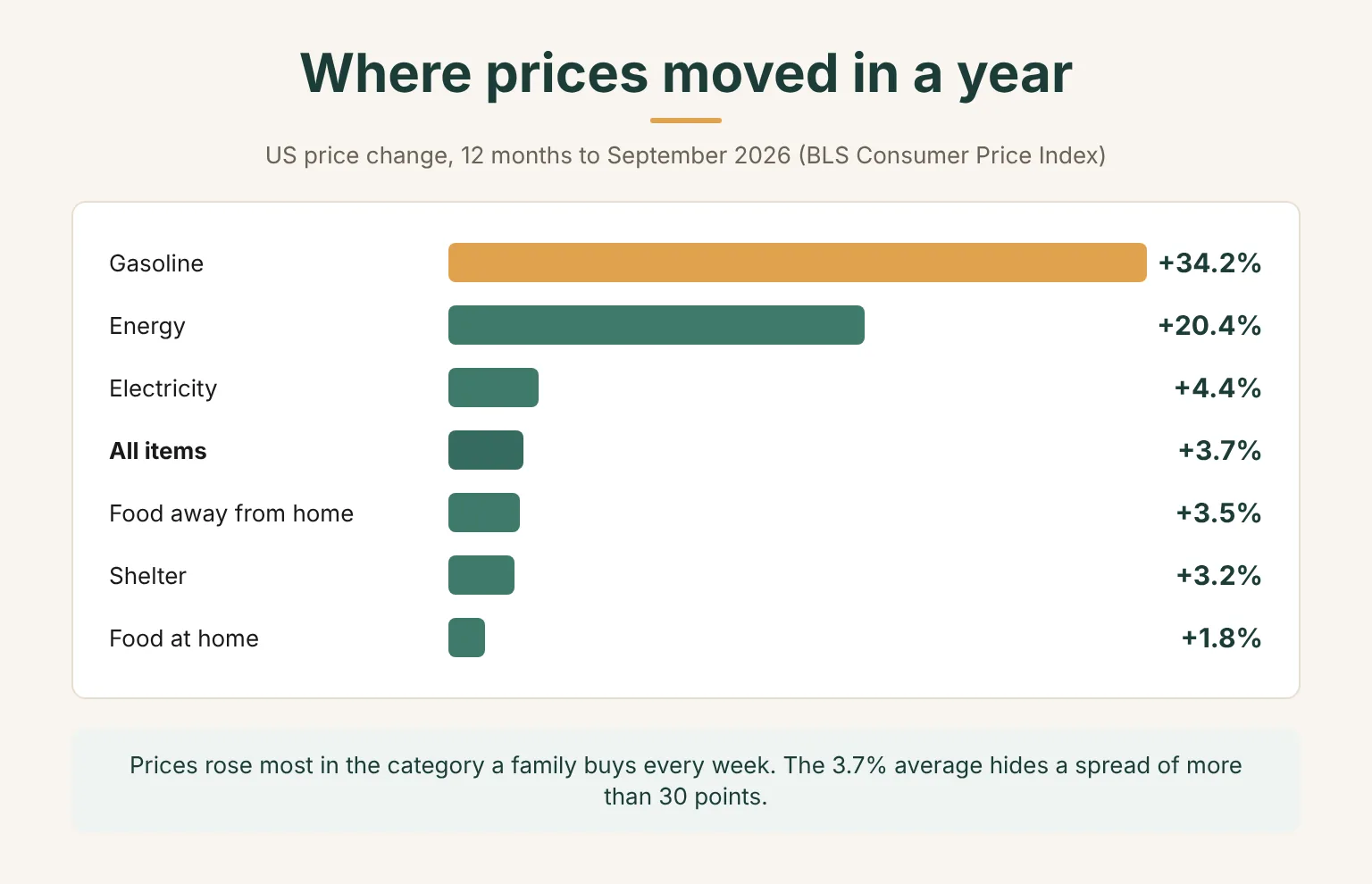
These are national averages for 12-month changes, not forecasts. Your own rise depends on how much you drive, how you heat your home and what you eat out. A few lines went the other way, so a reset is not only bad news: motor vehicle insurance was down 5.0% over the same period.
How much more does gas cost the average family?
About $856 more a year for the average US household, if it buys the same amount of fuel as in 2025. The BLS Consumer Expenditure Survey puts average 2025 spending per consumer unit (the BLS term for a household spending group) at $81,905, of which $2,503 went on gasoline and other fuels. Applying the September price rise to that figure gives a rough size of the change, as the table shows. It is an illustration, not a forecast.
| Line | Average spend in 2025 | Price change to September 2026 | Extra a year at the same quantity |
|---|---|---|---|
| Gasoline and other fuels | $2,503 | +34.2% | About $856 |
| Food at home | $6,491 | +1.8% | About $117 |
| Food away from home | $4,142 | +3.5% | About $145 |
Gasoline moves more dollars than food does. The extra $856 on fuel is larger than the extra $262 across groceries and eating out together. The same survey shows that fuel spending fell 5.4% in 2025, from $2,645 in 2024, so the average family had less fuel in its budget before this year’s jump.
The pump price shows the same pattern. The US Energy Information Administration (EIA) reported regular gasoline at $4.269 a gallon for the week of 26 October 2026, which is $1.234 above the same week a year earlier. A car that burns 40 gallons a month (a round number chosen for the example) costs about $49 more a month at that gap.
Which budget categories should you check first when prices rise?
Start with the categories that are both large and moving, and ignore the ones that are small or flat. In 2025 the average household spent 33.9% of its budget on housing, 16.5% on transportation and 13.0% on food, so those three are where a price change shows up as real money. Our guide to how much a family of four spends a month has the full breakdown by category.
- Fuel and transport. Gasoline is up 34.2% and airline fares are up 22.4%. If a holiday flight is on the calendar, price it again.
- Home energy. Electricity is up 4.4% and fuel oil is up 74.2%. A fuel oil household has a very different year from an all-electric one.
- Eating out. Food away from home rose 3.5%, almost twice the 1.8% for groceries. It is also the line a family can change fastest.
- Fixed costs. Rent, a mortgage and loan payments do not move with fuel prices, but shelter is up 3.2% and a lease renewal can reset it.
If your categories are not set up yet, the post on family budget categories covers how to keep them to eight to twelve lines, so that a price change lands in one clear place.
How do you reset a family budget in 30 minutes?
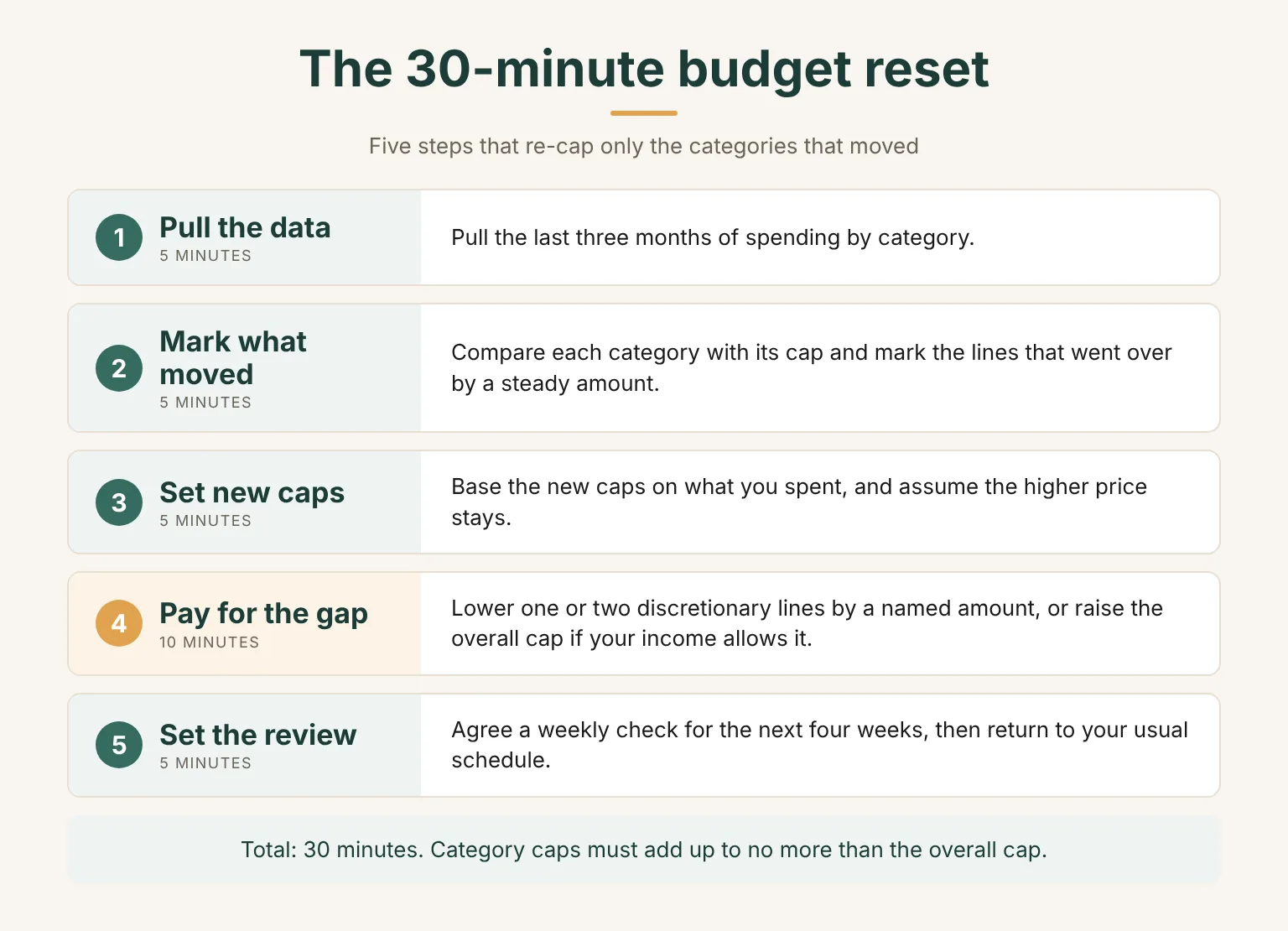
Reset only what moved. A full rebuild takes an evening and rarely survives the first busy week, while a targeted reset takes half an hour and leaves everything that still works alone. The five steps below add up to about 30 minutes, and the minutes are a guide, not a rule.
- Pull the last three months by category (5 minutes). Use what you actually spent. Three months smooths out one odd week.
- Mark the lines that moved (5 minutes). Compare each category with its cap. Mark any line that went over by a steady amount and skip the one-off big purchase.
- Set new caps for the marked lines (5 minutes). Base them on what you spent and assume the higher price stays. If prices fall, the difference is spare money.
- Pay for the gap (10 minutes). Pick one or two discretionary lines to lower by a named amount, or raise the overall cap if your income allows it. The next section compares the options.
- Set the review date (5 minutes). Agree a weekly check for the next four weeks, then go back to the usual schedule.
Should you cut spending or raise the budget when prices rise?
Cut a discretionary line first, and raise the overall cap only if your income or savings plan really allows it. A cap is a promise about the total, so when one category goes up another has to go down by the same amount, or the overall number has to move on purpose. The table compares the levers.
| Lever | Fits when | Example | Watch for |
|---|---|---|---|
| Use less of the item | The price rise is in something you can use less of | Combine errands, drop one regular trip, share a school run | Savings only count if the pump or meter total actually falls |
| Lower a discretionary line | The rise is steady and the gap is known | Take $30 from dining out and put it on the fuel cap | Pick one or two lines. Ten small cuts are hard to remember |
| Raise the overall cap | Income rose or you have room in savings | A new monthly total with fuel at its new level | It changes the whole plan, so decide it together |
| Do nothing and hope | Almost never | Leaving the old cap in place | The category goes over every month and the budget stops meaning anything |
The simplest rule is that the category caps must add up to no more than the overall cap. If they do not, the budget is promising money that is not there. Our guide to creating a shared family budget explains how one overall cap and category caps fit together.
What about fixed bills and costs that come once a year?
Fixed bills do not rise with the pump, and some of them leave room in a reset. Car insurance, for example, fell 5.0% across the US in the 12 months to September 2026, so a renewal quote may come in lower than last year’s. General information only: compare quotes at renewal, and check what each policy covers before you switch.
Costs that arrive once or twice a year need their own line, or they land on a month that has already gone over. The post on irregular family expenses and sinking funds shows how to divide each by twelve. If one of them is a flight, price it again, since airline fares are up 22.4% over the year.
What if you are a family in the UK?
The pattern is the same in the UK, with a smaller gap between fuel and food. The Office for National Statistics (ONS) reports CPI inflation of 3.5% in the 12 months to September 2026, up from 3.1% in August, with motor fuel up 29.8%. Transport made the largest upward contribution to the annual rate.
| Measure | September 2026 | Source |
|---|---|---|
| CPI annual inflation | 3.5% (3.1% in August) | ONS, 21 October 2026 |
| Motor fuel, 12 months | +29.8% (23.0% in August) | ONS, 21 October 2026 |
| Average petrol price | 169.5 pence a litre | ONS, 21 October 2026 |
| Average diesel price | 192.5 pence a litre | ONS, 21 October 2026 |
| Housing and household services, 12 months | +5.3% (4.9% in August) | ONS, 21 October 2026 |
| Food and non-alcoholic beverages | +1.3% | ONS, 21 October 2026 |
The ONS says petrol is at its highest average price since August 2022, and diesel at its highest since July 2022. The same reset applies in pounds: pull three months, find the lines that moved, and pay for the gap from one or two discretionary categories. For the UK category list, see household expenses in the UK. The next ONS release is due on 18 November 2026.
How do you explain rising prices to kids?
Show them one category and one number. A child of eight can understand that the car now costs $49 more a month to fill, and that the family is taking $30 from dining out and $19 from somewhere else to cover it. Teenagers can do more: let them propose the cut from their own clothing or going-out line and agree it before it starts.
A short regular meeting gives this a place to happen. Our guide to running a family money meeting has a 15-minute agenda with a step for what is coming and one decision, which fits a price change well.
How do you track a reset week by week without linking a bank?
Log each purchase as it happens and compare the category total with its cap once a week. That takes a place where everyone in the house writes spending down and one view of each category against its cap. A bank connection adds nothing to it.
CapKin is a shared household budgeting app where the owner sets an overall monthly cap and a cap for each category, and every member logs expenses against them by voice, text or receipt photo. A sentence such as “gas 52, groceries 84” becomes two line items that you confirm before they are saved. Children can log their own entries, which wait for a parent’s approval and do not count toward totals until then. CapKin never connects to a bank, holds no money and gives no financial advice. See the budgeting app without a bank login page for how it works, and the product facts page for what it does and does not do.
If you log item by item (“milk 3.20, bread 2”), CapKin's Sunday recap now does the price check for you: when a product you buy regularly drifts up, it says so, with the entries behind it. It works from your own entries only; there is no bank feed and no outside price data.
Sources
- US Bureau of Labor Statistics, Consumer Price Index Summary, September 2026 (14 October 2026)
- US Bureau of Labor Statistics, The Economics Daily: Prices for gasoline increased 34.2 percent over the year ended September 2026 (16 October 2026)
- US Bureau of Labor Statistics, Consumer Expenditures 2025 (29 October 2026)
- US Energy Information Administration, Gasoline and Diesel Fuel Update (week of 26 October 2026)
- Office for National Statistics, Consumer price inflation, UK: September 2026 (21 October 2026)
Frequently asked questions
- How do I adjust my family budget when prices go up?
- Pull the last three months of spending by category, mark the lines that went over their caps by a steady amount, and set new caps for those lines. Then pay for the gap by lowering one or two discretionary lines, or raise the overall cap if your income allows it. The whole reset takes about 30 minutes.
- How much more does gas cost a family in 2026?
- The average US household spent $2,503 on gasoline and other fuels in 2025 (BLS). Gasoline prices rose 34.2% in the 12 months to September 2026, so the same fuel would cost about $856 more a year, or $71 a month. Your own figure depends on how much you drive and what your car uses.
- Should I cut spending or raise my budget when prices rise?
- Cut a discretionary line first, such as dining out, and move that amount to the category that rose. Raise the overall cap only if your income or savings plan allows it, and decide it together. Category caps should add up to no more than the overall cap, or the budget promises money you do not have.
- How often should I review my budget when prices are rising?
- Weekly for about four weeks after a reset, then back to your usual schedule. A weekly check compares each category total with its cap while there is still time to change a habit. A monthly check finds an overrun after the money has already been spent.
- Which expenses should I cut first when gas prices rise?
- Start with discretionary lines you can change quickly, such as dining out and entertainment. Food away from home rose 3.5% in the 12 months to September 2026, almost twice the 1.8% for groceries. Pick one or two lines and a named amount. This is general information, not financial advice.
- How much have prices risen in the UK in 2026?
- UK CPI inflation was 3.5% in the 12 months to September 2026, up from 3.1% in August, and motor fuel was 29.8% higher (ONS, 21 October 2026). Petrol averaged 169.5 pence a litre and diesel 192.5 pence, the highest since August and July 2022 respectively.
- Can I budget without linking my bank account?
- Yes. Write each purchase down as it happens, by voice, text or receipt photo, and compare category totals with their caps once a week. CapKin works this way for a household: members log expenses, the owner sets the caps, and nothing connects to a bank or moves money.