By Artem Panasiuk · 24 October 2026 · 14 min read
Irregular Expenses: The Family Sinking Funds List and a 12-Month Calendar
The bill that breaks a family budget is almost never a monthly one.
The short version
- Irregular expenses are the costs a household pays a few times a year or less: insurance renewals, back-to-school, the holidays, camps, car repairs, the vet. They are the reason a budget can look right for two months and fail in the third.
- Six of them, at current US averages, add up to $9,869 a year: back-to-school $863.86, the holiday season $1,654, car insurance $2,638, car upkeep $1,656, home maintenance $2,041 and one child’s sport $1,016. That is about $822 a month that sits in no monthly category.
- Most of them are predictable: they land in the same month every year, and the calendar below shows where. The Federal Reserve found 63% of adults could cover a $400 unexpected expense from cash or savings in 2025.
- Sort every irregular cost into one of three kinds: dated and fixed (divide by the months until it is due), seasonal and sized (set a cap from last year’s actual), or anytime and unknown (a buffer, refilled monthly). The kind decides the method.
- Build the calendar once from the last twelve months of spending, review it twice a year, and read the next six weeks of it aloud at the monthly money meeting.
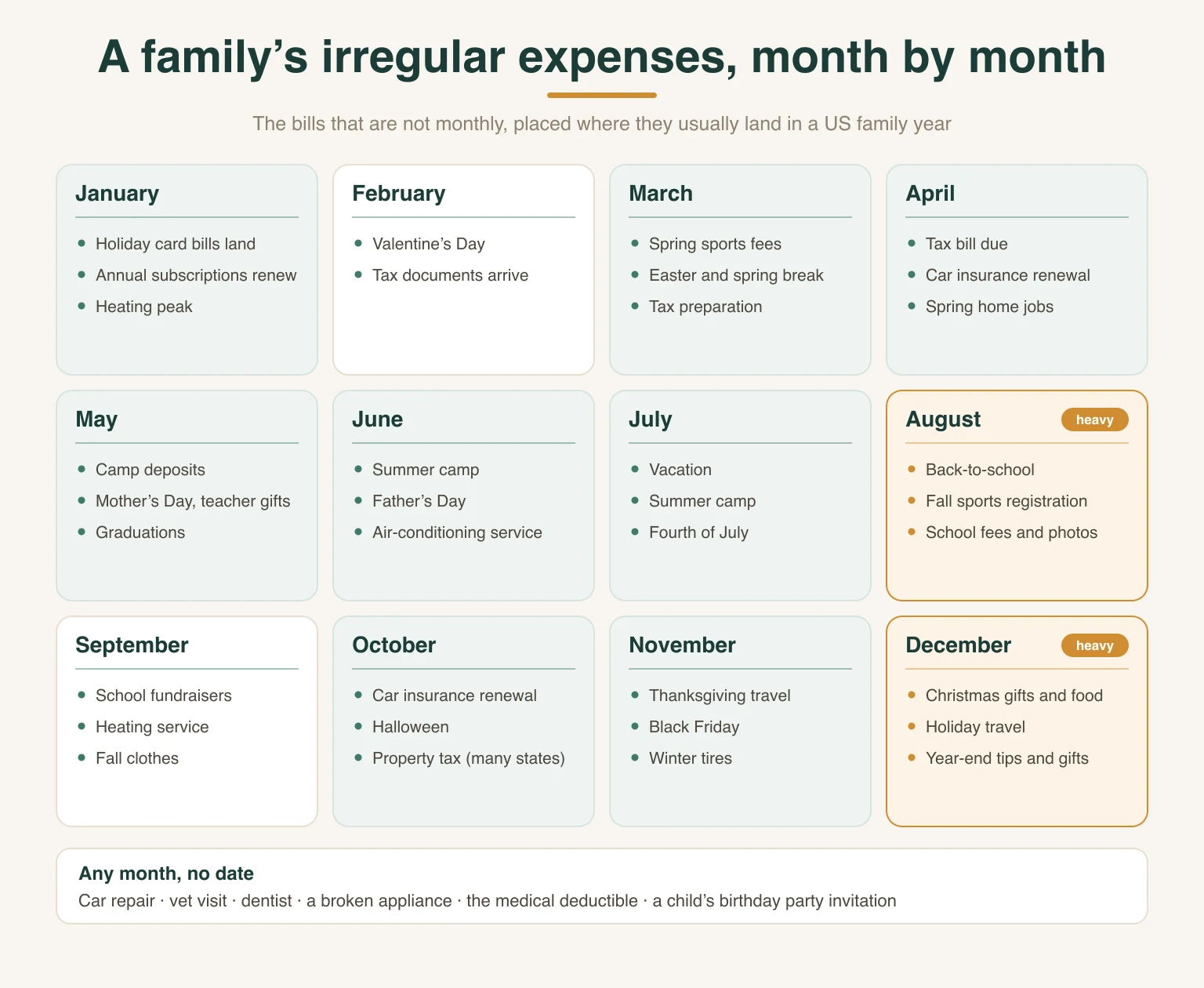
Irregular expenses are the costs a household pays a few times a year or less, in amounts that do not fit a monthly line: the car insurance renewal, back-to-school shopping, summer camp, the holidays, a set of tires, the vet. Some have a date and a known amount, some have a season and a rough size, and some have neither. What they share is that none of them appears in the month most families use to set their budget, so the budget is built without them and then meets them one at a time.
Below is the list, with the month each cost usually lands and the latest US figure for the ones that have one; the arithmetic that turns a yearly bill into a monthly line; the three kinds of irregular cost and the different method each needs; and a 20-minute routine for building your own calendar. If you want the regular monthly costs as well, they are in the monthly household expenses list, and this piece is the companion to it.
Why the irregular bill is the one that breaks the budget
A family that sets category caps from an ordinary month has budgeted for groceries, fuel, rent and the phone bill, and for nothing that happens once a year. The ordinary month then runs fine until August, when back-to-school arrives on top of it, or December, or the month the insurance renews. The household concludes that it overspent. In fact the cap never included the cost that pushed it over.
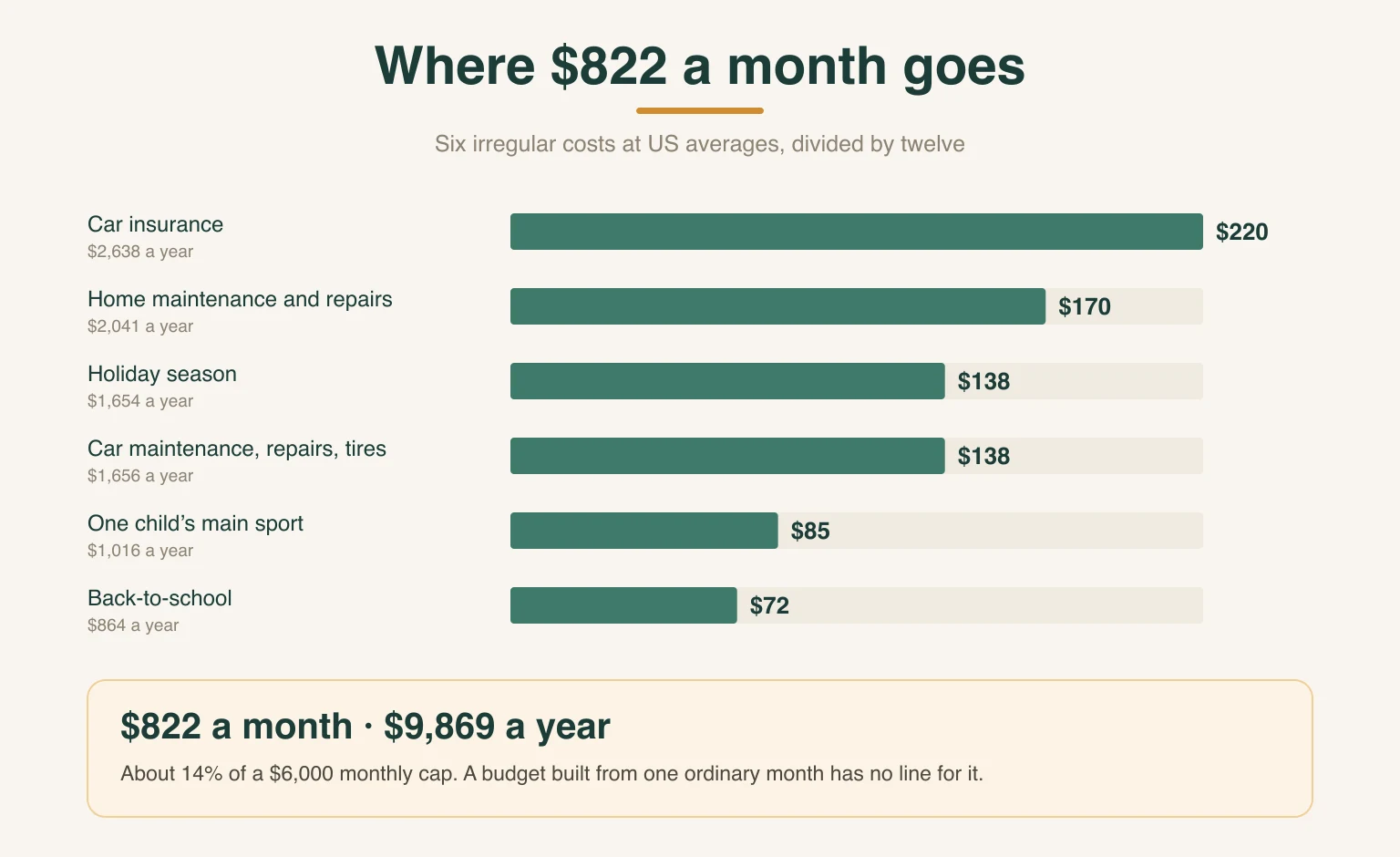
The scale is easy to underestimate. Take six irregular costs at their current US averages, listed in the table below: back-to-school at $863.86 per household, the holiday season at $1,654, car insurance at $2,638 a year, car maintenance, repairs and tires at about $1,656, home maintenance at $2,041, and one child’s main sport at $1,016. Together they come to $9,869 a year, or about $822 a month. On a $6,000 monthly cap that is roughly 14% of the budget, and a budget built from one ordinary month has no line for it.
Surveys about unexpected expenses show how little room most households keep for this. The Federal Reserve’s 2025 household survey, published in May 2026, found that 63% of US adults would cover a $400 unexpected expense with cash, savings or a card paid off at the next statement, a share unchanged for several years, while 12% said they could not pay it by any means. Bankrate’s January 2026 report put the bar at $1,000 and found only 30% would pay it from savings; 33% would borrow, on a card, from family or with a loan. Tires, a deductible, a school year and December all cost around that much, and each of them has a month.
The irregular expenses list for a family
The list below is the one most US families end up with, in the order the costs usually fall through the year. The figure column gives the latest national average where a reliable one exists and leaves the cell blank where it does not; the sources are at the end. The last column is the kind of cost, explained in the next section, which decides how to budget it.
| Expense | Usually lands | Typical US figure | Kind |
|---|---|---|---|
| Annual subscriptions and memberships | The month you signed up, often January | Varies; $65–$140 each for the common ones | 1 · Dated |
| Tax bill or tax preparation | April | Varies | 1 · Dated |
| Car insurance | Every 6 or 12 months | $2,638 a year, full coverage (Bankrate, 2025) | 1 · Dated |
| Vehicle registration | Annual, state-dependent | Varies | 1 · Dated |
| Property tax (if not escrowed) | Once or twice a year, often October to December | Varies by state | 1 · Dated |
| School fees, photos, yearbook | August to October | Varies | 1 · Dated |
| Home and renters insurance | Annual renewal | Varies | 1 · Dated |
| Spring break and Easter | March or April | Varies | 2 · Seasonal |
| Summer camp | Deposits in May, camp in June and July | Under $100 to over $1,500 a week (ACA) | 2 · Seasonal |
| Vacation | July, or the school break you take | Varies | 2 · Seasonal |
| Back-to-school | August | $863.86 per K-12 household (NRF, July 2026) | 2 · Seasonal |
| Youth sports season | Registration in March and August | $1,016 a year for one child’s main sport (Project Play) | 2 · Seasonal |
| Halloween | October | Varies | 2 · Seasonal |
| Thanksgiving travel and food | November | Varies | 2 · Seasonal |
| The holiday season | December, paid in January | $1,654 per household (Deloitte, 2026) | 2 · Seasonal |
| Birthdays, gifts, parties | Spread through the year | Varies | 2 · Seasonal |
| Seasonal clothing and shoes | Spring and autumn | Varies | 2 · Seasonal |
| Heating and cooling peaks | January and July | Varies by region | 2 · Seasonal |
| Car maintenance, repairs, tires | Any month | About $1,656 a year at 15,000 miles (AAA, 2025) | 3 · Anytime |
| Home maintenance and repairs | Any month | $2,041 a year; $1,143 of it emergency repairs (Angi, 2025) | 3 · Anytime |
| Vet visit | Any month | $200 per visit on average; $220 for dog owners (AVMA, 2025) | 3 · Anytime |
| Dentist and medical deductible | Any month | Varies by plan | 3 · Anytime |
| Appliance or phone replacement | Any month | Varies | 3 · Anytime |
Two notes on the figures. Each is a national average across very different households, so the column is for ranking and order of magnitude, and your own number is last year’s actual. And the figures with a trend have all risen recently: car insurance rose 12% in a year, home maintenance went from $1,750 to $2,041, and youth sports spending is up 46% since 2019. A calendar built from three-year-old amounts will be short.
Three kinds of irregular cost
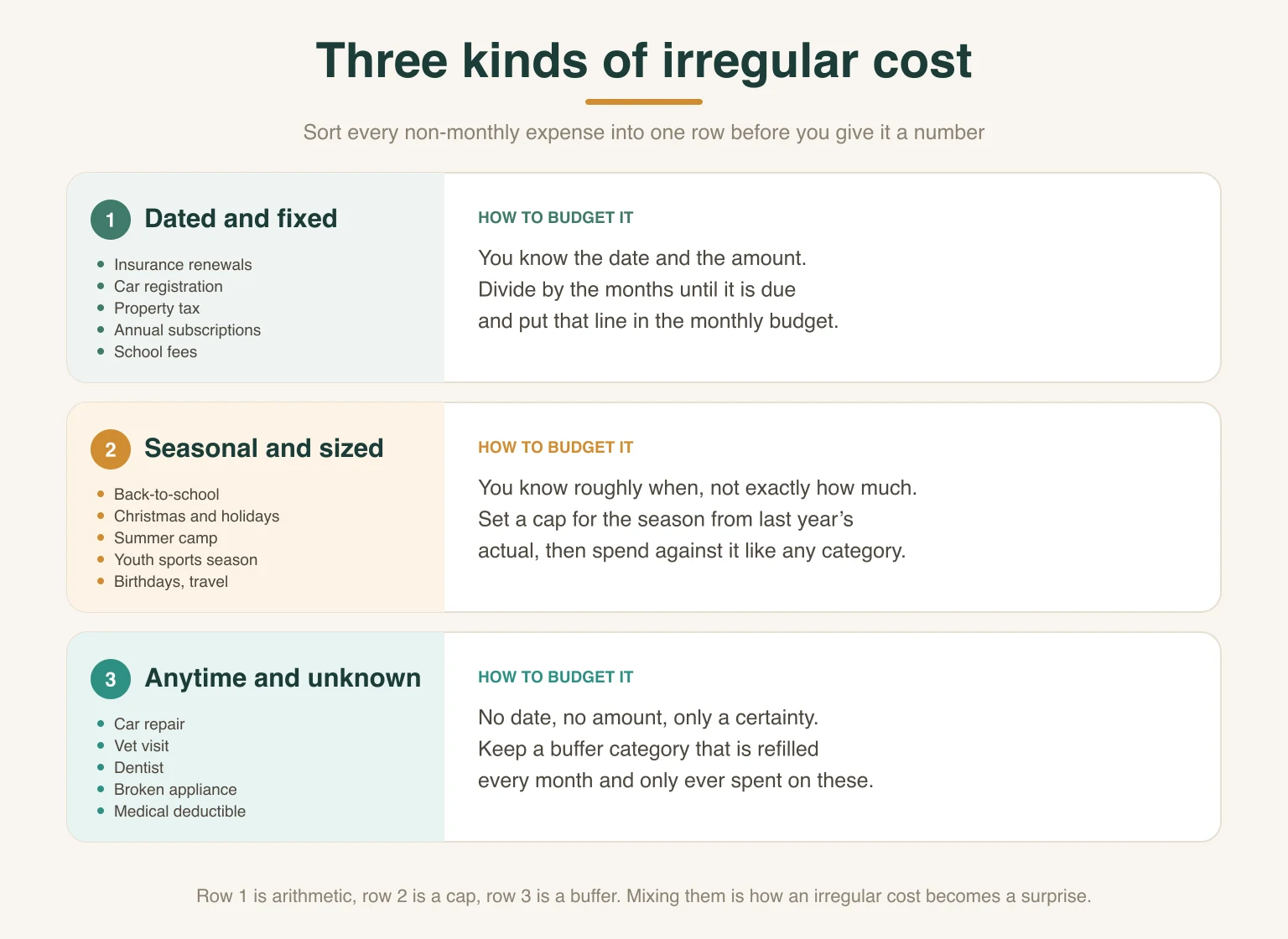
A common recommendation is a separate savings pot for every irregular cost, fed monthly. That works for some of them and fails for the rest, because the list above contains three different problems. The method has to match the kind.
- Dated and fixed. You know the date and, within a few dollars, the amount: the insurance renewal, car registration, the property tax bill, the subscription that renews on the 14th of January. These are arithmetic. Divide the amount by the months until it is due and put that line in the monthly budget.
- Seasonal and sized. You know roughly when and only roughly how much: back-to-school, the holidays, camp, a sports season, a vacation. The amount depends on decisions you have not made yet, so the tool is a cap set in advance from last year’s actual, and then the season is spent against it like any other category. Our Christmas budget guide is this method applied to the biggest seasonal cost of the year.
- Anytime and unknown. No date and no amount, only a certainty that something in the group will happen: a car repair, the vet, the dentist, the dishwasher. They share a single buffer that is refilled every month and only ever spent on this group, sized from what the group actually cost last year.
Mixing the kinds is where irregular budgeting usually goes wrong. A separate fund for the dentist means guessing an amount nobody can know, and a single “miscellaneous” line meant to cover the insurance renewal as well as the vet will be empty when the renewal lands.
The ÷12 method, and when not to divide by twelve
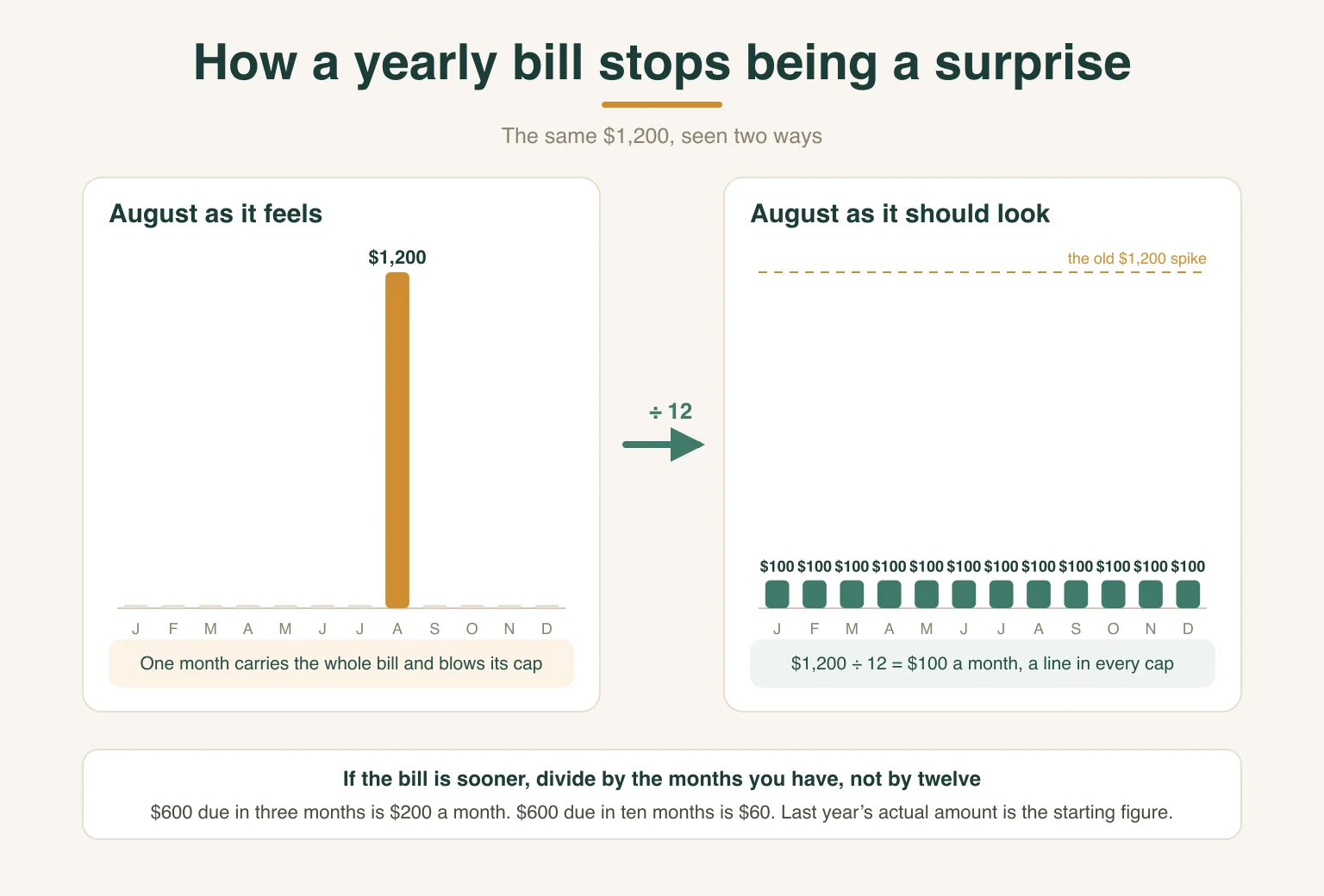
A sinking fund is money set aside a little at a time for a cost you know is coming, so the whole amount is there when the bill lands. The name comes from corporate finance, where a company retires a debt in instalments, and the household version is the same idea with smaller numbers: take the yearly amount, divide by twelve, and treat the result as a monthly bill you pay to yourself.
| Irregular cost | Yearly figure | Monthly line |
|---|---|---|
| Car insurance | $2,638 | $220 |
| Home maintenance and repairs | $2,041 | $170 |
| Holiday season | $1,654 | $138 |
| Car maintenance, repairs, tires | $1,656 | $138 |
| One child’s main sport | $1,016 | $85 |
| Back-to-school | $864 | $72 |
| Six lines together | $9,869 | $822 |
The table is the national averages divided by twelve, and the last row matters most: an average family carries around $822 a month of irregular cost. A budget with no line for it runs about $822 a month short, and the shortfall shows up as overspending.
Divide by twelve only when you have twelve months. If you are building the calendar in October and the car insurance renews in January, you have three months, and $600 due in three months is $200 a month. The workable version of the method is to divide by the months you actually have, run a heavier line until the first renewal has passed, and then drop to the twelfth. The first year of a sinking fund is always the expensive one; after that, every bill was paid for over the previous twelve months and the spike disappears from the budget for good.
Build your family’s calendar in 20 minutes
All you need is the last twelve months and a sheet of paper, a spreadsheet or the notes app. Once you have your own figures, the national ones above stop mattering.
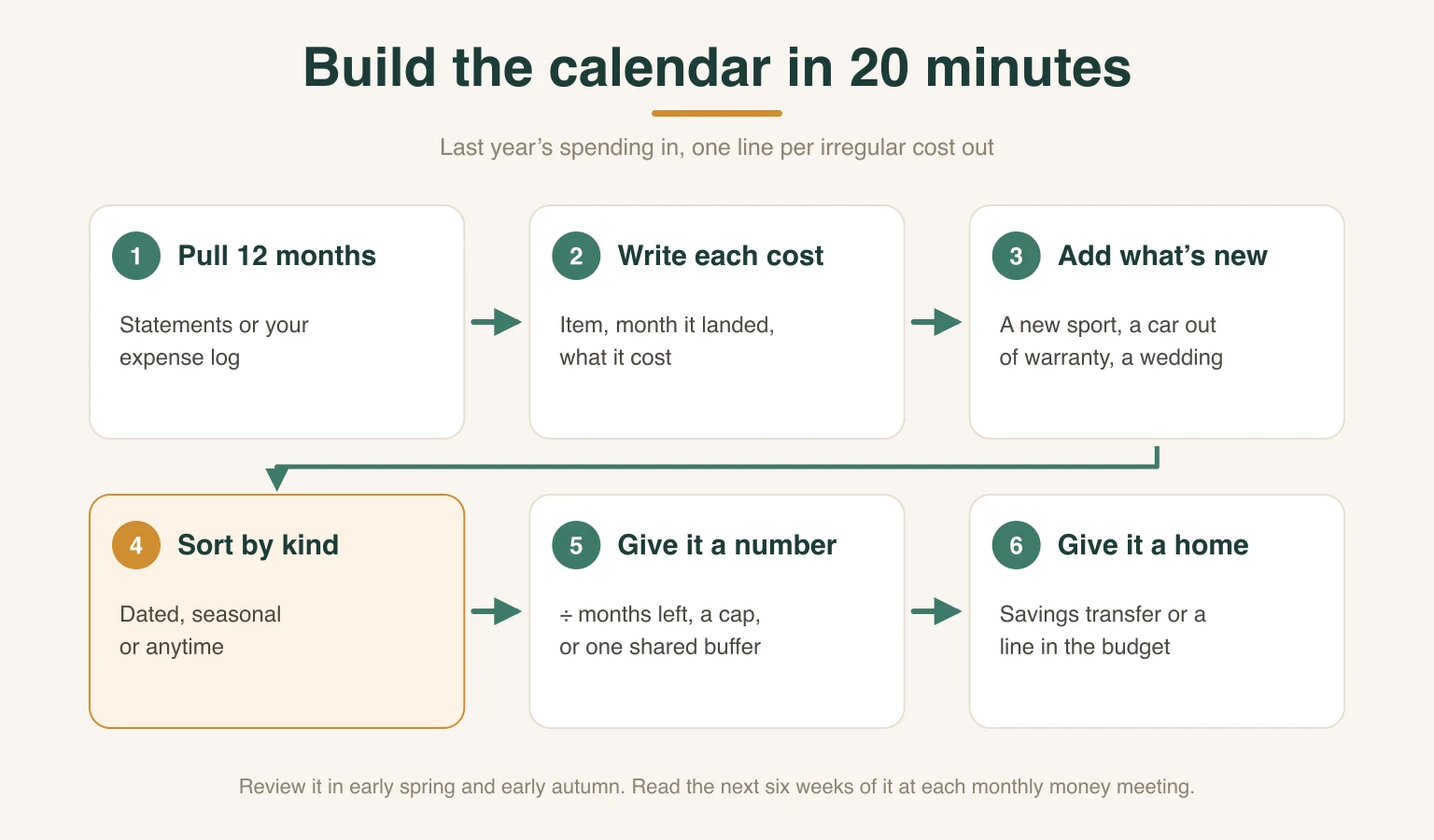
- Pull the last twelve months. Bank and card statements, or your expense log if the household keeps one. You are looking for anything that was not groceries, fuel, rent or a bill that comes every month.
- Write each one against its month. The item, the month it landed, what it cost. The first pass always misses a few; more come back to mind during the week.
- Add what is coming that last year did not have. A child starting a sport, a car that is out of warranty, a wedding you have been invited to. The calendar is for next year, and last year is only its first draft.
- Sort each item into one of the three kinds. Dated, seasonal or anytime. One word per row, and the kind decides the method in the next step.
- Give every row a number. Dated rows: the amount divided by the months until it is due. Seasonal rows: a cap, set from last year’s actual. Anytime rows: add them up into one buffer figure and divide that by twelve.
- Put the lines where the money lives. Either as monthly transfers to a savings account, or as lines inside the monthly budget, or both; the next section covers the choice. That finishes the calendar.
Review it twice a year, in early spring and early autumn, because that is when the next season’s costs become visible, and read the next six weeks of it aloud at each monthly family money meeting. The “what is coming” step of that meeting is this calendar, three minutes at a time.
Sinking funds and the emergency fund are different money
An emergency fund is for the thing you could not have planned: a job loss, a medical event, a car written off. The Federal Reserve found that 55% of adults had set aside three months of expenses in 2025, unchanged from 2024 and down from 59% in 2021. A sinking fund is for the thing you could have planned and now have. Keeping them apart matters, because an emergency fund that pays for Christmas is gone by the time the real emergency arrives, and a family with no sinking funds will keep concluding that its emergency fund is too small.
The anytime buffer from the third kind sits between the two, closer to planning money: a set of tires or a vet bill is a cost the household knows it will carry, in an amount and month it cannot predict. Fund it from last year’s total for the group, and let the emergency fund stay untouched for the things that have no last year.
Where the money actually sits
There are three places a sinking fund can live, and families argue about them more than the choice deserves.
- Separate savings pots. Some banks let you split one savings account into named buckets, and some families open several accounts. Clear, slightly fiddly, and the money is genuinely out of reach of the monthly spending, which is the point.
- One savings account and a list. A single transfer each month for the total of all the lines, and a sheet that records what the balance is for. Simpler, and it works as long as somebody keeps the sheet.
- Lines inside the monthly budget. The irregular costs appear in the month they land, as expenses against a category with a cap, and the monthly cap is set high enough that an ordinary month runs under it by about the sinking amount. This is how a shared tracking app does it, and it is the method that keeps everyone in the household looking at the same picture, because the renewal shows up in the budget on the day it is paid, where both adults see it. A savings account is usually visible to one.
A mix usually works best: a savings transfer for the big dated items, and lines in the budget for the seasonal and anytime groups. What matters is that every row on the calendar has exactly one home, and that the home is written down. The shared family budget guide covers setting the overall cap that these lines sit inside, and the family budget categories list is where the seasonal categories come from.
Where CapKin fits
CapKin is a shared household budgeting app: one overall monthly cap, category caps underneath it, and every member logging what they spent by voice or text, with no bank login. It tracks spending against caps; it does not hold or move money, so the savings transfers in the first two options above happen at your bank. What CapKin does with the calendar is the third option.
Dated costs become recurring templates with a monthly, quarterly or annual cadence. The household owner sets the amount and the start month, and the template posts the expense automatically in the month it is due, already confirmed, so the January renewal is in January’s totals without anyone remembering to enter it and shows up in the month-close recap as what it is. Seasonal costs become categories with their own caps, a Back-to-school or Holidays category that exists for the months it is needed, so the season is spent against a number. The anytime group lives in the gap between the category targets and the overall cap, which CapKin shows as a “To Be Allocated” remainder: a deliberate buffer, visible on the dashboard to everyone in the household.
When the month closes, the recap lists where the money went by category, the largest single expense, and the change from the month before, and every adult in the household reads the same page. A month with the insurance renewal in it looks heavy, and the recap says why. Bring that page to the monthly meeting, together with the next six weeks of the calendar.
Sources
- Board of Governors of the Federal Reserve System. Economic Well-Being of U.S. Households in 2025, May 2026. Survey of Household Economics and Decisionmaking, fielded October 2025: 63% would cover a $400 unexpected expense with cash, savings or a card paid off at the next statement; 12% could not pay it by any means; 55% had set aside three months of expenses.
- Bankrate. 2026 Annual Emergency Savings Report, 21 January 2026. Online survey by YouGov of 2,564 US adults, 2–8 December 2025: 30% would pay a $1,000 emergency expense from savings; 33% would go into debt; 47% have the liquidity to cover it.
- National Retail Federation and Prosper Insights & Analytics. Back-to-school survey, 14 July 2026. 7,677 consumers, fielded 1–8 July 2026, margin of error ±1.1 percentage points: $863.86 per K-12 household, up from $858.07 in 2025; electronics $293.11, clothing $250.29, shoes $174.01, supplies $146.45; $43.3 billion in total.
- Deloitte. 2026 Holiday Retail Survey, October 2026: $1,654 per household for the season. National Retail Federation and Prosper Insights & Analytics, October 2025: $890.49 per person, of which $627.93 on gifts.
- Bankrate. National Average Cost of Car Insurance Reaches $2,638, 10 February 2025: full coverage $2,638 a year, up 12% from $2,349 in 2024.
- AAA. Your Driving Costs 2025, September 2025: $11,577 a year to own and operate a new vehicle at 15,000 miles; maintenance, repair and tires 11.04 cents per mile, about $1,656 a year. AAA’s September 2026 edition puts total ownership at $12,863 and notes that methodology changes make it not comparable with 2025.
- Angi. State of Home Spending 2025, January 2026: home maintenance $2,041 per household, up from $1,750 in 2024; emergency repairs $1,143, up from $978; total home project spending $12,472.
- Aspen Institute Project Play. Parent survey with Utah State University and Louisiana Tech University, 24 February 2025: $1,016 spent on one child’s primary sport in 2024, up 46% since 2019, plus $475 on the same child’s other sports.
- American Camp Association. How to Afford Camp: fees at ACA-accredited day and overnight camps range from under $100 to more than $1,500 a week.
- American Veterinary Medical Association. 2025 Pet Ownership and Demographics Sourcebook: average cost of the most recent veterinary visit $200 in 2025, up from $147 in 2024; $220 for dog owners, $202 for cat owners.
Frequently asked questions
- What are irregular expenses?
- Costs a household pays a few times a year or less and that do not fit a monthly line: insurance renewals, car registration, property tax, back-to-school, the holidays, camp, a sports season, car repairs, the vet, the dentist. They are predictable in the year even when they are absent from the month, which is why a budget built from one ordinary month leaves them out.
- What is a sinking fund?
- Money set aside a little at a time for a cost you know is coming, so the full amount is there when the bill lands. The household version is the yearly figure divided by twelve and treated as a monthly bill you pay to yourself. If the bill is due sooner, divide by the months you actually have.
- How many sinking funds should a family have?
- Fewer than the long lists suggest. Give each dated cost its own line because the arithmetic is exact, give each season one cap, and put all the anytime costs such as car repairs, the vet and the dentist into a single buffer. Keep the list short enough that someone actually maintains it.
- How much should a family set aside each month for irregular expenses?
- Your own last twelve months, divided by twelve. As a benchmark, six common US costs at current averages, back-to-school, the holiday season, car insurance, car upkeep, home maintenance and one child’s sport, add up to $9,869 a year, or about $822 a month, before anything specific to your household.
- What is the difference between a sinking fund and an emergency fund?
- A sinking fund is for a cost you can see coming, even if you do not know the exact amount: the renewal, the school year, the tires. An emergency fund is for the thing you could not plan, such as a job loss or a medical event. Keeping them apart stops the holidays from draining the emergency fund, and stops a family from thinking it needs a bigger emergency fund when what it lacks is a calendar.
- Where should sinking funds be kept?
- In separate savings buckets, in one savings account with a list of what the balance is for, or as lines inside the monthly budget that run under their cap in ordinary months. A practical mix is a savings transfer for the big dated items and budget lines for the seasonal and anytime groups. The rule is that every irregular cost has exactly one written-down home.
- How do I find my family’s irregular expenses?
- Go through the last twelve months of statements or your expense log and write down everything that was not a monthly bill, with the month it landed and what it cost. Add anything next year has that last year did not. Sort each into dated, seasonal or anytime, and the method for each follows.