Watch it with your child: a penny vs a million
 5:45
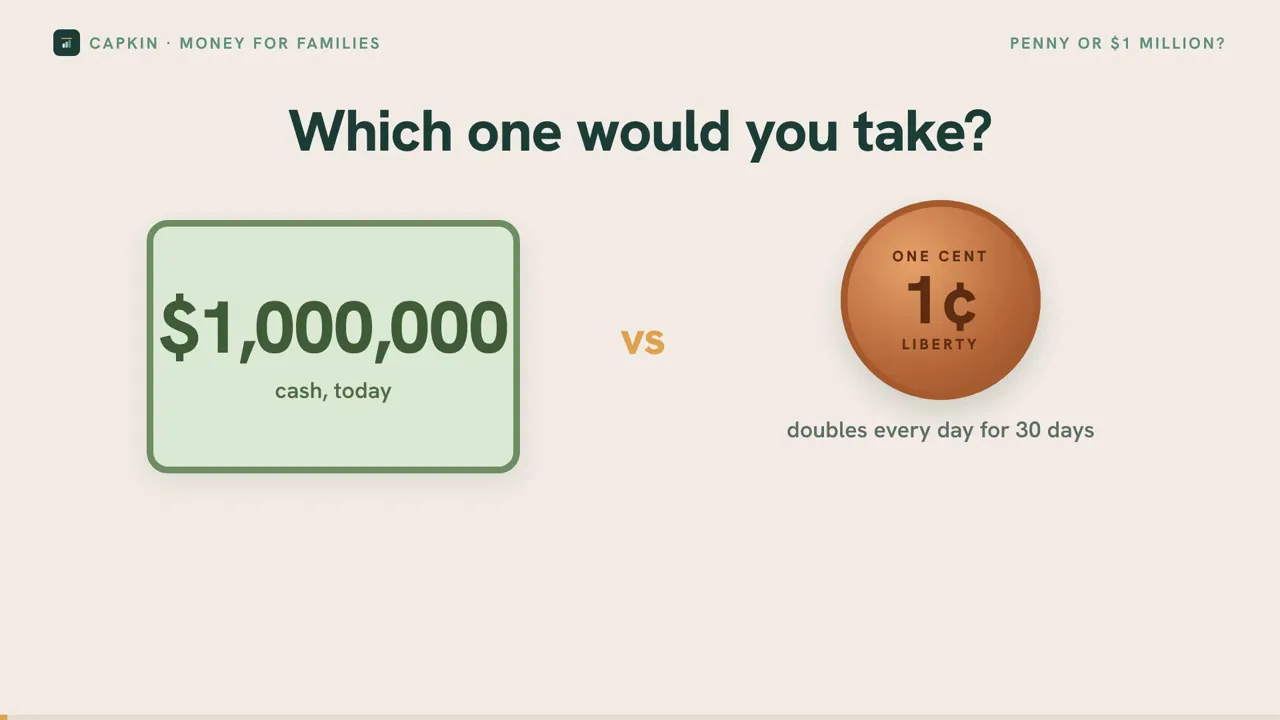
A million dollars today, or a penny that doubles every day for 30 days? Ask your kid before you press play.
A penny that beats a million
Ask a child: a million dollars today, or one penny that doubles every day for 30 days? Most adults take the million, and so do most kids. On day 10 the penny is $5.12. On day 20 it’s $5,242.88, and the million still looks like the right call. On day 30 it’s $5,368,709.12, and half of it arrives on the very last day.
That is exponential growth: every day the penny adds an amount equal to everything it already has. We count it day by day in our six-minute video, Penny vs a million, with three ways to explain it to a child at home.
Compound interest is the penny in slow motion
Real money doesn’t double every day. When savings earn interest and that interest earns interest too, they grow by the same rule, only much more slowly. For years it looks like nothing is happening, and then the later years do most of the work. That is why the age you start matters more than the amount.
Start early: one family example
- A dollar a day from birth: at 7% a year that is $6,570 saved by 18, and it grows to about $13,101.
- From birth to 18: $50 a month at 7% a year is $10,800 saved, and it grows to about $21,536.
- Left alone until 65: the same savings, with nothing added after 18, come to about $572,590.
- Starting at 18 instead: someone who saves the same $50 a month from 18 to 65 puts in $28,200 and ends with about $219,321.
The early saver puts in less and ends with more than twice as much. The only difference is when they started.
The rule of 72
Divide 72 by the yearly rate to get roughly how many years it takes money to double. At 7% that is about ten years, so $100 becomes about $200 in ten years, $400 in twenty and $800 in thirty: slow, slow, then big.
| Rate a year | Doubles in about |
|---|---|
| 2% | 36 years |
| 3% | 24 years |
| 4% | 18 years |
| 5% | 14.4 years |
| 6% | 12 years |
| 7% | 10.3 years |
| 8% | 9 years |
| 10% | 7.2 years |
Is 7% realistic?
Seven percent is a round number for long-term investing, used to keep the maths simple. Investments go up and down, some years they lose money, and nobody can promise a rate. A savings account pays less and doesn’t fall. The calculator starts at 7% so it matches the video; change the rate to see a careful case next to a hopeful one.
Where to keep a child’s savings
The maths is the same for any account; what changes is the rate, the risk and the rules. The usual homes for a child’s savings:
- Savings account (US and UK): pays interest and can’t fall, but usually less than the 7% used here.
- Trump Account (US): an account in the child’s name, open for contributions since 4 July 2026. US citizens born from 2025 to 2028 can get a one-time $1,000 from the government, elected on IRS Form 4547. The money is invested in US stock index funds and locked until 18. Our guide: what is a Trump Account.
- 529 plan (US): invested, and the growth is tax-free when it is spent on qualified education costs.
- Junior ISA (UK): tax-free, up to £9,000 a year, in cash or in stocks and shares, and locked until 18.
This is general information, not financial advice: check the rules and fees before you choose.
Three ways to explain it tonight
- Play the doubling game. One grain of rice in a bowl on Monday, two on Tuesday, four on Wednesday. Keep going for a week or two; kids remember the day the bowl suddenly fills up.
- Pay interest yourself. When your child saves a dollar, add ten cents at the end of the week. A parent match shows money growing faster than any bank.
- Ask the penny question. Then show them day 30 and let them be surprised. A lesson they work out on their own sticks.
To see what saving part of a weekly allowance adds up to, try the allowance calculator by age. For the habits behind it, read how to teach kids to save money and see CapKin for kids.
Your plan takes 18 years. Your child can watch the same thing happen in 4 weeks.
Set a savings goal in CapKin and lock it. Each week, add 10% of what they saved as a pocket-money top-up, and let them see the goal grow faster than they fill it.
Frequently asked questions
- How do you explain compound interest to a kid?
- Start with the doubling penny: one cent that doubles every day for 30 days ends at more than five million dollars. Then say that savings grow the same way, only slower: the interest earns interest too. A parent match, such as ten cents for every dollar saved, lets a young child see it happen.
- How much will $50 a month be worth when my child turns 18?
- From birth, at 7% a year compounded monthly, about $21,536: $10,800 saved and $10,736 interest. Starting at age 5 instead gives about $12,667. Rates are not guaranteed.
- What is the rule of 72?
- A shortcut for how long money takes to double: divide 72 by the yearly rate. At 7% that is about 10 years; at 4%, about 18.
- Would you take a million dollars or a penny doubled every day for 30 days?
- The penny. On day 30 it is worth $5,368,709.12, and on day 28 it passes a million for the first time. Until day 20 it is only $5,242.88, which is why most people pick the million.
- Is 7% a realistic rate?
- It is a round number for long-term investing, not a promise. Investments rise and fall and can lose money in a given year; savings accounts pay less but don’t fall. Try a lower rate in the calculator to see both.
- When should I start saving for my child?
- As early as you can. With compound interest the first years do the most work, so starting 5 years later with the same amount ends with noticeably less, even though you only skipped a few years of saving.
- Does the calculator include inflation and tax?
- No. It shows what the savings grow to in today’s numbers, before tax and before prices rise. Use it to compare plans, not as a forecast.
How we calculate this
Monthly saving until 18, compounded monthly at the rate you choose, then left to grow until the age you pick. An illustration of compound interest, not a forecast: inflation, tax and changing rates are not included.
Full methodology and sources
- Saving: the regular saving is added at the end of each month from your child’s age now until they turn 18. A daily amount counts as 365 days ÷ 12 a month, a weekly one as 52 weeks ÷ 12. A starting amount, if you add one, goes in today.
- Gifts and raises: a yearly gift is paid in on each birthday until 18. A yearly raise lifts the regular saving by that percentage once a year.
- Interest: the yearly rate ÷ 12 is added every month, on everything saved so far and on the interest already earned.
- After 18: nothing more is added. If you pick a later age, the balance keeps growing at the same rate until then.
- Starting later: the same plan started the number of years you pick (5 to begin with, and never so late that there is less than a year of saving), with the starting amount paid in then. “+$10 a month” reruns your plan with $10 more each month.
- Rule of 72: 72 ÷ the yearly rate, rounded to one decimal. It is a shortcut, most accurate for rates around 6% to 10%.
- Not included: inflation, tax, fees, and rates that change from year to year. Investments can fall.
Privacy. We never ask for a child’s name. The link and the email carry the age, the amounts and the rate you chose, nothing else.