By Artem Panasiuk · 23 October 2026 · 15 min read
How to Run a Family Money Meeting: A 15-Minute Agenda That Includes the Kids
Fifteen minutes, the same numbers for everyone, one decision. Then stop.
The short version
- A family money meeting is a short, scheduled conversation in which everyone who spends the household’s money looks at the same numbers, agrees on one change for the month ahead, and stops.
- Most families never hold one: 49% of couples avoid money conversations to prevent arguments (Fidelity, 2026) and 57% of parents are at least somewhat reluctant to talk to their kids about money (T. Rowe Price). The scheduled meeting replaces the surprise money talk, which is where the arguments happen.
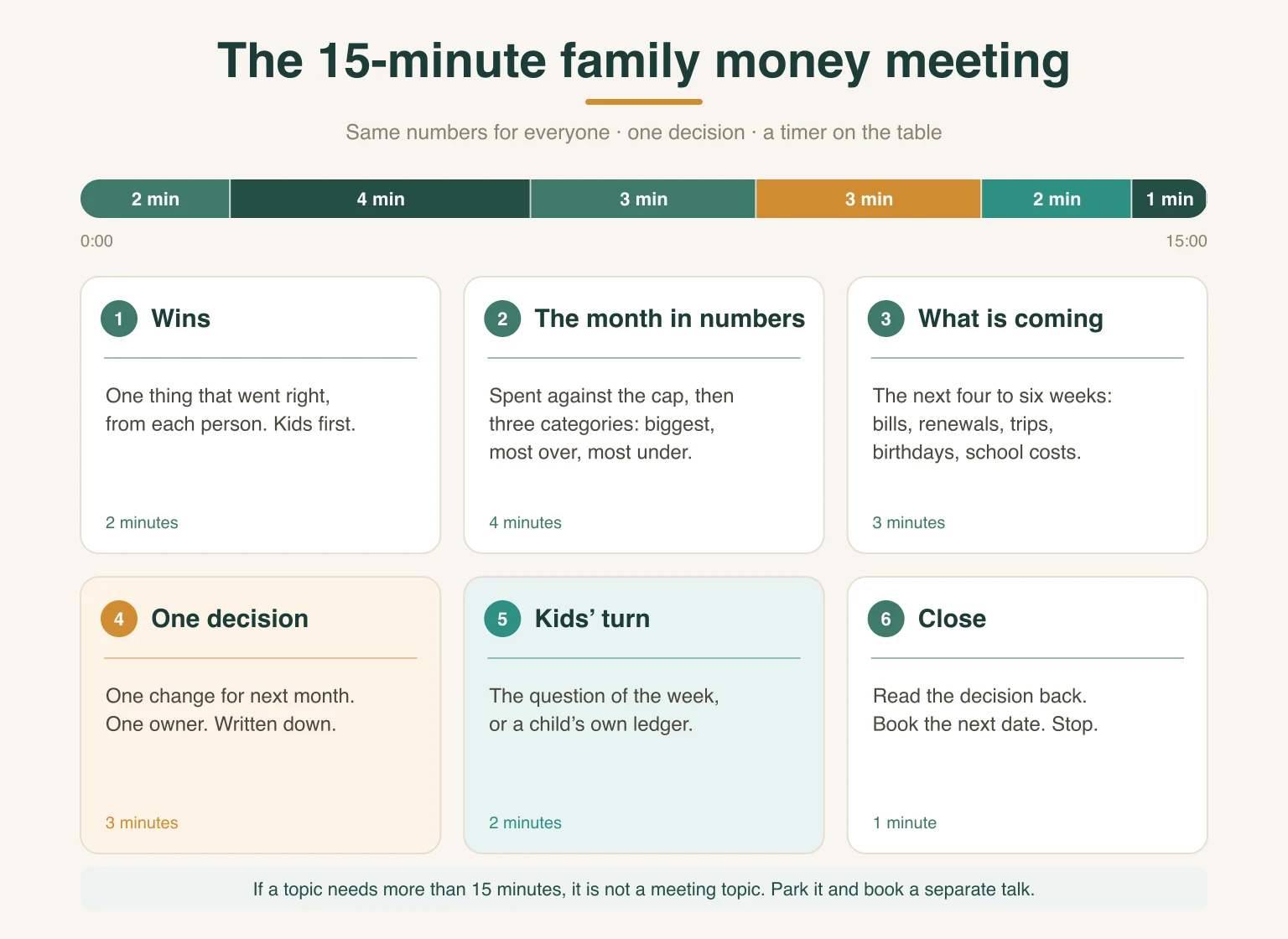
- The agenda fits in 15 minutes: wins (2), the month in numbers (4), what is coming (3), one decision (3), kids’ turn (2), close (1). Anything that needs longer is not a meeting topic.
- Children get a job that grows with them: a guest at 5–7, a reporter on their own pocket money at 8–12, the owner of one real category at 13–17. They hear the household total, never the salary or the debt.
- The meeting only works if it sits inside a loop: log as you go, close the month on one page, hold the meeting, turn the decision into next month’s cap. A meeting with no numbers in front of it is a lecture.
A family money meeting is a short, scheduled conversation in which everyone who spends the household’s money looks at the same numbers, agrees on one change for the month ahead, and stops. It is the one time each month when the household’s money gets discussed on purpose.
Families already talk about money constantly, at the worst possible moments: in the car when the card is declined, at the checkout when a child asks for something, at eleven at night when a renewal email arrives. Those are the conversations that turn into arguments, and a scheduled meeting is there to replace them.
This guide gives you a 15-minute agenda, a role for every age from five upwards, a five-minute preparation routine, a script for the first meeting, and the loop that keeps the meeting attached to real numbers. If you have a shared family budget already, the meeting is what turns it from a spreadsheet into a habit. If you do not, the meeting is a good reason to start one.
Why most families never hold one
Because talking about money is uncomfortable, and nobody schedules discomfort. In Fidelity’s 2026 Couples & Money study of 3,193 partnered US adults, 49% said they avoid money conversations to prevent arguments, fewer than a third regularly talk about day-to-day finances, and almost one in four admitted to hiding a financial secret from their partner. Half said they wish they talked more about day-to-day money, so the people avoiding the conversation are largely the same people who want more of it.
The CFP Board’s October 2026 report put money ahead of health, work and intimacy as the top stressor in American relationships: 65% of married or cohabiting adults named it, 46% called it the most uncomfortable subject to raise with a partner, and 41% had made a major financial decision in the past year without telling their partner. At the same time, 66% of those couples said they discuss affordability at least weekly. There is plenty of money talk in these households. What is missing is money talk that anyone planned.
With children, the gap is wider. In T. Rowe Price’s Parents, Kids & Money survey, 57% of parents said they were at least somewhat reluctant to talk to their kids about money, and a YouGov survey of 1,028 US parents for Greenlight in October 2025 found only 15% talk about money with their child weekly. That matters because, as LeBaron and Kelley’s review of a decade of research concludes, parents are the primary source of children’s financial learning, and explicit parent-child discussion of money is linked to better financial knowledge, attitudes and behaviour, including a habit of planning and written goals in adulthood. The same review notes that this works best when the parent-child relationship is warm and trusting, which is one more argument for a calm, scheduled meeting over a checkout-aisle confrontation. The wider numbers are in our kids and money statistics round-up.
A money meeting makes the uncomfortable conversation boring: same day, same length, same agenda, same numbers. Boring is the goal, because a meeting nobody dreads is one that keeps happening.
What a family money meeting is not
Most meetings fail because they try to be something else. Before the agenda, it helps to rule four things out.
- Not a budget-building session. Setting categories, caps and recurring costs is a one-off job that takes an evening. Do it once, outside the meeting; the family budget categories list is a good starting point. The meeting then adjusts one number a month, not the whole structure.
- Not a line-by-line review. Reading out every transaction turns the meeting into a trial, with one person as prosecutor. You look at totals against caps, and at most three categories.
- Not a lecture for the kids. Children attend to take part, not to be taught. If the only thing a child does is listen, they will stop coming, and they will be right to.
- Not the place for the big topics. Restructuring debt, a career change, moving house, whether to sell the car: these need an hour and no children in the room. Park them, write them down, and book a separate conversation. The meeting is for the month ahead.
The 15-minute agenda
Fifteen minutes is deliberate. Nobody can reasonably refuse a quarter of an hour, a seven-year-old can sit through part of it, and there is no room in it to wander. Put a timer on the table and let it run.
| Minutes | Step | What happens | Who speaks |
|---|---|---|---|
| 0–2 | Wins | One thing that went right with money this month, from each person. Kids first. | Everyone |
| 2–6 | The month in numbers | Total spent against the cap. Then three categories: the biggest, the most over, the most under. | The chair |
| 6–9 | What is coming | The next four to six weeks: bills, renewals, trips, birthdays, school costs, anything that is not a normal month. | The other adult |
| 9–12 | One decision | One change for next month. One owner. Written down. | Adults, teens |
| 12–14 | Kids’ turn | The question of the week, or a child’s own pocket money report. | Kids |
| 14–15 | Close | Read the decision back. Book the next date. Stop. | The chair |
Minutes 0–2: wins
Start with one thing that went right. Groceries came in under the cap. Somebody cancelled a subscription. A child saved for three weeks and bought the thing. Wins first because the rest of the meeting is numbers, and numbers without a good opening feel like a reckoning. Kids go first because they are the most likely to drift, and because a child who has just been listened to will tolerate four minutes of adult arithmetic.
Minutes 2–6: the month in numbers
One person reads the month. First the headline: how much the household spent against its overall cap. Then exactly three categories: the biggest, the one most over its target, and the one most under. Three is enough to see the month’s shape and too few to start a fight about anyone’s coffee.
The rule that keeps this step safe is that nobody presents the other person’s spending. The chair reads totals by category. If one adult logged most of the groceries, it is because they do most of the shopping. If you track spending in an app that gives you a month summary, this step is reading it aloud. If you do not, you need the four numbers covered in the preparation section below.
Minutes 6–9: what is coming
The second adult looks four to six weeks ahead and names everything that makes next month different from a normal one: the car insurance renewal, the school trip, a birthday, a wedding, the dentist, the quarter’s water bill. Most blown budgets come from an ordinary month colliding with a predictable expense everyone forgot, and naming it in October is how it stops being a surprise in November. Seasonal spikes deserve their own line; how much a family should spend on Christmas is the obvious one.
Minutes 9–12: one decision
This is the step that makes the meeting worth having, and the one most families skip. Looking at the month and the month ahead, you agree on one change. Raise the groceries target by 50 because it has been over for three months running. Add a line for the school trip. Move the streaming services into one category so you can see what they add up to. Give the teenager the clothes budget to run.
One decision, with one owner who will actually make the change in the budget, written down so that next month’s wins step can begin with whether it worked. A meeting that ends in general agreement that “we should spend less” has decided nothing.
Minutes 12–14: kids’ turn
Two minutes that belong to the children. For younger ones, a single money question that the adults answer too: what would you do with ten dollars right now, what is the best thing money cannot buy, what was the first thing you ever bought with your own money. For older ones, a short report on their own pocket money: what came in, what went out, what is left, how the savings goal is going. The allowance by age guide covers what those numbers usually look like.
Minutes 14–15: close
The chair reads the decision back in one sentence, names the owner, and says the date of the next meeting. Then the meeting is over. Ending on time every month is what makes people willing to come to the next one.
Who does what: roles by age
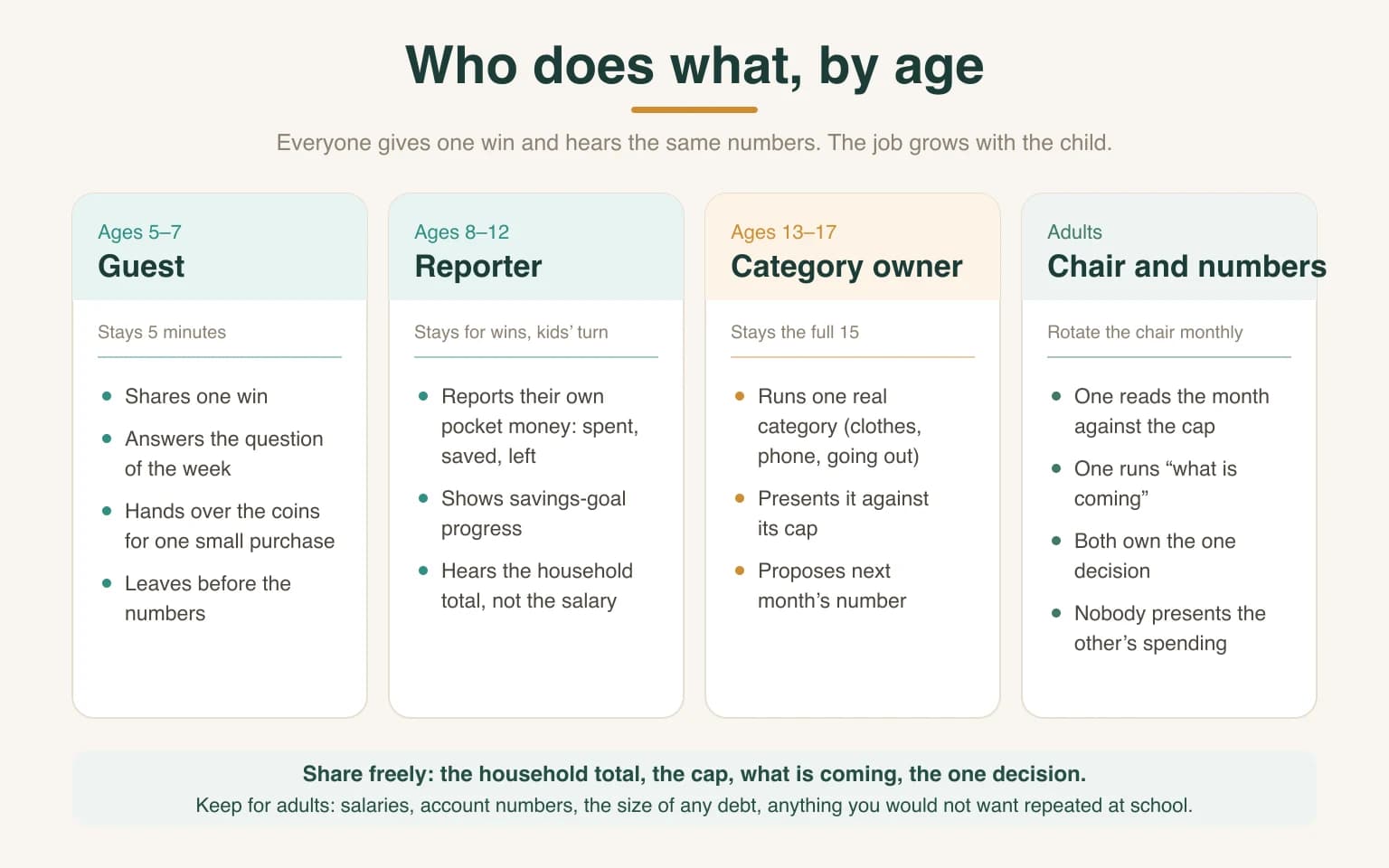
The usual question is whether children should attend at all, and the answer depends on what they are asked to do there. A child with a job stays engaged; a child in the audience does not. The jobs below grow with the child, and they line up with the age bands in our guide to when to teach kids about money.
- Ages 5–7: the guest. Joins for the first five minutes. Shares a win, answers the question of the week, and, if there is a small purchase coming up, is the one who will hand over the cash for it. Leaves before the numbers; the concepts are not there yet, and the meeting should not be the thing that makes them dread money.
- Ages 8–12: the reporter. Stays for wins and kids’ turn, and reports on their own pocket money: spent, saved, left, and where the savings goal stands. A pocket money tracker turns the report into a glance at a screen. They hear the household total and the cap. They do not hear the salary.
- Ages 13–17: the category owner. Stays the full fifteen minutes and runs one real household category: clothes, their phone, going out. They present it against its cap in the numbers step and propose next month’s figure in the decision step. Running one real category for a year is the best practice a teenager can get before leaving home, and it is what a budget app for teens is for. The wider plan is in how to teach a teenager about money.
- Adults: chair and numbers. One adult reads the month, the other runs what is coming, and both own the decision. Rotate the chair monthly so the meeting never belongs to one person. The rule that protects the relationship is simple: nobody presents the other adult’s spending.
| Share freely with the kids | Keep for the adults |
|---|---|
| The household total for the month | Salaries and what each adult earns |
| The overall cap and whether you came in under it | Account numbers and passwords |
| What is coming next month | The size of any debt |
| The one decision | Anything you would not want repeated at school |
“We have less to spend this month, so we are being careful” is a complete and honest sentence for a child. “Dad’s hours were cut and we are 400 short” is not a child’s burden to carry.
Prepare in five minutes, not an evening
The meeting dies if preparing for it takes longer than holding it. You need four things in front of you, and nothing else.
- Last month’s total spend against the overall cap.
- The category list with spend against each target, so you can pick the biggest, the most over and the most under.
- A list of what is coming in the next four to six weeks. The monthly household expenses list is a useful prompt for the irregular items people forget.
- Last month’s decision, so you can start with whether it worked.
If you keep a spreadsheet, the first two take ten minutes of totting up and usually a short argument about a missing receipt. If every member logs their spending as it happens in a shared app, the first two already exist and the preparation is opening the summary. That difference, more than any agenda, is what decides whether the meeting survives past month three.
The month-close loop
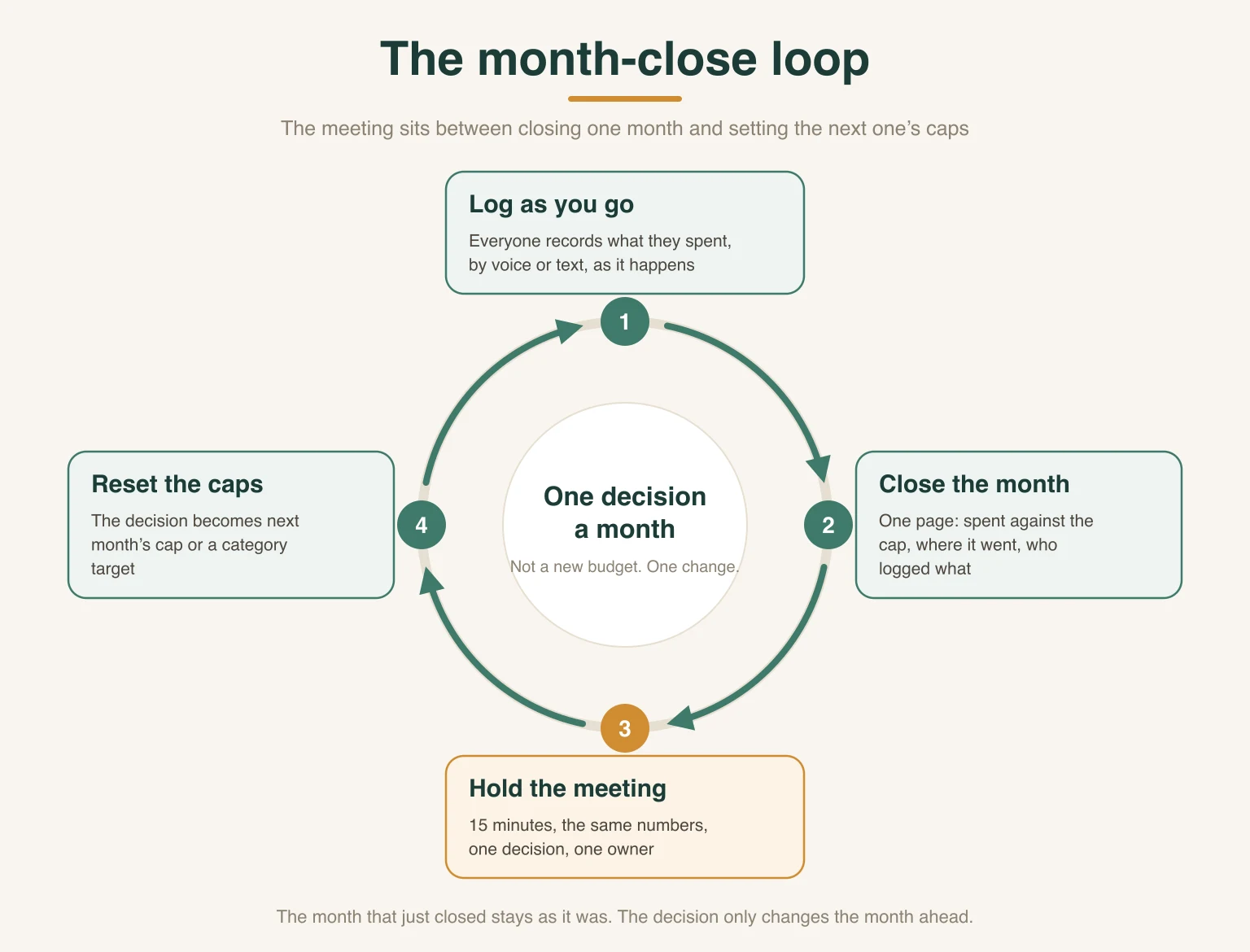
On its own, the meeting is a conversation; what makes it work is the loop around it. The loop has four steps, and the meeting is the third.
- Log as you go. Every member records what they spent when they spend it, in seconds, by voice or text. No month-end reconstruction from bank statements, and no need to link a bank account to get the numbers.
- Close the month. On the first days of the new month, one person checks the list for anything forgotten and closes it. The result is one page: spent against the cap, where it went by category, who logged what, the largest single expense, and how it compares with the month before.
- Hold the meeting. Fifteen minutes with that page in front of everyone. One decision.
- Reset the caps. The decision becomes next month’s overall cap or a category target, entered by its owner. The closed month stays exactly as it was; the decision only changes the month ahead.
The loop is what stops the meeting drifting into opinion. Without the closed month, step two is somebody’s memory of how the month went, and memories of money are reliably wrong in the direction of whoever is talking. Without step four, the decision is a good intention that nobody enters anywhere, and next month’s meeting starts from the same place as this one.
When the meeting goes wrong
When a family money meeting fails, it is usually in one of five ways. Each has a fix, and most of the fixes are shorter than the problem.
- It becomes a trial. One adult reads the other’s purchases aloud. Fix: totals by category only, and rotate the chair so the same adult is not always the one with the numbers.
- It runs long. Forty minutes in, everyone is tired and the children left half an hour ago. Fix: the timer. When it goes off, the meeting ends mid-sentence if necessary. Whatever was not reached goes first next month.
- Nothing is decided. The month was discussed, people nodded, and nothing changed. Fix: the decision step is mandatory, and “keep everything as it is” counts as a decision only if someone says it out loud and it is written down.
- The kids are an audience. They sat through it once and will not sit through it again. Fix: a job, from the age-by-age list above, and the right to leave when their part is done.
- A bad month cancels it. The cap was blown, nobody wants to look, so the meeting is skipped. Fix: hold it anyway, in ten minutes. The bad month is the one the meeting exists for. Keep the wins step, read the headline number once without commentary, make one decision, close.
The first meeting: a script
The first one is shorter than the rest, because there is no previous decision to review and the numbers may be rough. Aim for ten minutes, and use these words or something like them.
- “We are going to try a short money meeting once a month. Fifteen minutes, with a timer. Today is the first one, so it is shorter.”
- “One thing that went right with money this month. Kids first.” Go round the table. Do not comment on the answers.
- “Here is what we spent last month, and here is what we said we would spend.” One number against one number. If you do not have a cap yet, say the total and stop.
- “Here is what is coming next month that is not normal.” Two or three items.
- “One thing we will change for next month.” If you have no cap, the first decision is to set one; the shared family budget guide walks through choosing it. If you have one, pick the one category that needs a different number.
- “Question of the week: if someone handed you ten dollars right now, what would you do with it?” Everyone answers, adults included.
- “Next meeting is the first Sunday of next month, same time. Done.” Stop the timer.
The first meeting will feel slightly artificial and the third will not. Somewhere around the sixth, a child reminds you that it is money meeting day, and that is when you know the habit belongs to the whole household.
Where CapKin fits
CapKin is a shared household budgeting app built around exactly this loop. The household owner sets one overall monthly cap and category targets. Every member logs what they spent by saying or typing it, and nothing is saved until the person confirms it. There is no bank login and no card; the numbers exist because the family entered them, which is also why both adults can see the same month in a shared view.
When a month ends, the owner closes it in a few steps: check the list for anything forgotten, read the recap, choose next month’s cap, set the category targets. The recap is the meeting’s preparation done for you: spent against the cap, where it went by category with the gap to each target, who logged how many entries, the largest single expense, the change from the previous month, and a short written summary in plain sentences. Every other adult in the household gets the same summary to read, so nobody arrives at the meeting with a different version of the month. Children do not see it.
The decision step has somewhere to land. Next month’s cap can be kept as it is, set to last month’s actual spend, or set to the three-month average, and each category target shows last month’s figure beside it while you change it. The closed month is frozen with the caps and categories that applied to it, so changing next month’s numbers never rewrites the history you just discussed.
For the kids’ turn, a child’s CapKin home shows one hand-written question each week, and a child and a parent each answer it in a line. Neither sees the other’s answer until both have written one, nothing nags anyone to answer, and the answers are never processed by AI. A child’s own entries are saved as pending until the owner approves them, so the pocket money report in the meeting is their real ledger, reviewed by a parent. The CapKin for kids page shows how that works age by age.
You still have to sit down for fifteen minutes. The app makes sure that when you do, the numbers are already on the table.
Sources
- Fidelity Investments. 2026 Couples & Money Study, press release 19 May 2026. Survey by Versta Research, 14 October to 2 November 2025, of 3,193 married or partnered US adults in relationships of three years or more.
- CFP Board. To Have and to Hold: Couples Navigating Money and Commitment, 5 October 2026. Survey with Morning Consult, 2–4 September 2026, of 820 married or cohabiting US adults.
- T. Rowe Price. Parents, Kids & Money Survey, March 2022, as cited in T. Rowe Price, How Successful Families Approach Money, June 2026.
- Greenlight / YouGov. Survey of 1,028 US parents, 10–23 October 2025, in the Greenlight Family Trends report, December 2025.
- LeBaron, A. B. & Kelley, H. H. (2021). Financial Socialization: A Decade in Review. Journal of Family and Economic Issues, 42(S1), 195–206.
Frequently asked questions
- How long should a family money meeting be?
- Fifteen minutes, with a timer on the table. That is long enough to read the month against the cap, look four to six weeks ahead and make one decision, and short enough that nobody can reasonably refuse it. Anything that needs longer is parked for a separate conversation.
- How often should a family hold a money meeting?
- Once a month, in the first week, after the previous month has been closed. Monthly matches how caps, bills and pay arrive. A fixed slot, such as the first Sunday after dinner, works better than deciding each time.
- Should kids be part of a family money meeting?
- Yes, with a job that fits their age. From about five they can join for the first five minutes, share a win and answer a money question. From eight they report on their own pocket money. Teenagers can own one real household category and present it against its cap. A child with nothing to do will stop coming.
- What should you not discuss in front of the kids?
- Salaries, account details, the size of any debt, and anything you would not want repeated at school. The household total, the cap, what is coming next month and the one decision are all fine. “We have less to spend this month” is honest and enough.
- What do we need to prepare for a family money meeting?
- Four things: last month’s total against the overall cap, spend against target for each category, a list of what is coming in the next four to six weeks, and last month’s decision. If everyone logs spending as it happens, the first two already exist and preparation takes five minutes.
- What if my partner does not want a money meeting?
- Make the first one ten minutes, with one number and one question, and call it a trial. Most refusals are a reaction to the open-ended money talk people have learned to dread; the fixed length and the rule that nobody presents the other person’s spending usually change the answer.
- Do we need an app to run a family money meeting?
- No. A sheet of paper with the total, the cap, three categories and one decision is enough. An app matters for the preparation: if every member logs spending as it happens and the month closes on one page, the numbers are ready and the meeting survives past the third month.