4 August 2026 · 8 min read · Updated 5 September 2026
When to Teach Kids About Money: An Age-by-Age Guide
Earlier than most parents expect — and later than it ever stops mattering.
The short version
- Core money habits are largely formed by age seven, according to University of Cambridge research for the UK Money Advice Service — which puts the weight on the early primary years, not on secondary school.
- Five and six is not too early: counting coins, handing over cash and simple either-or choices are exactly the right curriculum at that age.
- By seven a child should have met four ideas — money is earned, it runs out, saving means waiting, and a need is not a want.
- Starting late is not a lost cause: there is a lesson that fits every age from 5 to 15, and the later ones are about real budgets rather than coins.
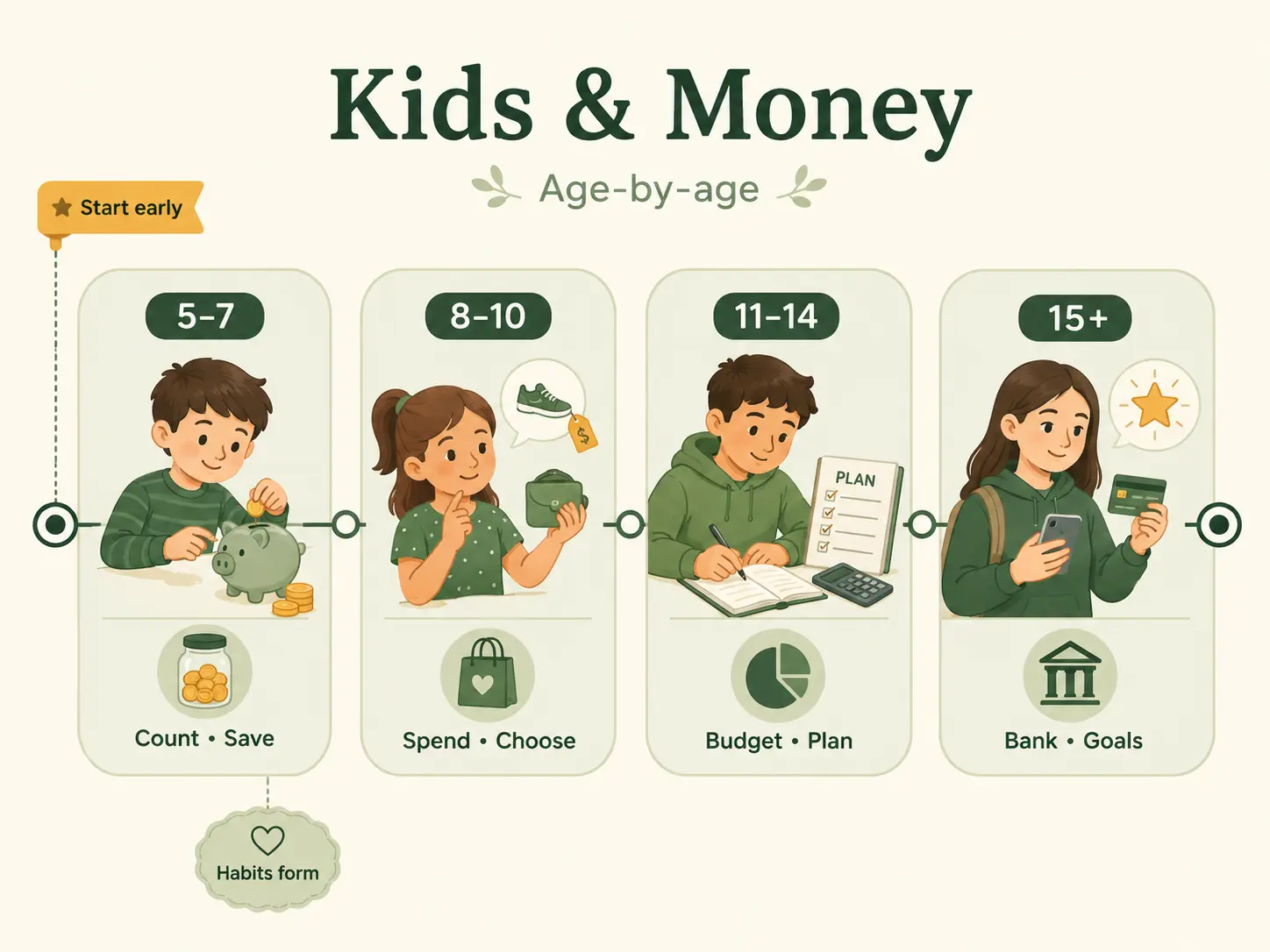
Research shows that core money habits form around age seven, yet formal school courses often don’t arrive until age fifteen. So, what should you teach in those crucial years in between?
If you are wondering what age kids should start learning about money, the answer is usually around five or six. Basically, as soon as a child can count coins and understand that a thing costs money. That is not just a parenting opinion; it is backed by a widely cited University of Cambridge study commissioned by the UK’s Money Advice Service, which found that the foundational habits behind how we handle money are typically formed by age seven.
That single fact reshapes the entire conversation. Most parents assume money is a teenage topic — something to bring up alongside first jobs and bank cards. But by then, the researchers found, the foundations are already poured. The useful question isn’t whether a five-year-old is ready for money lessons. It is which lessons fit a five-year-old, a nine-year-old, and a fourteen-year-old.
This guide walks through exactly that, one age band at a time. And if your child is already past seven, keep reading. Seven is when habits start forming, not when learning ends.
Why age seven matters more than any school course
The Cambridge study (Habit Formation and Learning in Young Children) found that by around seven, most children have grasped the core concepts that adult money behaviour rests on. They understand that money can be exchanged for things, that it runs out, that you sometimes have to wait, and that choosing one thing means giving up another. More importantly, they have already begun forming habits around those concepts, largely by watching the adults around them.
Compare that to when formal education usually steps in. In the United States, 30 states currently require a standalone personal finance course, and nearly all of them are taught in high school. In the UK, financial education sits mostly in the secondary curriculum. Wherever you live, the pattern holds: the habits form around seven, the school course arrives around fifteen, and the eight years in between belong entirely to parents.
Arriving late has a measurable price. The National Financial Educators Council estimates that a lack of financial knowledge cost the average American adult $948 in 2025, totalling over $246 billion nationally. None of this is a reason to panic, but it is a great reason to start earlier and smaller than you originally thought.
The age-by-age guide to teaching kids about money
Every child is different, so treat these bands as a sequence rather than a strict schedule. What matters is the order: see money, handle money, plan money, answer for money.
| Age | What clicks at this age | What to teach | Try this week |
|---|---|---|---|
| 5–6 | Money is real, and it runs out | Coins and notes, paying, simple choices | Let them hand over the cash and count the change |
| 7–8 | Earning, waiting, saving | Pocket money, needs vs wants, a first savings goal | Start a small weekly allowance with one rule |
| 9–12 | Plans and trade-offs | A simple budget with caps, opportunity cost, spending records | Give them a ledger and let them track their own spending |
| 13–15 | Real stakes | Earning, bigger goals, subscriptions, adverts and scams | Hand over a real monthly budget for one category |
Ages 5–6: Money is real, and it runs out
Children at this age are concrete thinkers. Money they can see is money they can understand. The risk of a cashless household is that money becomes invisible — it just looks like a magic card that always works. So, the first lessons need to be physical. Pay with cash sometimes and let your child hand it over. Count the change together. Say the quiet arithmetic out loud: “We have ten. The bread is two. What’s left?”
Two ideas are worth planting right now. First, money comes from work. Explaining that “this is what Mum gets for the hours she works” turns money from an object into stored effort. Second, choosing costs something. Let them pick one treat at the shop. A five-year-old agonising between two chocolate bars is essentially running their first budget meeting.
Ages 7–8: Earning, waiting, and the first savings goal
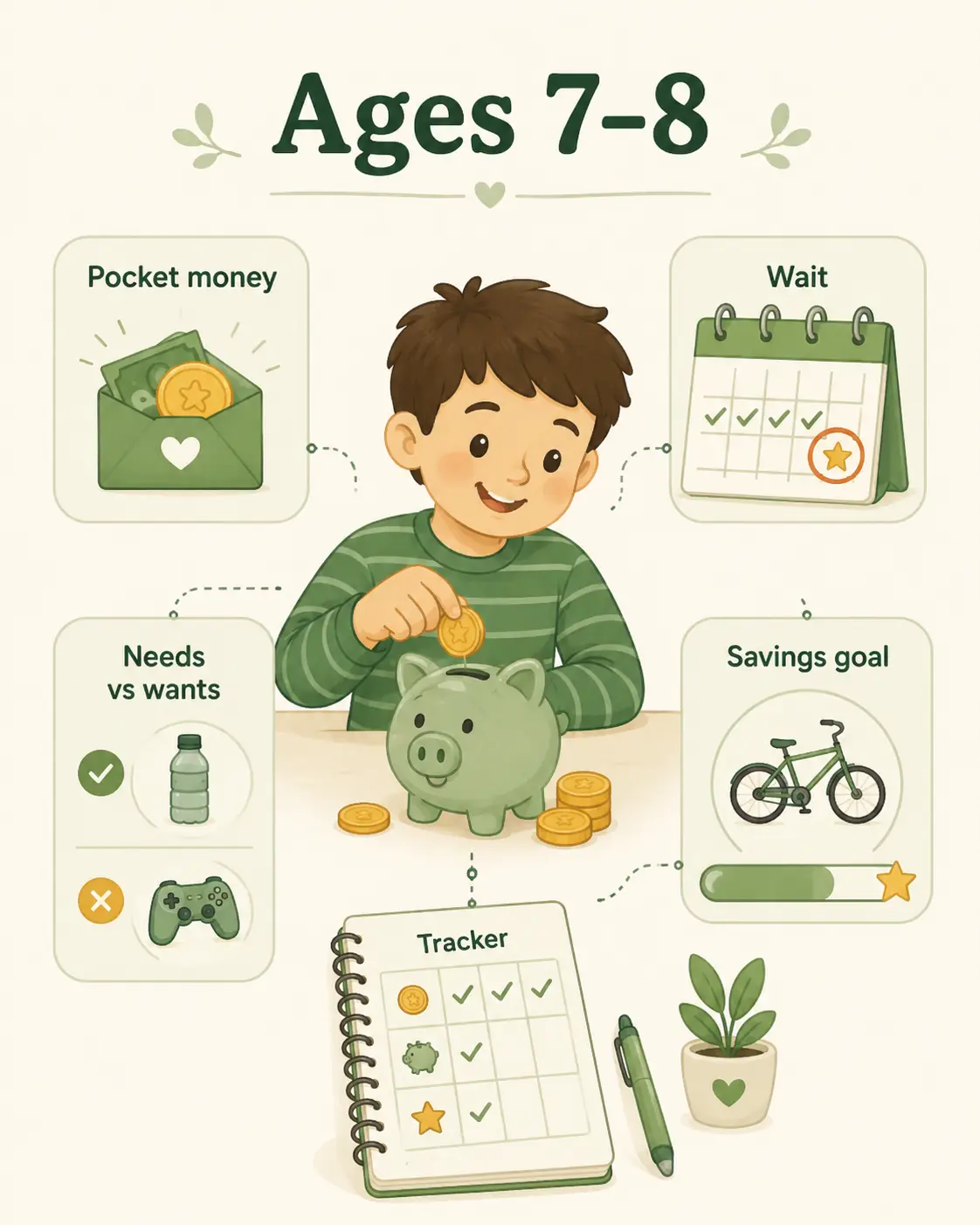
This is the habit window the Cambridge research points to, and the single most useful thing you can introduce here is pocket money. Treat it not as a gift, but as material for them to practise on. Keep it small, regular, and tie it to one clear rule (for example, a portion must go toward something they’re saving for). A child who runs out of money on Tuesday and has to wait until Saturday is learning more about budgeting than any worksheet can ever teach.
This is also the perfect age to teach “needs versus wants.” Frame it as a game rather than a lecture (“Is this a need or a want? What about the dog? What about wifi?”). A first savings goal works wonders here too — pick something concrete, a few weeks away, with a picture of it stuck somewhere visible. If you give pocket money already, setting up a simple pocket money tracker keeps the record-keeping honest and eliminates the need for a shoebox full of IOUs.
Ages 9–12: Budgets, trade-offs, and their own numbers
Somewhere around nine, children become capable of genuinely abstract money thinking. This is where most families under-teach because the child “knows the basics” but school hasn’t started yet. In reality, this is the best teaching window you will ever get.
First, introduce a real budget. Take their pocket money and help them split it across a few categories they choose, each with a hard cap. Caps beat percentages at this age because “you’ve got 40 left for snacks this month” is concrete in a way that “30% for wants” never will be.
Second, teach opportunity cost through their own numbers. If a game costs 30, point out that it equals six weeks of snack money. Pricing things in terms of their own effort and trade-offs is the most durable trick in financial literacy.
Finally, introduce the waiting test. If they want something, put it on a list for seven days. If they still want it next week, it might be worth it. If they’ve forgotten about it, it was an impulse, and they’ve just caught one cheaply. Let them keep their own records and make their own small mistakes. A blown snack budget at ten is a cheap education; that same habit at twenty-five comes with interest charges.
Ages 13–15: Real stakes before real consequences
By the teenage years, the goal shifts from concepts to repetition. They need practice with real stakes while mistakes are still recoverable. Give them a real budget to run — like their clothing or entertainment allowance for the month — with the understanding that when it’s gone, it’s gone.
Talk about earning through side jobs and what a payslip actually says. More importantly, talk about money that is designed to be invisible: subscriptions that renew quietly, in-game purchases, and adverts engineered to feel like advice. Teens are the most targeted and least experienced consumers on the internet; naming the tricks is half the defence.
This is also when a teenager can take a real seat at the family’s money table. Seeing part of the household picture and logging their own spending builds immense trust. If school finally delivers its personal finance course now, it will act as revision rather than a revelation.
Three principles that work at every age
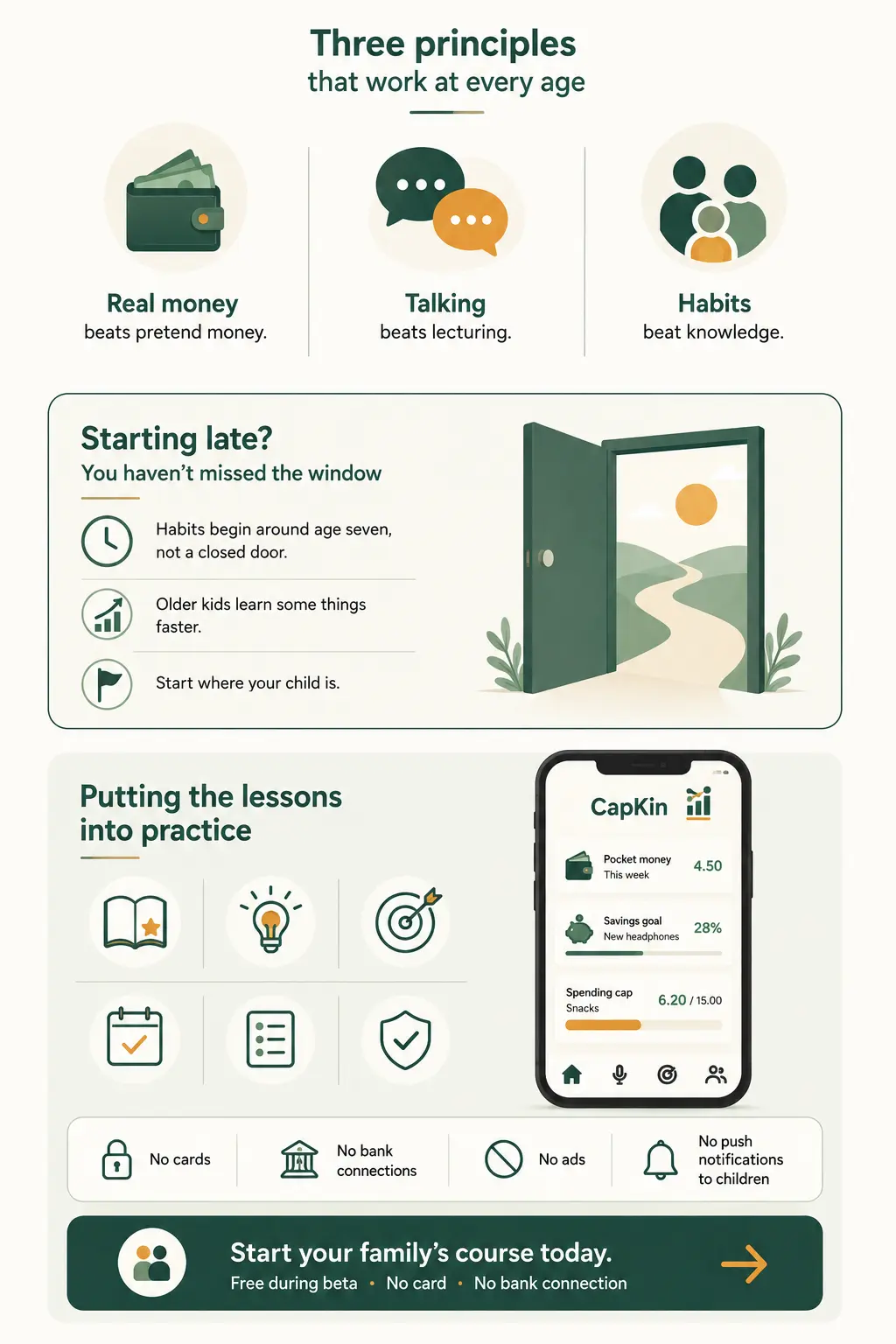
Real money beats pretend money. Lessons stick when the numbers are the child’s own — their pocket money, their goal, their snack spending. Abstract examples wash off; telling them “your 4.50 a month is 54 a year” rarely connects the way holding the cash does.
Talking beats lecturing. In a T. Rowe Price survey, only 23% of kids said they talk with their parents about money frequently. Parents who do talk about it raise kids who are measurably smarter about it. You don’t need a curriculum. One good money question a week — answered by the adults too — beats a quarterly lecture.
Habits beat knowledge. Children learn money mostly by watching you. A parent who says, “Let’s check the budget first” out loud, in front of the child, is teaching more in five seconds than an hour of explanation. You are the curriculum.
Starting late? You haven’t missed the window
Age seven is when habits begin forming, not a door that closes permanently. Older children actually learn some things faster. A fourteen-year-old grasps opportunity cost in a single afternoon because they finally have things they urgently want.
The method doesn’t change — real money, real choices, real conversations — only the starting band does. Start where your child is, not where the timeline says they should be. Pick the next age band up from wherever they are, and begin.
Putting the lessons into practice
CapKin was built to help families transition from talking about money to actually managing it together. It is a shared household budgeting app with a built-in financial education layer designed specifically for children aged 6 to 12.
The learning runs on your family’s real money, not tokens. It includes a storybook money course for ages 6–8 (with chapters, gentle quizzes, and family conversation starters), a daily-discovery layer for ages 8–12, and real practice in between. Pocket money arrives on schedule, kids get their own ledger and spending caps, and savings goals come with a parental lock. For your peace of mind, every child entry requires parent approval, and there are no payment cards, bank connections, ads, or push notifications sent to children.
If you’re at the “how do I actually start?” stage, the CapKin for kids page walks through exactly how families use it, age by age.
Sources
- Whitebread, D. & Bingham, S. (2013). Habit Formation and Learning in Young Children. University of Cambridge / Money Advice Service.
- T. Rowe Price. Parents, Kids & Money Survey (2017).
- Next Gen Personal Finance (NGPF), April 2026.
- National Financial Educators Council (2025).
Frequently asked questions
- What age should kids start learning about money?
- Around age 5–6, with simple cash-and-choices lessons. Research from the University of Cambridge for the UK Money Advice Service found core money habits are typically formed by age 7, so the early primary years matter most — but useful lessons exist for every age from 5 to 15.
- Is 5 too young to talk about money?
- No. Five-year-olds can count coins, hand over cash, and make simple either-or spending choices — which is exactly the right curriculum at that age. Keep it physical and concrete; skip anything abstract.
- What should a 7-year-old understand about money?
- That money is earned, that it runs out, that saving means waiting, and the difference between needs and wants. Age 7 is also the right time for a small regular pocket-money amount and a first savings goal.
- Is it too late to teach a teenager about money?
- No. Age 7 is when habits begin forming, not a deadline. Teenagers learn budgeting quickly because the stakes finally feel real — give them a real monthly budget for one category and let them run it, mistakes included.
- Do schools teach kids about money?
- Increasingly, but late: 30 US states now require a standalone personal finance course, and it’s taught in high school. Money habits form around age 7, so the years between 7 and 15 are covered by parents or by no one.