2 July 2026 · 13 min read · Updated 5 September 2026
Family Budget Categories: A Practical List for Couples and Families
Choosing family budget categories can feel more complicated than setting the budget itself.
The short version
- Start with roughly eight to twelve categories and add more only when the extra detail supports a real decision.
- The usual working set: housing, utilities, groceries, transport, health, children, household purchases, dining out, entertainment, subscriptions and personal care.
- Rent and utilities can share one category for a simpler budget; keep them apart when you want the fixed cost of the property separate from the bills that move each month.
- Categories are shared by the whole household, so name them the way your family already talks about money — a category nobody understands is a category nobody uses.
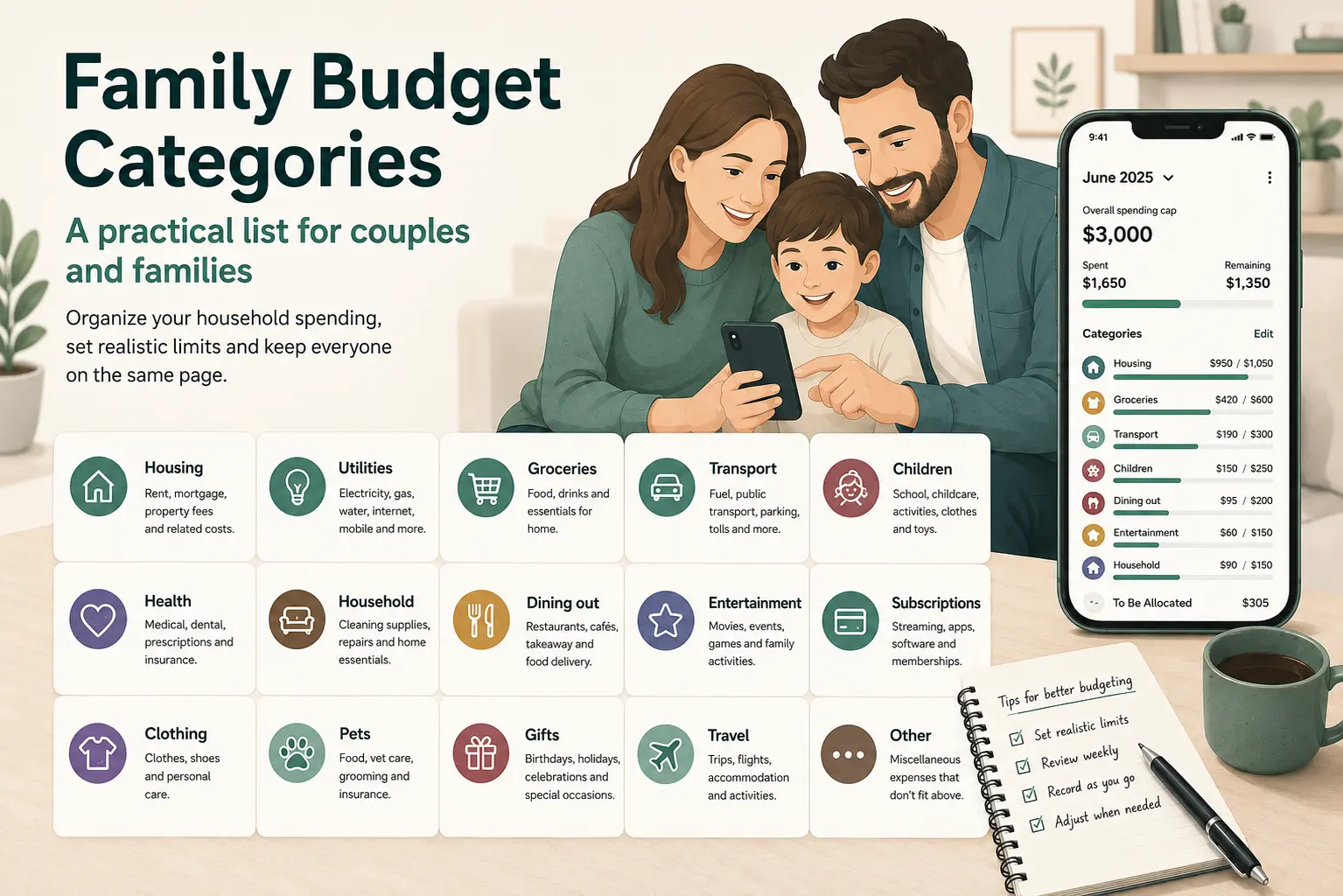
A short list may not show where the household’s money is going. A highly detailed list creates extra work every time someone records a purchase — which matters most when the household is entering expenses by hand rather than importing them from a bank. The right structure sits between those extremes: specific enough to support decisions, but simple enough for everyone in the household to use.
This guide provides a practical list of household budget categories, examples for different types of households and a straightforward way to set a cap for each one. If you have not yet written down what the household actually spends on, start with the monthly household expenses list and group it afterwards — categories are easier to choose once the costs are in front of you.
What are family budget categories?
Family budget categories are groups used to organise household spending.
Instead of reviewing a long list of individual purchases, you can see how much the household has spent on areas such as:
- Housing
- Groceries
- Transport
- Children
- Dining out
- Entertainment
Each category answers a useful question. Are grocery costs rising? Is too much of the monthly budget going towards dining out? How much remains for household purchases?
Categories make those patterns visible.
In a cap-based budget, each category also has a planned maximum amount. For example, a household might set a monthly cap of £600 for groceries and £200 for dining out. As purchases are recorded, the household can see how current spending compares with each cap.
CapKin is built around this structure: one overall household cap, individual category caps and a live view of spending against each one, with no bank connection anywhere in it. Any part of the overall cap that has not yet been assigned remains visible as “To Be Allocated,” allowing the household to keep a deliberate buffer rather than forcing every pound into a category. Setting that overall cap comes first — the order is laid out in the guide to creating a shared family budget.
How many budget categories should a family have?
There is no single correct number.
A practical starting point for many households is between eight and twelve main categories. This is usually enough to separate the expenses that require different decisions without turning every purchase into a classification exercise.
A category deserves its own place when at least one of these conditions applies:
- The household wants to control that type of spending separately.
- The expense is large enough to affect the monthly plan.
- Someone needs to know how much remains for it.
- The spending pattern is meaningfully different from other expenses.
- It belongs to a specific shared responsibility, such as children or pets.
A separate category may not be useful when two types of spending are always reviewed together.
For example, dividing groceries into dairy, meat, vegetables, bakery products and snacks creates more detail, but may not improve any household decision. One groceries category is often more useful.
The purpose of categories is not to produce perfect accounting. It is to make shared spending understandable.
A practical family budget categories list
The following list covers the most common household expenses. A family does not need to use every category. Select the ones that reflect how the household actually spends money.
1. Housing
Housing usually includes the main cost of maintaining the household’s home.
Possible expenses:
- Rent
- Mortgage payments
- Property management fees
- Service charges
- Property taxes
- Regular maintenance fees
Keep housing separate from utilities if the household wants to compare the fixed cost of the property with changing monthly bills. A simpler budget can combine both into one category called Housing and bills.
2. Utilities
Utilities include recurring services needed to run the home.
Possible expenses:
- Electricity
- Gas
- Water
- Heating
- Waste collection
- Internet
- Mobile phone plans
Utility bills may change throughout the year, so the cap can be based on a typical month rather than the lowest recent bill. For seasonal expenses such as heating, consider using a higher cap during expensive months or keeping part of the overall budget unallocated.
3. Groceries
The groceries category covers food and basic products purchased for use at home.
Possible expenses:
- Supermarket purchases
- Food markets
- Drinking water
- Basic household consumables
- Regular food deliveries intended for home meals
Decide whether cleaning products, toiletries and pet food belong under groceries or separate household categories. Either approach can work. Consistency matters more than the exact label.
4. Transport
Transport covers the cost of everyday travel.
Possible expenses:
- Fuel
- Public transport
- Taxis
- Ride-hailing services
- Parking
- Tolls
- Bicycle maintenance
- Car servicing
- Vehicle insurance
A household with a car may benefit from separating routine travel from larger vehicle costs. For example:
- Transport: fuel, public transport and parking
- Car costs: insurance, repairs, servicing and registration
For households without a car, one transport category is usually enough.
5. Children
A dedicated children’s category gives the household one clear view of child-related spending.
Possible expenses:
- School supplies
- Childcare
- School meals
- Clubs and activities
- Toys
- Children’s clothing
- Pocket money
- School trips
- Birthday expenses
A broad children’s category works well when the main goal is to understand the total. Larger households may prefer separate categories such as Education, Childcare, Activities, and Children’s clothing. Do not create separate categories unless the additional detail will be reviewed or used.
6. Health
Health expenses can include both predictable and occasional costs.
Possible expenses:
- Prescriptions
- Over-the-counter medication
- Doctor appointments
- Dental care
- Physiotherapy
- Glasses and contact lenses
- Medical insurance
- Health-related transport
Because health costs can be irregular, the category may need a flexible cap. A small unused amount can remain available for months when an unexpected expense appears.
7. Household
The household category covers products and services used to maintain the home.
Possible expenses:
- Cleaning products
- Toiletries
- Kitchen equipment
- Small furniture
- Repairs
- Home accessories
- Laundry
- Replacement household items
Large furniture purchases or renovations may be easier to understand when tracked separately rather than mixed with routine household spending.
8. Dining out
Dining out should usually remain separate from groceries because the two categories support different decisions.
Possible expenses:
- Restaurants
- Cafés
- Takeaway meals
- Food delivery
- Work lunches
- Snacks purchased outside the home
If the household wants to reduce flexible spending, this is often one of the most useful categories to track separately. A café visit should not require debate every time. Agree in advance whether it belongs under dining out, personal spending or entertainment.
9. Entertainment
Entertainment covers shared leisure spending.
Possible expenses:
- Cinema tickets
- Events
- Family activities
- Games
- Museums
- Concerts
- Paid attractions
- Recreational outings
Streaming platforms can be included here or placed under subscriptions. Choose the category that makes the monthly report easier to understand.
10. Subscriptions
Subscriptions are easy to overlook because they are often charged automatically.
Possible expenses:
- Streaming services
- Cloud storage
- Software
- News subscriptions
- Gaming memberships
- Fitness applications
- Paid online services
Review this category periodically. A small number of low-cost subscriptions can become a meaningful monthly total.
CapKin’s product design supports recurring expense templates for predictable costs such as utilities and subscriptions. These entries can be added to the new period automatically while remaining adjustable when the real amount changes, so the only spending anyone types by hand is the spending that varies — usually by speaking it in a sentence.
11. Clothing and personal care
This category can include routine purchases for adults in the household.
Possible expenses:
- Clothing
- Shoes
- Haircuts
- Cosmetics
- Skincare
- Personal hygiene products
Children’s clothing can stay here or be included under children. Avoid recording the same type of purchase differently from month to month.
12. Pets
Households with pets may need a separate category for:
- Pet food
- Veterinary care
- Medication
- Grooming
- Insurance
- Toys and accessories
- Boarding or pet sitting
Veterinary expenses can vary significantly, so the category may include both routine costs and occasional larger payments.
13. Gifts and celebrations
This category helps prevent birthdays and holidays from appearing as unexplained overspending.
Possible expenses:
- Birthday gifts
- Holiday gifts
- Party supplies
- Family celebrations
- Wedding gifts
- Flowers
- Cards
- Seasonal decorations
Gift spending is often uneven. A household may use a modest monthly cap and allow unused amounts to accumulate where its budgeting method supports carryover.
14. Travel
Travel may include:
- Accommodation
- Flights
- Train tickets
- Car hire
- Travel insurance
- Meals during trips
- Tourist activities
- Local transport
For frequent travellers, it may be useful to distinguish between regular transport and travel-related costs. For occasional trips, the category can remain inactive during months when it is not needed.
15. Other or miscellaneous
A small miscellaneous category is useful for expenses that genuinely do not fit elsewhere. It should not become the largest category in the budget. When the same type of expense repeatedly appears under miscellaneous, create a clearer category or decide where it should belong.
Fixed and variable household budget categories
It is useful to distinguish between fixed and variable expenses even when they appear in the same budget.
Fixed expenses
Fixed expenses happen regularly and are usually predictable.
Examples include: rent, mortgage payments, internet, insurance, childcare, subscriptions, and loan repayments. The amount may remain the same each month or change only occasionally.
Variable expenses
Variable expenses change according to daily choices, needs and circumstances.
Examples include: groceries, fuel, dining out, entertainment, clothing, and household purchases.
This distinction matters because fixed expenses use part of the household budget before everyday spending begins. When a new month starts, predictable costs should already be visible. This gives the household a more accurate picture of what remains for flexible categories.
Three sample household budget category setups
These templates are starting points. Categories and percentages should be adapted to actual expenses rather than treated as rules.
Example 1: Budget categories for a couple
| Category | Suggested share of spending cap |
|---|---|
| Housing | 35% |
| Utilities | 8% |
| Groceries | 15% |
| Transport | 10% |
| Health and personal care | 5% |
| Dining out | 7% |
| Entertainment | 5% |
| Household | 5% |
| Travel and gifts | 5% |
| To Be Allocated | 5% |
| Total | 100% |
This setup keeps the number of categories low while separating groceries, dining and entertainment. A couple with separate personal spending may exclude clothing, hobbies and individual purchases from the shared budget — the split between joint and personal money is covered in more detail on the budgeting for couples page.
Example 2: Budget categories for a family with children
| Category | Suggested share of spending cap |
|---|---|
| Housing | 32% |
| Utilities | 8% |
| Groceries | 18% |
| Transport | 10% |
| Children | 10% |
| Health | 5% |
| Household | 5% |
| Dining out | 4% |
| Entertainment | 3% |
| Clothing | 2% |
| Gifts and celebrations | 1% |
| To Be Allocated | 2% |
| Total | 100% |
Families with childcare fees or significant school costs may need to assign a much larger share to the children’s category.
CapKin’s shared model is designed for different household roles. The organiser can set category caps, partners can add their own purchases, and children can use capture-only access with entries reviewed by the owner — the same mechanism behind pocket money tracking and a teenager’s first budget of their own.
Example 3: Budget categories for a shared flat
| Category | Suggested share of spending cap |
|---|---|
| Rent | 55% |
| Utilities | 12% |
| Shared groceries | 10% |
| Household supplies | 6% |
| Internet and subscriptions | 5% |
| Shared transport | 2% |
| Repairs and replacements | 5% |
| Shared entertainment | 2% |
| To Be Allocated | 3% |
| Total | 100% |
A shared flat budget should include only genuinely shared expenses. Personal food, clothing, transport and leisure can stay outside the common budget.
CapKin’s planned onboarding includes starter structures for couples, families with children and shared flats. Each template can pre-fill common categories and scale the suggested caps to fit the household’s overall spending cap.
How to set a cap for each category
A category list becomes useful only when each category has a realistic amount attached to it. Use the following process.
Step 1: Set the overall household spending cap
Decide how much the household plans to spend during the month on the expenses included in the shared budget. This should be one clear number.
Step 2: Add predictable costs first
Start with expenses that must be paid or are difficult to change during the month, such as housing, utilities, childcare, insurance, transport passes, and subscriptions.
Step 3: Set caps for variable spending
Allocate the remaining amount across categories such as groceries, dining out, entertainment, household purchases, and clothing. Use recent spending as a reference where available, but avoid treating an unusually expensive or unusually quiet month as normal.
Step 4: Keep a buffer
It is not necessary to assign the entire overall cap. An unallocated amount gives the household room to handle a higher utility bill, an unexpected school cost or another irregular expense without immediately rebuilding the budget.
In CapKin, the sum of all category caps cannot exceed the overall household cap. Any amount that has not been assigned remains visible as “To Be Allocated” and can either stay as a buffer or be assigned later.
Step 5: Review after a complete month
The first setup is an estimate. At the end of the month, check:
- Which categories repeatedly reached their caps?
- Which categories had large amounts left?
- Which expenses were difficult to classify?
- Did miscellaneous spending become too large?
- Were fixed costs recorded before flexible spending?
- Did everyone use the same category rules?
Adjust the structure rather than trying to force the household into an inaccurate plan.
Categories that are often confused
Clear rules reduce the number of corrections required later.
Groceries or household?
Food belongs under groceries. Cleaning products, kitchen tools and home supplies can go under household. A supermarket receipt may contain both. When useful, divide it into separate entries.
Groceries or dining out?
Food bought to prepare or eat at home usually belongs under groceries. Restaurant meals, takeaway and café purchases belong under dining out.
Children or clothing?
Either can work. Use children if the household wants one total for all child-related spending. Use clothing if it wants to compare clothing costs across the family.
Entertainment or subscriptions?
Regular digital services can go under subscriptions. One-off activities and events can go under entertainment.
Transport or travel?
Routine movement belongs under transport. Costs connected to holidays and longer trips belong under travel.
The best category is the one the household will apply consistently.
Should savings be a family budget category?
Savings can be part of a broader financial plan, but they are not necessarily a spending category.
A household expense tracker answers questions about money that has been spent. Moving money into a savings account is different from buying groceries, paying a utility bill or taking a taxi. Keeping those functions separate can make the spending picture clearer:
- The savings plan determines how much is set aside.
- The household spending cap determines how much can be spent.
- The category structure shows where that spending goes.
CapKin deliberately focuses on shared outflows against category caps. It does not present itself as a bank, savings tool or complete view of the household’s finances.
How to make categories easy for the whole family to use
A category system will fail if only the person who created it understands it.
Use names that everyone recognises. Groceries is clearer than Domestic variable consumption. Dining out is clearer than Discretionary food services.
Keep the everyday process simple:
- Record the purchase.
- Check the proposed amount and category.
- Correct it when necessary.
- Confirm the entry.
With CapKin, household members can say or type purchases such as “milk 3.20, bread 2 and a taxi home 14.” The system separates them into line items and proposes categories, but the person confirms uncertain matches before anything is saved.
The household gets the benefit of consistent categories without requiring one person to complete every entry.
Build a budget people can understand
The best family budget categories are not the most detailed. They are the ones that make household spending clear without making every purchase difficult to record.
Begin with the categories that matter most. Set one cap for each. Leave room for irregular costs. Then review the structure after the household has used it for a complete month. If you would rather sketch the structure before committing to an app, a free spreadsheet template does the planning part perfectly well.
CapKin keeps the process shared: everyone can record what they bought, the app sorts purchases into the household’s categories, and each category remains visible against its cap.
Household spending, spoken for.
Frequently asked questions
- What are the main household budget categories?
- The main categories usually include housing, utilities, groceries, transport, health, children, household purchases, dining out, entertainment, subscriptions and personal care. The final list should reflect the household’s actual spending.
- How many family budget categories should I use?
- Start with approximately eight to twelve main categories. Add more only when the additional detail supports a real decision.
- Should rent and utilities be in the same category?
- They can be combined for a simpler budget. Keep them separate when the household wants to distinguish the fixed cost of the property from changing monthly bills.
- Should every purchase have its own category?
- No. Categories should group similar expenses. Individual purchases can retain their own descriptions within a broader category. For example, “apples,” “bread” and “milk” can all belong under groceries.
- What should go into a miscellaneous category?
- Use it for rare expenses that do not clearly fit elsewhere. If the same expense repeatedly appears there, assign it to an existing category or create a new one.
- Do category caps need to use the entire budget?
- No. The total of the category caps can remain below the overall spending cap. The difference acts as an unallocated buffer.