By Artem Panasiuk · 30 October 2026 · 9 min read
What to Do With Money Your Kids Get as Gifts: Rules, Splits and Tax
Birthday cards and holiday envelopes put cash in your child’s hands a few times a year, and most families decide what happens to it on the spot. This guide takes the decision in order: whose money it is, what the giver wanted, how to split it, where a bigger gift can go, and what the US and UK tax rules say.
The short version
- Children on NatWest Rooster Money received an average of £46.41 in birthday money in the year to 28 February 2026, with grandparents giving £24.49 and aunts and uncles £24.80 on average (NatWest Rooster Money Pocket Money Index 2026).
- In a February 2024 Mumsnet thread on what to do with money given to young children, parents most often said they save it, and many split it between saving and spending. The split gives a child some of the money to decide about and keeps part of it for later.
- In the US the donor, not the child, is generally responsible for any gift tax, and the annual exclusion is $19,000 per recipient in 2026 (IRS), so ordinary birthday money is far below it.
- In the UK, interest above £100 a tax year on money a parent gave a child is taxed as the parent’s income, but money from grandparents, relatives or friends and money in a Junior ISA is exempt from that limit (GOV.UK).
- Decide the default split before the envelope arrives, say it out loud once, and keep a record the child can see. That removes most of the argument.
The simplest way to handle a child’s gift money is to treat it as the child’s, with a parent deciding the split until the child can run it. Pick a default (some to spend now, some to save toward a goal), follow any wish the giver expressed, and write the amount down. The sections below cover each step, and the last two cover tax in the US and the UK, which is general information and not advice.
Whose money is a child’s birthday or holiday gift money?
A gift of cash to a child is a gift to the child, and most families treat it that way even while a parent holds it. The practical question is who decides what happens next. Until a child is old enough to hold and track money, that is the parent. Some parents in the Mumsnet thread below hand the spending decision over around age seven, and from then the money in the envelope is the child’s first real budget.
Official sources reflect the same split between ownership and control. GOV.UK describes a Junior ISA as an account a parent opens and manages for the child, who can take control at 16 and cannot withdraw anything until 18. In a February 2024 Mumsnet thread with 42 replies, parents differ on the details: some bank it all in a child’s account, some keep it in their own name for the child, and some let the child choose. Most of them treat the money as being for the child.
How much gift money do kids actually get?
In the UK, children on NatWest Rooster Money received an average of £46.41 in birthday money between 1 March 2025 and 28 February 2026. Grandparents gave an average of £24.49 and aunts and uncles £24.80. The index draws on more than half a million Rooster Card users, so it reflects families who already use a pocket money app and may run higher or lower than yours.
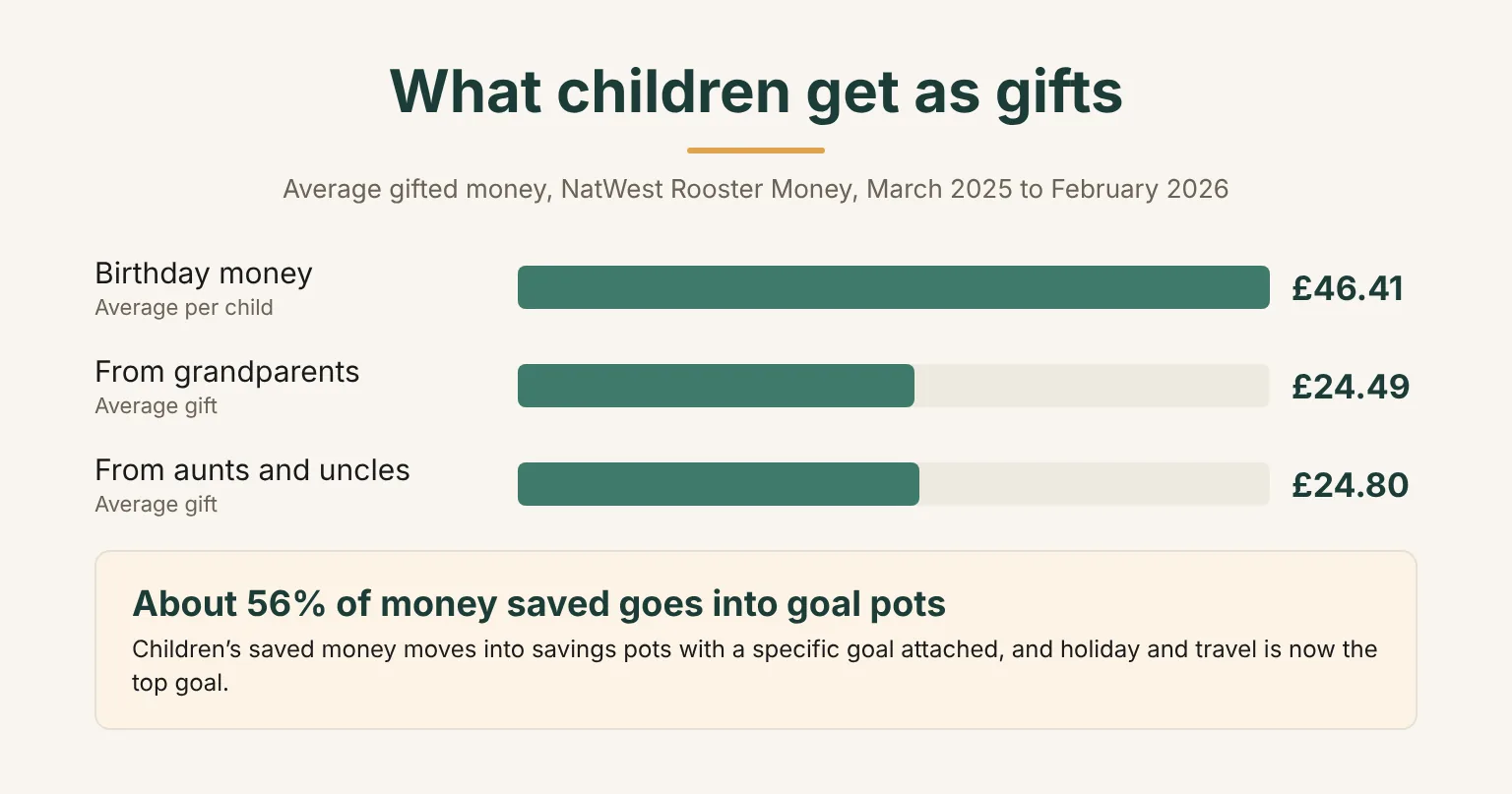
Rooster’s index also shows what children do with money once it is set aside. About 56% of the money its users save is moved into savings pots with a specific goal attached, and holiday and travel is now the top goal. A named goal is the habit worth copying. Our guide to teaching kids to save money covers how to set goals by age.
What should you do with a child’s gift money?
Parents in the Mumsnet thread described several approaches, and the table sets them out with the situation each one suits. Saving was the most common answer in the replies we read. Others spent the money on things the child needed or wanted, split it, or let the child decide once old enough.
| Approach | Suits | Watch for |
|---|---|---|
| Spend it on what the child picks | Small amounts, children old enough to choose, gifts given to buy something specific | No leftover for later; a child who spends it all by Saturday has still learned something |
| Save all of it | Larger gifts, babies and toddlers, children who already have what they need | The child never decides anything with it, and a long wait feels like a lock-up |
| Split it between spending and saving | Most children from about five or six; families who want one simple rule | Needs a ratio agreed in advance, or the split gets renegotiated at each envelope |
| Fund a bigger goal | A child saving for a bike, a console or a trip | The goal has to be the child’s own, and the timeline short enough to stay real |
| Put it in a long-term account | Larger gifts, or money the giver meant for the future | Access rules, tax rules and fees differ by account; see the sections below |
Gift money is irregular income, and pocket money is the regular kind. Our guide to how much allowance to give by age covers the regular income side of the same question.
How should you split birthday money between saving and spending?
A half-and-half split is easy to run: half to spend, half to save. There is no official ratio, and the right one depends on the child’s age and the size of the gift. The table below shows how families commonly shift it as children grow. Treat the numbers as a starting point to adjust, since nothing here is a rule.
| Age | A workable starting split | Who decides what |
|---|---|---|
| 4 to 6 | Most to spend or a physical jar; a small part toward one goal | Parent holds the money; the child picks the purchase |
| 7 to 10 | Half to spend, half to a savings goal | Child chooses the goal; parent sets the timing and keeps the record |
| 11 to 14 | Half to spend, the rest split between a goal and long-term savings | Child proposes the split; parent agrees it before the money is spent |
| 15 and over | The teen sets the split; a parent reviews it once a month | Teen decides, parent asks questions |
Say the rule once, before the next birthday, and it stops being a negotiation. If the child’s record shows what came in, what went to the goal and what was spent, the conversation at the next envelope takes a minute. Our post on when to teach kids about money covers what children can handle at each age.
What if the giver wants the money saved, or spent on something?
If the giver named a purpose, follow it. A card that says “for your bike fund” is a request, and some parents in the Mumsnet thread said they honor requests like that. If the giver gave nothing but the cash, the decision is yours, and you can say so kindly: “Thank you, we’ll put it toward the scooter she’s saving for.”
Grandparents sometimes ask what a gift is for in advance, and answering helps. “She’s saving £60 for a scooter” gives the giver something to aim at, and the amount in the card then matches the goal. It also keeps the thank-you honest, because the child can say what the money did.
Is a child’s gift money taxable in the US?
Ordinary gift money is not a tax problem for the child. The IRS says the donor is generally responsible for paying any gift tax, and the annual exclusion for 2026 is $19,000 per recipient, so a person can give each child up to that amount in a year without it counting against anything. A birthday card with $50 in it is nowhere near the line.
What the child earns on the money is different. Interest on a savings account is the child’s unearned income. For 2026, IRS Revenue Procedure 2025-32 sets the amount that reduces a dependent child’s unearned income under the “kiddie tax” at $1,350, and IRS Topic 553 puts the point where the kiddie tax applies at $2,700 of unearned income. If a child’s account earns $20 in interest over a year, which is a made-up example for scale, it sits far below both figures.
Is a child’s gift money taxable in the UK?
There is usually no tax to pay on children’s accounts, with one exception. GOV.UK says that if a child gets more than £100 in interest in a tax year (6 April to 5 April) from money a parent gave them, the parent pays tax on all of that interest if it is above the parent’s own Personal Savings Allowance. The £100 limit does not apply to money given by grandparents, relatives or friends, or to money in a Junior ISA.
That makes the source of the money worth recording. A grandparent’s £50 birthday gift and a parent’s £50 top-up are treated differently once interest builds up. For the 2026 to 2027 tax year the Junior ISA limit is £9,000, and the child cannot withdraw from it until 18.
Where can a larger gift go?
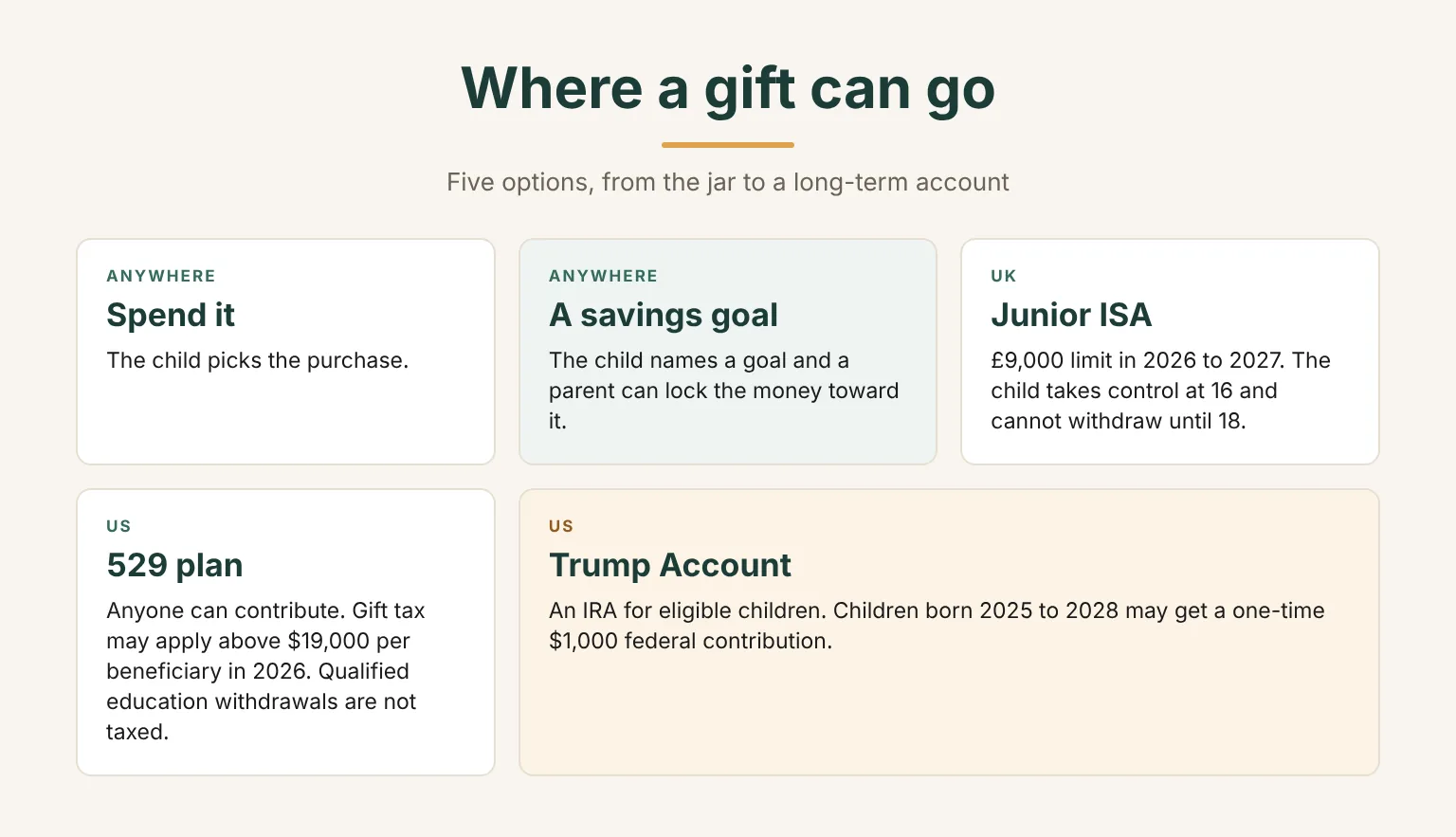
A larger gift can go to a goal inside the family’s own records, a Junior ISA in the UK, a 529 plan for education in the US, or a Trump Account for eligible US children. They differ on who can pay in, what the money can be used for, and when the child gets it. The figure and table summarize the rules we could confirm from the official pages.
| Option | Where | Key rule | Source |
|---|---|---|---|
| Junior ISA | UK | £9,000 limit in 2026 to 2027; child under 18 and UK resident; child controls at 16, withdraws at 18 | GOV.UK |
| 529 plan | US | Anyone can contribute; gift tax may apply above $19,000 a year per beneficiary; qualified education withdrawals are not taxed | IRS |
| Trump Account | US | An IRA for eligible children; children born 1 January 2025 to 31 December 2028 may get a one-time $1,000 federal contribution | IRS |
| Savings goal in a family ledger | Anywhere | A record of intent, not an account; the money stays where it already is | Family rule |
Our explainer on the Trump Account covers who can contribute and how the money is locked. None of these is a recommendation, and the rules on fees, investment choice and withdrawals change, so check the official page before moving money.
How do you keep track of gift money so your child can see it?
A written record that the child can see is what keeps a split from turning into an argument about what happened to the £20 from Grandma. A notebook works. A shared spreadsheet works. The record needs three numbers per gift: what came in, what went toward the goal, and what was spent.
CapKin is a shared household budgeting app that gives each child their own pocket money ledger. You log a gift when it arrives and it joins the child’s balance. The child sets a savings goal and moves money toward it, and a parent can lock that money, so getting it back out needs a request you approve. Entries a child logs wait for a parent’s approval. CapKin never moves money, holds no bank account and needs no card; it keeps the record, and the cash stays in the jar or the bank. The pocket money tracker page shows how the ledger looks, and the product facts page lists what the app does and does not do.
Sources
- NatWest Rooster Money, The Pocket Money Index 2026 (data 1 March 2025 to 28 February 2026)
- Mumsnet Talk, “What do you do with money given to your young children?” (25 February 2024)
- Internal Revenue Service, Frequently asked questions on gift taxes (2026 annual exclusion $19,000)
- Internal Revenue Service, IR-2025-103, tax inflation adjustments for tax year 2026 (9 October 2025)
- Internal Revenue Service, Revenue Procedure 2025-32 ($1,350 dependent and kiddie tax amount for 2026)
- Internal Revenue Service, Topic no. 553, Tax on a child’s investment and other unearned income (kiddie tax) (reviewed 24 September 2026)
- Internal Revenue Service, 529 plans: questions and answers
- Internal Revenue Service, Trump Accounts
- GOV.UK, Interest on savings for children
- GOV.UK, Junior Individual Savings Accounts (2026 to 2027 tax year limit £9,000)
Frequently asked questions
- What should I do with the money my child gets for their birthday?
- Pick a default split before the cards arrive, for example half to spend and half toward a savings goal the child chose, and follow any purpose the giver named. Write down the amount that came in and where it went. For larger gifts, look at an account with its own rules, such as a Junior ISA in the UK or a 529 plan in the US.
- Should kids keep their birthday money?
- Yes, in some form: the money is a gift to the child, and parents in a Mumsnet thread on the question most often saved it for the child or split it between saving and spending. The sensible middle is that the child has a say in part of it while a parent manages the rest until the child is old enough to hold it.
- How do I split birthday money between saving and spending?
- Half and half is the simplest rule. For young children use more spending and one small goal. For teenagers, let them propose the split and review it monthly. There is no official ratio, so choose one, say it out loud, and keep the same rule for every gift so it stops being a negotiation.
- Is money given to a child taxable in the US?
- Generally not for the child. The IRS says the donor is generally responsible for any gift tax, and the 2026 annual exclusion is $19,000 per recipient. Interest the money earns later is the child’s unearned income, and for 2026 the kiddie tax applies above $2,700 according to IRS Topic 553. This is general information, not tax advice.
- Do grandparents’ gifts count towards the £100 limit in the UK?
- No. GOV.UK says the £100 limit on interest from money given by a parent does not apply to money given by grandparents, relatives or friends, or to money in a Junior ISA. If a parent gave the money and it earns more than £100 a tax year, the parent pays tax on the interest above their Personal Savings Allowance.
- What if a relative gives my child a big cash gift?
- Ask what the giver had in mind, then choose an account that fits it. A Junior ISA in the UK has a £9,000 limit in 2026 to 2027 and locks the money until the child is 18. In the US, a 529 plan accepts contributions from anyone for education. Gift tax can apply above $19,000 a year per recipient. Check each official page first.