By Artem Panasiuk · 6 November 2026 · 9 min read
Black Friday Family Budget 2026: How to Set a Spending Cap by 27 November
Black Friday falls on 27 November 2026, and Adobe expects the deepest discounts to arrive across Cyber Week, which runs to 30 November. This guide covers when the forecast sales are deepest, how to set a family cap before the first sale email arrives, how to check that a “was” price is real, and how to include children and teenagers without losing the running total. It uses US data and dollars.
The short version
- Black Friday 2026 is Friday 27 November and Cyber Monday is 30 November. Adobe forecasts US online spending of $12.9 billion on Black Friday, up 9.2% on 2025, and $15.1 billion on Cyber Monday (Adobe, 28 September 2026).
- Adobe expects discounts of up to 14% in early November, up to 21% just before Thanksgiving, up to 30% during Cyber Week and 10% to 15% through December, so Black Friday is one point on a curve and not a single deadline.
- In a Bank of America survey of 2,062 US adults fielded on 10 to 12 September 2026, 29% planned to do most of their holiday shopping in early to mid-December and 17% around Black Friday. 27% named a firm per-person spending limit as a way to avoid overspending.
- Under the FTC’s Guides Against Deceptive Pricing (16 CFR 233.1), a “former price” comparison is fair only if it was the actual price at which the item was offered to the public on a regular basis. Write down the prices you care about now and compare against your notes.
- The FTC advises paying by credit card where possible, because a card lets you dispute a double charge or an order that never arrives, and treating a seller who insists on gift cards, wire transfers, payment apps or cryptocurrency as probably a scam.
A family gets through Black Friday on budget by settling three things before the sales start: a total for the week, a limit for each person on the list, and a day to stop. The sections below cover the timing data, how to set those numbers, how to check a discount and what to do about children’s money. It is general information and not financial advice.
When is Black Friday 2026, and is it still the best day to buy?
Black Friday 2026 is Friday 27 November, the day after US Thanksgiving, and Cyber Monday is Monday 30 November. Whether Black Friday is the best day to buy depends on what you want, because Adobe’s forecast puts its largest discounts across the five days from Thanksgiving to Cyber Monday. Adobe published the forecast on 28 September 2026.
| Period | Largest discount Adobe forecasts |
|---|---|
| Early November | Up to 14% |
| Just before Thanksgiving | Up to 21% |
| Cyber Week (Thanksgiving to Cyber Monday) | Up to 30% |
| Throughout December | 10% to 15% |
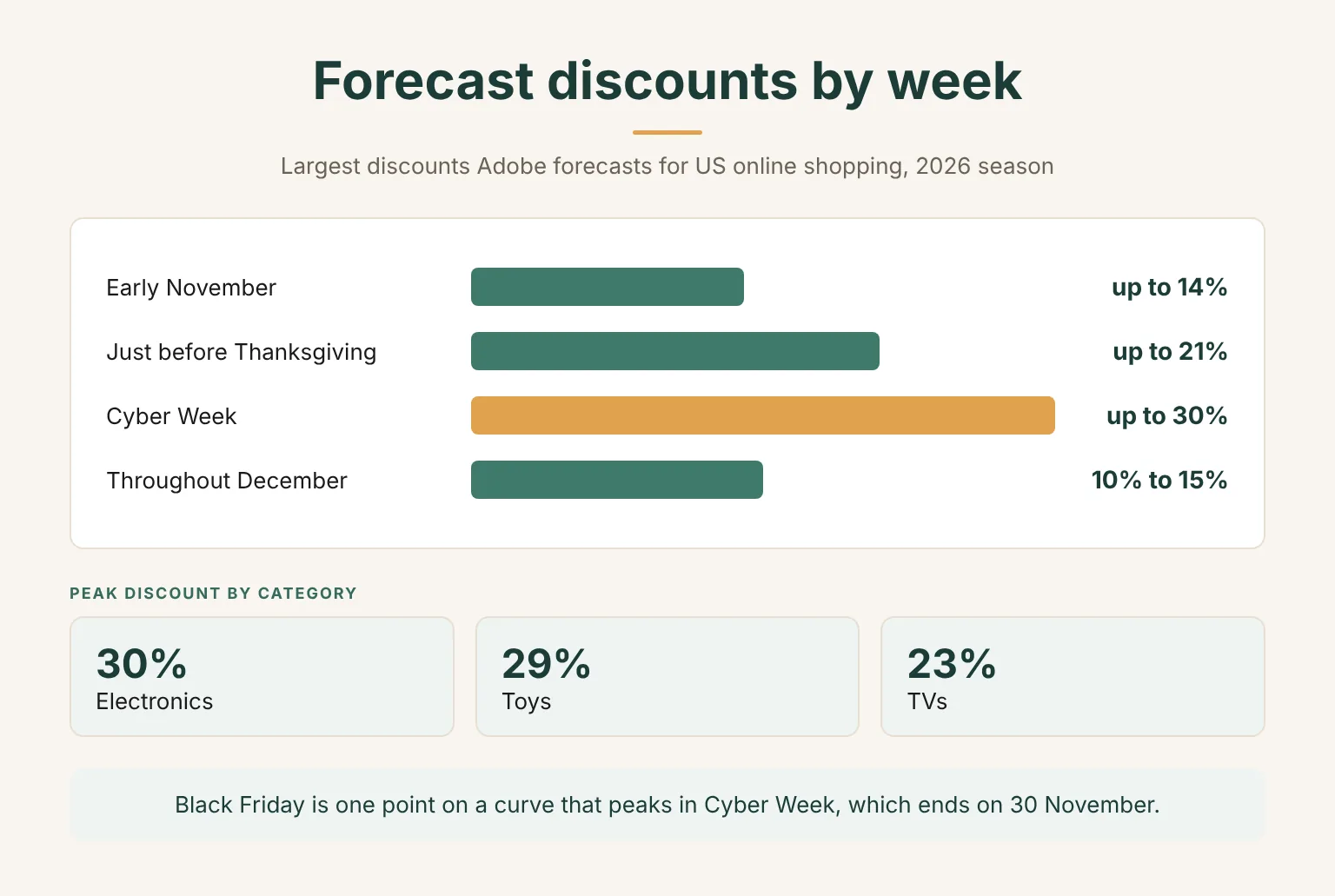
By category, Adobe expects peak discounts of 30% on electronics, 29% on toys and 23% on TVs. Adobe words every one of these as “up to”, so they are ceilings for the best deals.
Shoppers are also spreading out. In Bank of America’s 2026 Holiday Spending Survey, 17% of consumers planned to do most of their shopping around Black Friday, down from 25% the year before, while 29% planned to do most of it in early to mid-December, up from 19%. Only 38% said they had shopped or would shop earlier than usual, against 52% in 2025. The survey was fielded online by Ipsos on 10 to 12 September 2026 among 2,062 US adults, with a margin of error of 2.2 percentage points, so it records plans made in September, which may differ from what people end up doing.
How much will Americans spend online on Black Friday 2026?
Adobe forecasts $12.9 billion of US online spending on Black Friday 2026, up 9.2% on last year, and $275.1 billion across 1 November to 31 December, up 6.7%. Cyber Monday is still forecast to be the largest single online day.
| Day or period | Forecast US online spending | Change on 2025 |
|---|---|---|
| Thanksgiving Day | $6.9 billion | +8.5% |
| Black Friday (27 November) | $12.9 billion | +9.2% |
| Cyber Monday (30 November) | $15.1 billion | +6.2% |
| Cyber Week (Thanksgiving to Cyber Monday) | $47.5 billion | +7.4% |
| Season (1 November to 31 December) | $275.1 billion | +6.7% |
Adobe also forecasts $21.3 billion of buy now, pay later spending across November and December, up 6.6%, including $807 million on Black Friday. These are totals for all US online shoppers and say nothing about what one household should spend. For per-person averages and why they disagree, see our guide to how much a family should spend on Christmas.
How do you set a Black Friday spending cap for a family?
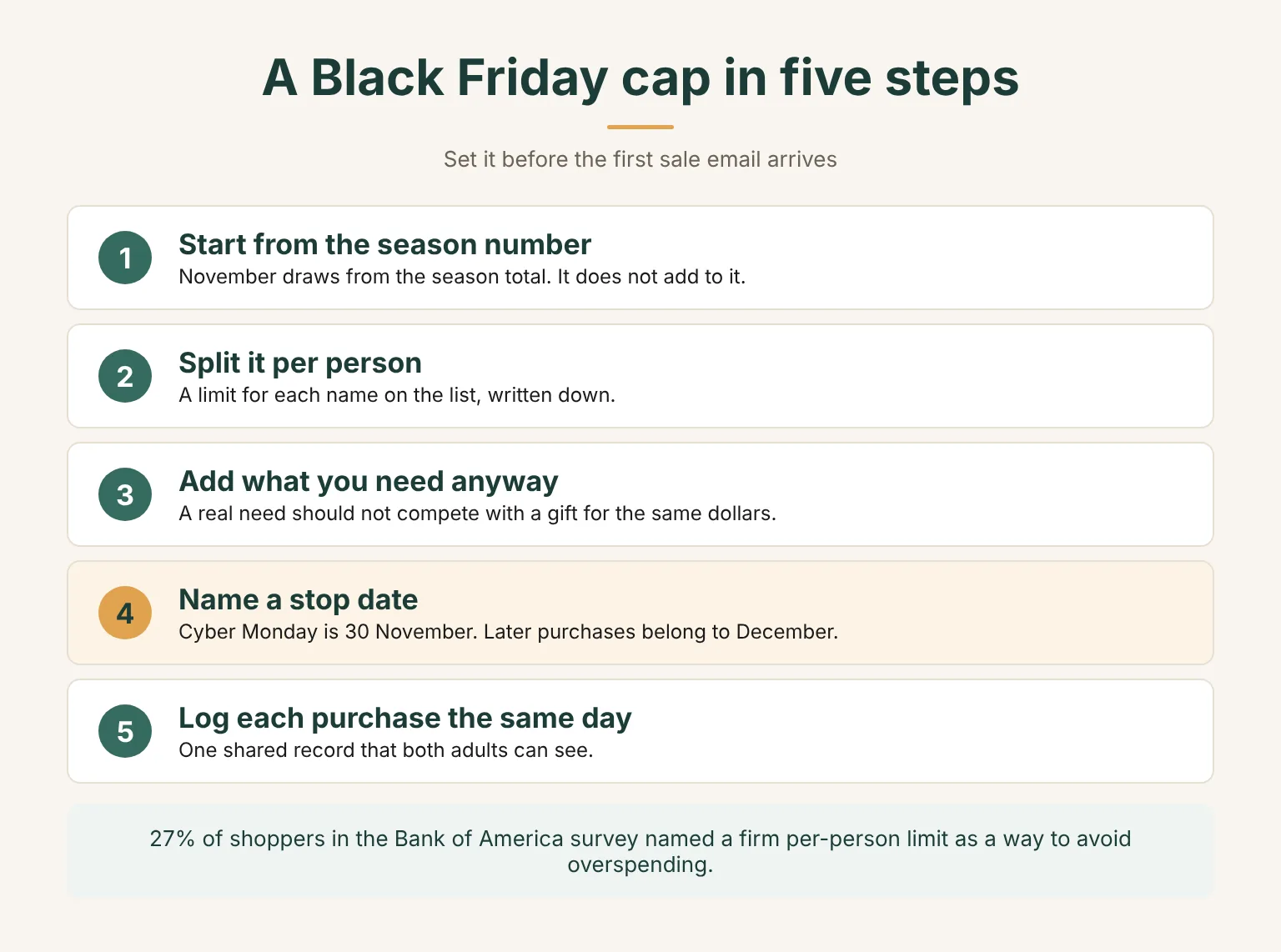
Set the cap before you open the first sale email, and set it as three things: a total, a limit for each person, and a stop date. In the Bank of America survey, 27% of shoppers named a firm per-person limit as a way to avoid overspending, and 63% said they base their holiday spending strictly on their own budget. Five steps turn that into a plan.
- Start from the season number, not the sale. Take the total you have set for the whole holiday season, or set one now, and decide how much of it may go out in November. Black Friday draws from that total. It does not add to it.
- Split it per person. Divide the November amount across the names on the list. As an illustration, a $300 gift cap across four recipients is $75 each. A limit for each person is easier to hold than a limit for each item, and it settles the question of who got more.
- Add what you need anyway. If the household has to replace a coat or a charger this month, put it on the same list, so a real need does not compete with a gift for the same dollars.
- Name a stop date. Pick the last day you will buy against this cap, for example Cyber Monday on 30 November. What comes after belongs to the December plan.
- Log each purchase the same day. Sales run for days and orders come from several sites, so one shared record is the only way to know where you stand on the Tuesday after.
If the household has no season number yet, the post on family budget categories shows how to give gifts a line of their own, and how to create a shared family budget explains how category caps fit under one overall cap.
How can you tell if a Black Friday discount is real?
Compare the sale price with a price you wrote down before the sale, not with the crossed-out price in the ad. The FTC’s Guides Against Deceptive Pricing treat a former price as a fair comparison when it was “the actual, bona fide price at which the article was offered to the public on a regular basis” (16 CFR 233.1). The same guide lists as fictitious a price at which the seller never offered the article at all, and a price that was not kept for a reasonable length of time but was cut immediately.
Here is a short check. It works best this week, while prices are still ordinary.
- Pick the three to five items you actually plan to buy, and ignore the rest of the sales.
- Note each item’s price and the date today, with a screenshot if you like.
- On the sale day, compare the sale price with your note. If it is the same as your note, it is not a discount.
- If the item fits the cap only at the sale price, buy it. If it fits only at a price you have not seen, leave it.
CapKin does not check prices for you. It compares nothing with shops and uses no outside price data, so the notes above stay your job.
What is the safest way to pay on Black Friday, and what about buy now, pay later?
The Federal Trade Commission advises paying by credit card when you can, because a card lets you dispute a double charge, an order you never received or a damaged item (FTC consumer alert, 25 November 2025). It also says that a seller who insists on a gift card, wire transfer, payment app or cryptocurrency is probably a scam, and that you should search the seller’s name with words like “review” or “complaint” before you buy.
Scams are common enough to plan for. In the Bank of America survey, 37% of shoppers said they had encountered at least one holiday scam tactic.
| Scam tactic | Share of shoppers who met it |
|---|---|
| Any holiday scam tactic | 37% |
| Phishing emails posing as retailers | 18% |
| Fake shipping or delivery notifications | 16% |
| Too-good-to-be-true deals | 16% |
Buy now, pay later is a separate decision. An instalment plan splits the payment into parts, and the full price is still owed. Decide in advance, together, whether the household will use one this season, and count every plan in your running total so the payments do not sit outside it. Children meet the same idea early, which our post on teaching kids about money in a cashless world covers.
Should kids and teenagers take part in Black Friday shopping?
Yes, if they have their own money and their own limit. The cap works at any age when it belongs to the person spending, and a sale is a cheap place to learn what a discount is worth. The table is editorial guidance and not research data.
| Age | What to hand over | Question to ask |
|---|---|---|
| 6 to 9 | A choice between two or three items on a short wish list | Which one would you still want tomorrow? |
| 10 to 12 | A set amount of their own money, such as birthday or pocket money | What did this cost last week, and what does it cost today? |
| 13 and over | Their own earnings or allowance and their own list | What is your stop date, and what is left after it? |
If a child’s money came as a gift, the post on what to do with money kids get as gifts covers how to decide between spending, saving and giving. Teenagers who want to track their own purchases can read about the budget app for teens.
How do you keep a running total during Black Friday week?
Record each purchase on the day you make it, in one place both adults can see, and compare the total with the cap each evening. All it takes is a shared record and a cap both adults can see.
CapKin is a shared household budgeting app where the owner sets an overall monthly cap and a cap for each category, and every member logs expenses by voice, text or receipt photo. A sentence such as “toy 24, hoodie 39” becomes two items that you confirm before they are saved. Black Friday and Cyber Monday both fall in November, so a single November category cap covers the whole week. Category caps must add up to no more than the overall monthly cap, so making room for a gift category means raising the overall cap or lowering another line. Children can log their own purchases, which wait for a parent’s approval and do not count toward totals until then.
CapKin never connects to a bank, issues no card and moves no money, and it gives no financial advice. It is in beta and free during beta. See the budgeting app without a bank login page and the product facts for exactly what it does and does not do, and the post on voice expense tracking for how entry by voice works.
What if you go over the cap?
Choose on purpose where the extra money comes from, and keep recording. Either lower another category by the same amount, or stop buying and move the rest of the list to December. The worst option is to leave the overage unrecorded, because an overage you can see is one you can plan around.
The method is the same as in our 30-minute guide to adjusting a family budget when prices rise: find the line that moved, set a new number and pay for the gap. The December section of the Christmas post, what to do if you are already past the number, covers what comes after.
Sources
- Adobe, “Adobe: U.S. Holiday Shopping Season to Hit Record $275.1 Billion Online, Rising 6.7% YoY” (28 September 2026)
- Bank of America, “Early December Could Overtake Black Friday as the Peak Holiday Shopping Window This Year”, 2026 Holiday Spending Survey (29 October 2026)
- Federal Trade Commission, Guides Against Deceptive Pricing, 16 CFR 233.1 Former price comparisons (current text, eCFR)
- Federal Trade Commission, “How to avoid an online shopping scam this holiday season” (25 November 2025)
- CapKin, product facts (last verified 4 November 2026)
Frequently asked questions
- When is Black Friday 2026?
- Black Friday 2026 is Friday 27 November, the day after US Thanksgiving on Thursday 26 November. Cyber Monday follows on Monday 30 November. Adobe counts Thanksgiving to Cyber Monday as Cyber Week and forecasts $47.5 billion of US online spending across those five days, up 7.4% on 2025.
- Is Black Friday still the best time to buy in 2026?
- Not always. Adobe forecasts discounts of up to 21% just before Thanksgiving and up to 30% in Cyber Week, with 10% to 15% through December. In a Bank of America survey, more shoppers planned to buy in early to mid-December (29%) than around Black Friday (17%). The best day depends on the item.
- How much should a family spend on Black Friday?
- There is no single right number. Start from the total you have set for the whole holiday season, decide how much of it may go out in November, and split that across the names on your list. In a Bank of America survey, 27% of shoppers used a firm per-person limit to avoid overspending.
- How do I know if a Black Friday deal is a real discount?
- Write down the price of the items you want before the sale, with the date, and compare the sale price with your note. The FTC’s pricing guides say a former price must be one at which the item was actually offered to the public on a regular basis, so a crossed-out price you never saw is not proof.
- Is it safe to use buy now, pay later on Black Friday?
- It is a decision for your household, and it is better made before checkout than at it. An instalment plan splits the payment but the full price is still owed, so count every plan in your running total. The FTC advises paying by credit card where possible because a card allows you to dispute a charge.
- Should my kids get Black Friday money to spend?
- If you want them to take part, give them their own amount and their own list, and let them make the choice within it. A child spending birthday or pocket money against a limit learns what a discount is worth. Ask what the item cost last week and whether they would still want it tomorrow.
- Can I track Black Friday spending without linking my bank?
- Yes. Write each purchase down the day you make it and compare the total with your cap each evening. CapKin works this way for a household: members log expenses by voice, text or receipt photo, the owner sets the caps, and nothing connects to a bank, a card or any money movement.