29 August 2026 · 13 min read · Updated 5 September 2026
How to Teach Kids About Money in a Cashless World
Your child's first currency is not the dollar. It is Robux, V-Bucks or gems — money that was deliberately built not to feel like money. Here is what the evidence says that does to them, and what puts the missing signal back.
The short version
- 80% of US children aged 6 to 17 say they are familiar with in-game virtual currency, while 42% can say what a stock is — 21% among six-to-nine-year-olds (Acorns Early, August 2026).
- Children who buy digital goods spend an average of $23.60 a month, nearly $284 a year, on products that exist only online.
- The problem is the renaming, not the arithmetic: Robux, V-Bucks and gems report value in a unit that means nothing outside the app.
- What puts the missing signal back: convert the price into dollars out loud before the purchase, and have the child record what they spent themselves.
On 11 August 2026 Acorns Early published its second annual Money Matters for Kids Report, run by Opinium across 2,000 US parents and 2,000 children aged 6 to 17. One pair of numbers from it is worth reading twice: 80% of children say they are familiar with in-game virtual currency, and 42% say they understand what a stock is. Among six-to-nine-year-olds, the stock figure is 21%.
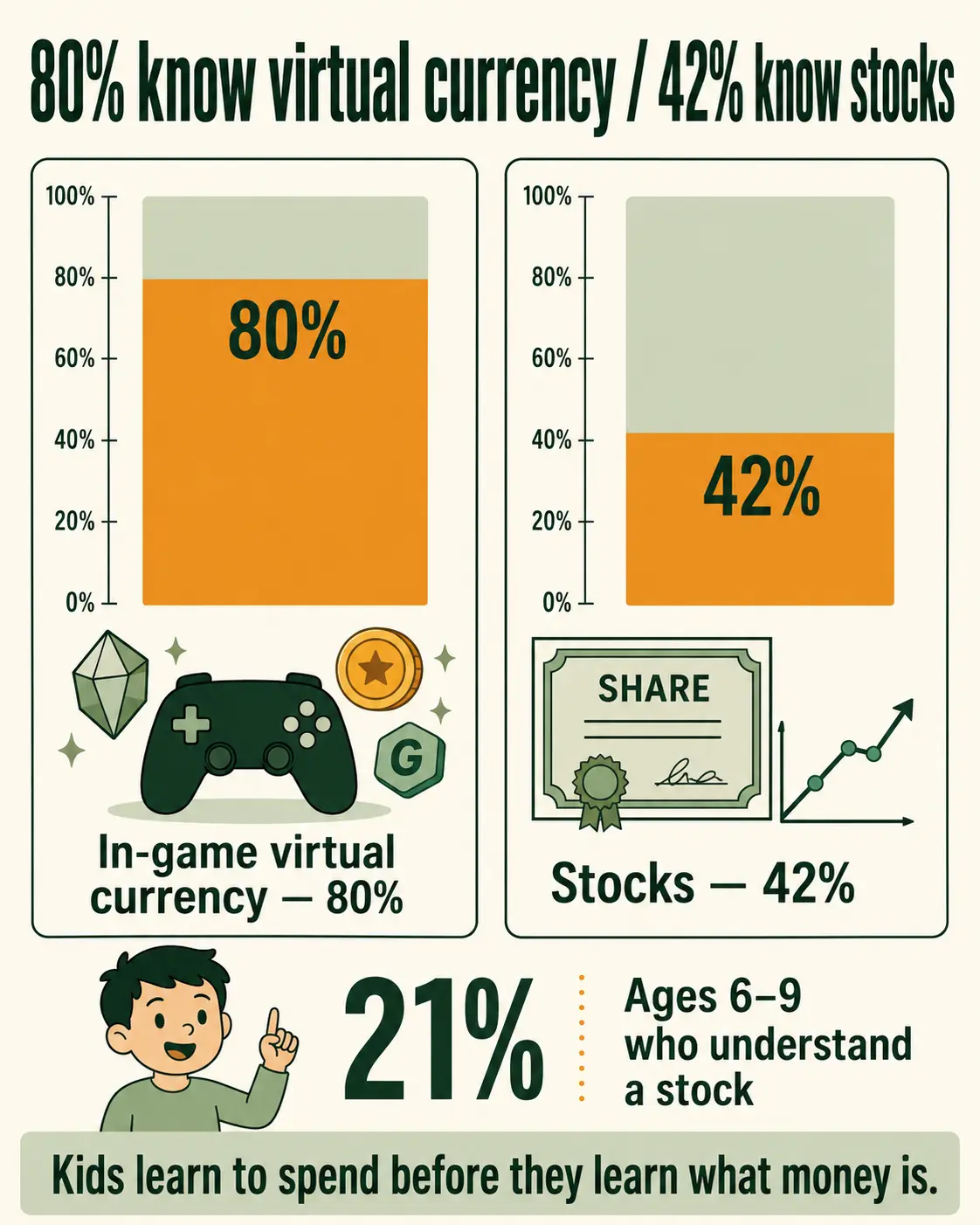
The obvious reading is that children are learning the wrong things. The more useful reading is that they are learning the thing they actually encounter. A child meets Robux daily and a share certificate never. The problem is not that virtual currency arrived first. It is that virtual currency was designed, quite deliberately, not to behave like money — and a child who learns money from it learns something with a piece missing.
Children who spend on digital goods put an average of $23.60 a month into them, roughly $284 a year on products that exist only online. Across all children in the survey the average is $18.52 a month. That is real money, moving through a mechanism that reports itself in a made-up unit.
The money your child meets first isn’t money
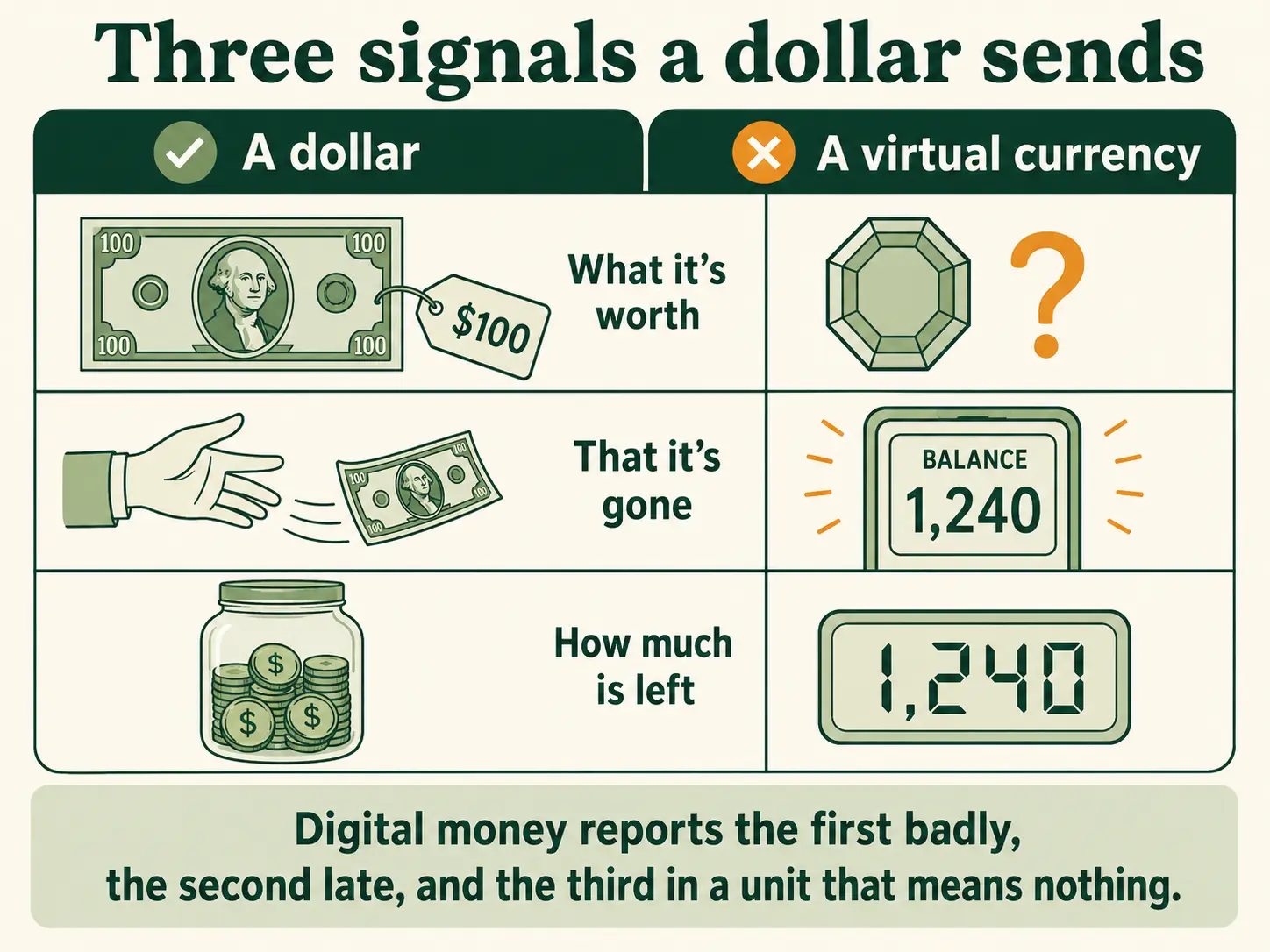
A dollar tells you three things at once: what it is worth, that it is gone, and how much is left. A virtual currency reports the first badly, the second late and the third in a unit that means nothing outside the app. That is not an accident of engineering, and in 2026 it stopped being a matter of opinion.
In May 2026 the child-safety organisations Fairplay and the National Center on Sexual Exploitation filed a complaint with the US Federal Trade Commission asking it to investigate Roblox under Section 5 of the FTC Act. Among the allegations: that the platform “obfuscates the exchange rate between cash and the virtual Robux currency”, and uses false scarcity and reward mechanisms to drive spending by children. Roblox strongly disputes the claims and points out that paying users were 1.4% of its 132 million daily active users in the first quarter of 2026. The FTC has not said whether it will open a formal investigation.
A week earlier, Marcus Carter and Sanika Vekhande at the University of Sydney published an analysis of 15 popular Roblox experiences and found designs likely to mislead child consumers in 14 of the 15 — about the real monetary value of a purchase, the likelihood of a reward, the necessity of an upgrade and the consequence of not spending. Roblox reports more than 350 million monthly users, over half of them under 17.
The most quotable evidence, though, comes from the children. In a 2025 CHI paper, Taylor Hardwick, Carter and colleagues interviewed 22 children aged 7 to 14 and gave each of them a AU$20 debit card to spend however they liked. Four bought physical things — bicycle parts, toys, lollies. Twelve spent it inside Roblox. Asked to describe the mechanics they were spending it on, children reached for words the researchers did not supply: “scams”, “cash grabs”, and — from one child — “literally just child gambling”. An eleven-year-old described navigating the currency system as “scary”.
So children are not fooled, exactly. They can feel that something is off. What they cannot do is price it.
It isn’t the arithmetic. It’s the renaming.
The intuitive theory is that virtual currency works by making the sums hard: 800 of something for $9.99, items priced at 1,200, a second purchase needed to cover the shortfall. Reasonable, and mostly wrong — or at least not the main mechanism.
Niccolò Toccafondi, Roberto Di Paolo and Sibilla Di Guida ran a randomised experiment on 753 UK adults, published in Experimental Economics in 2025, asking them what they would pay for loot boxes. In one condition the price was in pounds. In another it was in a virtual currency at a 1:1 exchange rate — one coin, one pound, no arithmetic whatsoever. Willingness to pay rose by about 4% in the virtual-currency condition, on both risky and ambiguous lotteries, at p < 0.001.
The honest counterweight sits in the same paper. When the rate was moved to 100:1, so that every price carried a much bigger number, willingness to pay fell by roughly the same 4% relative to the 1:1 condition — cancelling the effect rather than amplifying it. Big numbers are not the lever. Simply calling the money something other than money is.
That matters for what you do about it, because it rules out the parenting move most of us reach for first. Teaching a child to divide 800 by 80 does not address the mechanism. Making the price appear in dollars, in their head, before they click, does. Yunhui Huang, Kai Lim and Zhijie Lin found across six experiments in massive multiplayer games that how expensive a virtual item feels depends on whether the exchange rate is salient at the moment of purchase. When the rate is out of sight, the number on the price tag drives the feeling. When it is in sight, the dollars do.
Why cash taught this for free
Cash was never a good teacher because it was physical. It was a good teacher because it hurt. Drazen Prelec and George Loewenstein named this the pain of paying in 1998: the small aversive jolt of watching your own resources deplete, which does the work of self-control without anyone having to exercise any.
Every payment method invented since has been marketed on its ability to remove that jolt, and it works. Marie-Claire Broekhoff and Carin van der Cruijsen, studying Dutch consumers for the Journal of Economic Behavior and Organization in 2024, found electronic payments hurt less than cash — contactless most of all — and that paying in a blink means paying more. One detail in their results deserves a parent’s attention: the reduction in pain was clearest among older respondents and did not show up among teenagers. The likeliest reading, though the authors do not draw it, is that you cannot lose a sensation you never had.
This is where the standard advice — “just give them cash” — runs into the actual data, and it is worth being straight about how weak that advice is. Cash has not disappeared: the Federal Reserve’s 2026 Diary of Consumer Payment Choice found cash still accounts for 14% of US payments, that four in five consumers used it in the past 30 days, and that 76% carry some, averaging $69. Households are not short of cash to hand over.
And they hand it over. In a Talker Research survey of 2,000 US parents for Achieve in April 2025, 57% pay a regular allowance and 73% of those pay it in cash. So the gap is not that parents have stopped using cash. It is that the money goes in as cash and comes out as a digital purchase, and nothing in between is teaching anything. In the same survey, 44% of parents said teaching the value of digital money is harder than teaching the value of physical money, and 72% said their child does not fully understand the value of a dollar.
The consequences show up on the receipt. Nearly one in three parents had discovered an online purchase their child made without permission, averaging around $170, with 19% reporting more than $300. Twenty-three per cent of parents said they rarely or never check their child’s card activity.
What actually puts the signal back
There is a specific, well-tested substitute for the pain of paying, and it is duller than anyone would like: writing the amount down.
Dilip Soman tested this in the Journal of Consumer Research in 2001, in two experiments that between them isolate exactly the two things digital money removes. In the first, 160 students worked through a simulated month of expenses, paying either by credit card or by writing cheques, then rated how likely they were to buy an unrelated $50 box set. The cheque-writers scored 3.80 out of 10; the card-payers scored 5.26. Same expenses, same balance, same product.
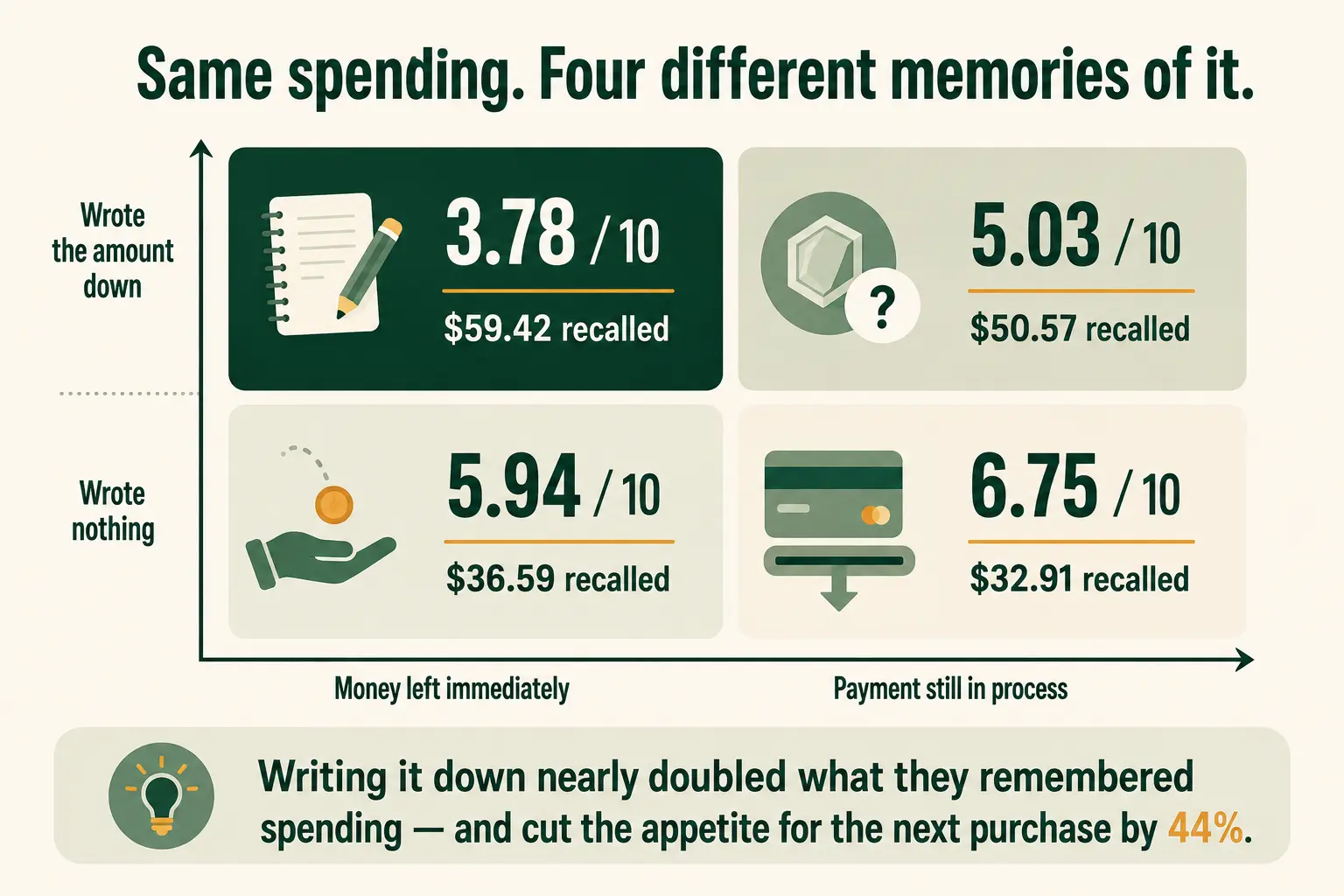
The second experiment separated the two ingredients. Soman crossed rehearsal — whether the payment made you write the amount — with immediacy — whether the money actually left your account there and then. Across 119 students the pattern was clean, and the size of it is the part worth carrying around:
| Condition | Appetite for the next purchase (1–10) | How much they thought they had spent |
|---|---|---|
| Wrote it down, money left immediately | 3.78 | $59.42 |
| Wrote it down, payment still in process | 5.03 | $50.57 |
| Nothing written, money left immediately | 5.94 | $36.59 |
| Nothing written, payment still in process | 6.75 | $32.91 |
Every row spent the same money. The group that wrote it down and watched it go recalled having spent nearly twice as much as the group that did neither, and wanted the next purchase about 44% less. Not because they were more disciplined. Because they could see what they had done.
One more result from that first experiment is the most practical thing in the paper. Soman showed some participants a running total of their spending as they went. It reduced the card-payers’ appetite noticeably, from 5.95 to 4.58. It did nothing at all for the cheque-writers — 3.85 against 3.75. A dashboard helps the people who are not recording anything themselves. Recording it yourself is stronger than being shown it, and the two do not stack.
Six rules for a cashless childhood
None of these require a card, an app or a platform to cooperate. They require about four minutes a week.
- Price everything in dollars, out loud, before the click. Not as a maths drill — as a habit of translation. “That’s 1,200 Robux, so about fifteen dollars, which is most of this month.” Salience of the exchange rate is the variable that changes how expensive a virtual item feels, and it is the exact thing the FTC complaint accuses the platform of hiding.
- Make them write down what they spent, in their own words. This is the rehearsal effect, and it is the single best-supported intervention here. A note on a phone works. A shared list works. What does not work is you keeping the record for them.
- Fixed balance, no top-up. A gift card or a set monthly amount is the digital version of a jar: when it is empty, it is empty until next month. Immediacy of depletion was worth more than a full point of purchase intention in Soman’s data, and a stored card balance is the only easy way to get it back.
- It has to be their money. Twelve of the 22 children in the Sydney study spent their own AU$20 in Roblox — and that is the point, not the problem. Money you spend on their behalf teaches nothing, because there is no depletion for them to feel. Ours is a separate argument for why they don’t need a debit card to learn any of this.
- Never say “it isn’t real money”. It is real money, it left a real account, and a child who has been told otherwise has been handed a licence rather than a lesson. Say what it cost instead.
- Review on a schedule, not after a shock. Almost a quarter of parents rarely or never check their child’s card activity, which is how a $170 surprise happens. A fixed weekly review turns the same conversation from an accusation into a routine.
| What the digital version removed | How to put it back | Evidence |
|---|---|---|
| The price, in a unit that means something | Convert to dollars aloud before every purchase | Perceived cost depends on whether the exchange rate is salient (Huang, Lim & Lin, 2020) |
| The record of what was spent | The child writes down each purchase themselves | Writing the amount cut purchase intention from 5.26 to 3.80 (Soman, 2001) |
| The moment the money leaves | Fixed balance or gift card, no auto top-up | Immediate depletion beat delayed depletion on every measure (Soman, 2001) |
| The sting of parting with it | Make it their own money, not a purchase you make for them | Pain of paying as a self-control mechanism (Prelec & Loewenstein, 1998) |
| Any sense of how much is left | A visible running total — for whoever isn’t logging | A running total helped card-payers (5.95 → 4.58) but not cheque-writers (Soman, 2001) |
Buy Now, Pay Later is the next one, and it’s already here
The same Acorns survey found 60% of children aged 6 to 17 are already familiar with Buy Now, Pay Later, and 30% of them believe financing groceries that way is a sound financial decision. That is not an abstract worry about the future: instalment payments do to the timing of money what virtual currency does to the units, and they are the second of Soman’s two ingredients, sold as a feature.
It lands on adults too. Gen Z leads BNPL adoption at 59%, and in PYMNTS’ 2026 data 56% of Gen Z said they struggle to track when instalment payments are due. If your child can already explain what a stored balance is and what it means for the money to be gone, the four-payment split will not read as free.
School is coming, and it’s coming late
There is genuine good news on the schools front. Thirty US states have now approved a standalone personal finance course as a graduation requirement, and once all of them have rolled out, 76% of American public high school students — the class of 2031 — will take one. That is roughly two million more students a year than in 2026.
It still arrives about a decade after the fact. The National Financial Educators Council’s 2026 test put the average score for 15-to-18-year-olds at 64%, and University of Cambridge research for the UK Money Advice Service found that core money habits are largely formed by age seven. Our age-by-age guide to teaching kids about money covers what fits at which age. No state curriculum is going to explain Robux to a nine-year-old. That is a household job, and it has a deadline.
It is also worth deciding where the money itself comes from before you worry about how it is spent. We have separate guides to how much allowance to give at each age, which chores should be paid at all, and why paying for grades doesn’t work. Once there is money, a single named savings goal is the change that most reliably increases how much of it survives — the mechanics are in our guide to teaching kids to save.
How this works in CapKin
The limits first, because they matter here more than usual. CapKin cannot see your child’s Roblox account, cannot block an in-game purchase, and is not a parental control. It has no debit card, no bank connection and no way to move money. If you are looking for something that stops the spending at the point of sale, this is not it.
What it does is the rehearsal step, deliberately and by hand. A child gets their own ledger inside the family budget: pocket money arrives on schedule, and when they spend, they log it themselves — by speaking or typing a sentence like “Robux twelve dollars”. It goes in as their own words, converted to dollars, which is rules one and two in the same action. There is no card and nothing is imported from anywhere, so the only way an expense exists is that the child wrote it down.
Every entry a child makes sits as pending and counts toward nothing until the household owner approves it. That review is the weekly conversation on rule six, with a specific line item to talk about rather than a vague sense that too much is going somewhere. Children can set their own cap and save toward goals a parent can lock, and the CapKin for kids page walks through what each age group gets — read-aloud story chapters for 6–8s, a daily money discovery and a weekly quiz for 8–12s. Older teenagers move up to running a real monthly budget of their own.
There are no ads, no data sold, and no emails or push notifications sent to children — voice input for a child is off until a parent turns it on. The details are on the children’s privacy page. CapKin is in beta and free while it is.
Sources
- Acorns Early. Money Matters Report for Kids 2026, published 11 August 2026. Survey by Opinium Research of 2,000 US parents and 2,000 children aged 6–17, conducted 6–14 July 2026.
- Soman, D. (2001). Effects of Payment Mechanism on Spending Behavior: The Role of Rehearsal and Immediacy of Payments. Journal of Consumer Research, 27(4), 460–474. Experiment 1: 160 students. Experiment 2: 119 students, rehearsal × immediacy within-subject design.
- Prelec, D. & Loewenstein, G. (1998). The Red and the Black: Mental Accounting of Savings and Debt. Marketing Science, 17(1), 4–28.
- Toccafondi, N., Di Paolo, R. & Di Guida, S. (2025). Virtual currencies in online gaming increase the willingness to pay for loot boxes: an experimental analysis. Experimental Economics, 28(6), 1262–1280. Randomised trial, 753 UK participants.
- Huang, Y., Lim, K. H. & Lin, Z. (2020). Leveraging the Numerosity Effect to Influence Perceived Expensiveness of Virtual Items. Information Systems Research, 32(1), 93–114.
- Broekhoff, M.-C. & van der Cruijsen, C. (2024). Paying in a blink of an eye: it hurts less, but you spend more. Journal of Economic Behavior and Organization, 221, 110–133.
- Hardwick, T., Carter, M., Harkin, S., Zhangshao, T. & Egliston, B. (2025). “They’re Scamming Me”: How Children Experience and Conceptualize Harm in Game Monetization. Proceedings of CHI 2025. Interviews with 22 children aged 7–14, each given AU$20 to spend.
- Carter, M. & Vekhande, S. (2026). Misleading and Deceptive Monetisation in Roblox. University of Sydney, 17 May 2026. Analysis of 15 popular Roblox experiences.
- Fairplay and the National Center on Sexual Exploitation. Complaint to the US Federal Trade Commission regarding Roblox, filed May 2026.
- Federal Reserve Financial Services. 2026 Diary of Consumer Payment Choice, published May 2026 (data collected October 2025).
- Talker Research for Achieve. Survey of 2,000 US parents of children aged 18 and under, 14–23 April 2025.
- Next Gen Personal Finance. State-by-state personal finance graduation requirements, 2026.
- National Financial Educators Council. National Financial Literacy Test, 2026 results for ages 15–18.
- Whitebread, D. & Bingham, S. (2013). Habit Formation and Learning in Young Children. University of Cambridge / Money Advice Service.
- PYMNTS Intelligence (2026). Gen Z instalment payment tracking and BNPL adoption.
Frequently asked questions
- How do you teach kids about money in a cashless world?
- By restoring the two things digital payment removes: a price in a unit that means something, and a record of what was spent. Convert every virtual-currency price into dollars out loud before the purchase, and have the child write down what they spent themselves. In Dilip Soman's 2001 experiments, participants who wrote the amount rated their appetite for the next purchase at 3.80 out of 10 against 5.26 for those who paid by card, on identical spending — and they recalled having spent nearly twice as much.
- Why don't kids understand digital money?
- Because the money they meet first was designed not to behave like money. Acorns Early's 2026 survey of 2,000 US children found 80% familiar with in-game virtual currency and only 42% able to say what a stock is — 21% among six-to-nine-year-olds. Virtual currency reports value in a unit that means nothing outside the app, and a complaint filed with the FTC in May 2026 alleges that Roblox specifically obfuscates the exchange rate between dollars and Robux.
- How much do kids spend on virtual currency and digital goods?
- Children who buy digital goods spend an average of $23.60 a month, or nearly $284 a year, on products that exist only online, according to the Acorns Early Money Matters Report for Kids published in August 2026. Across all children surveyed, including those who spend nothing, the average is $18.52 a month. Separately, a Talker Research survey for Achieve found nearly one in three parents had discovered an unapproved online purchase by their child, averaging around $170.
- Should I just give my child cash instead?
- Most parents already do — 73% of those who pay an allowance pay it in cash — and it is not solving the problem, because the money goes in as cash and comes out as a digital purchase. Cash is a good teacher not because it is physical but because it hurts to part with, and the fix is to reproduce that signal rather than the paper: their own money, a fixed balance that does not top up, and a written record of every purchase they make.
- How do I explain Robux to my child?
- As an exchange rate, not as play money, and out loud at the moment it matters: 'that item is 1,200 Robux, which is about fifteen dollars.' Research by Huang, Lim and Lin across six game experiments found that how expensive a virtual item feels depends on whether the exchange rate is visible at the point of purchase — when it is hidden, the number on the price tag drives the feeling instead of the dollars.
- Is in-game spending bad for kids?
- The spending itself is less of a problem than the design around it. A University of Sydney analysis of 15 popular Roblox experiences in May 2026 found designs likely to mislead children in 14 of them — about real value, reward odds, whether an upgrade is necessary, and what happens if you don't spend. In a 2025 CHI study, children aged 7 to 14 described the mechanics in their own words as 'scams' and, in one case, 'literally just child gambling'.
- Does making kids track their spending actually work?
- It is the best-supported intervention available to a household. Soman's 2001 experiments crossed whether a payment made you write the amount down with whether the money left immediately. Those who did both rated their appetite for the next purchase at 3.78 out of 10, against 6.75 for those who did neither — about 44% lower on identical spending — and recalled having spent $59.42 against $32.91.
- Is a running balance enough, or does the child have to log it?
- The child logging it is stronger, and the two do not add up. In Soman's first experiment, showing participants a running total of their spending cut purchase intention among card-payers from 5.95 to 4.58, but made no difference at all to people who had been writing cheques — 3.85 against 3.75. A dashboard helps whoever is not recording anything. It does not replace the recording.
- At what age should I start talking about digital money?
- As soon as they are spending it, which is usually earlier than the conversation starts. Acorns found 80% of six-to-seventeen-year-olds already familiar with virtual currency, and University of Cambridge research for the Money Advice Service found core money habits largely formed by age seven. School is arriving, but late: 30 US states have approved a standalone personal finance course, and it is taught in high school.
- Do my kids need to know about Buy Now, Pay Later?
- They already do. Sixty per cent of children aged 6 to 17 told Acorns they were familiar with BNPL, and 30% said financing groceries that way was a sound decision. It is the same mechanism as virtual currency applied to timing rather than units — it removes the moment the money leaves. A child who has run a fixed balance that does not top up has already met the idea that spending has a moment, which is the part BNPL is selling away.
- Does a kids' debit card fix the digital money problem?
- It fixes visibility for the parent, not comprehension for the child, and card apps run from about $6 to $20 a month for it. A card also makes spending faster and more frictionless, which is the direction that reduces the pain of paying rather than restoring it. What changes behaviour is the child recording the purchase themselves and running out of a fixed balance — neither of which requires a card.