12 August 2026 · 12 min read · Updated 5 September 2026
Should You Pay Kids for Good Grades?
American families pay more for an A than for a mowed lawn. The largest experiments ever run on the idea found it moves nothing — and showed clearly what does.
The short version
- The largest experiments ever run on the idea — Roland Fryer's randomised trials, 38,000 students across four US cities, $6.3 million paid out — moved state test scores by a statistically indistinguishable amount.
- Families pay anyway: report-card money averaged $12 in a September 2025 survey of 2,000 US parents, and an AICPA survey found 48% paying an average of $16.60 per A.
- Incentives raised how much students wanted the reward but not what they achieved, because a child cannot see how to convert enthusiasm into a better grade.
- What the research supports is paying for inputs a child controls — reading, revision, work around the house — and keeping the report card out of payroll.
Report-card money is one of the most expensive line items in American parenting. When Talker Research asked 2,000 US parents what they pay their children for in September 2025, good grades came second on the list at an average of $12 — ahead of yard work, ahead of cleaning the house, beaten only by babysitting a sibling. When the American Institute of CPAs put the question to parents more directly, 48% said they paid for grades, at an average of $16.60 per A. Five A’s a term, four terms a year, and a household is spending $332 on a policy it has never tested.
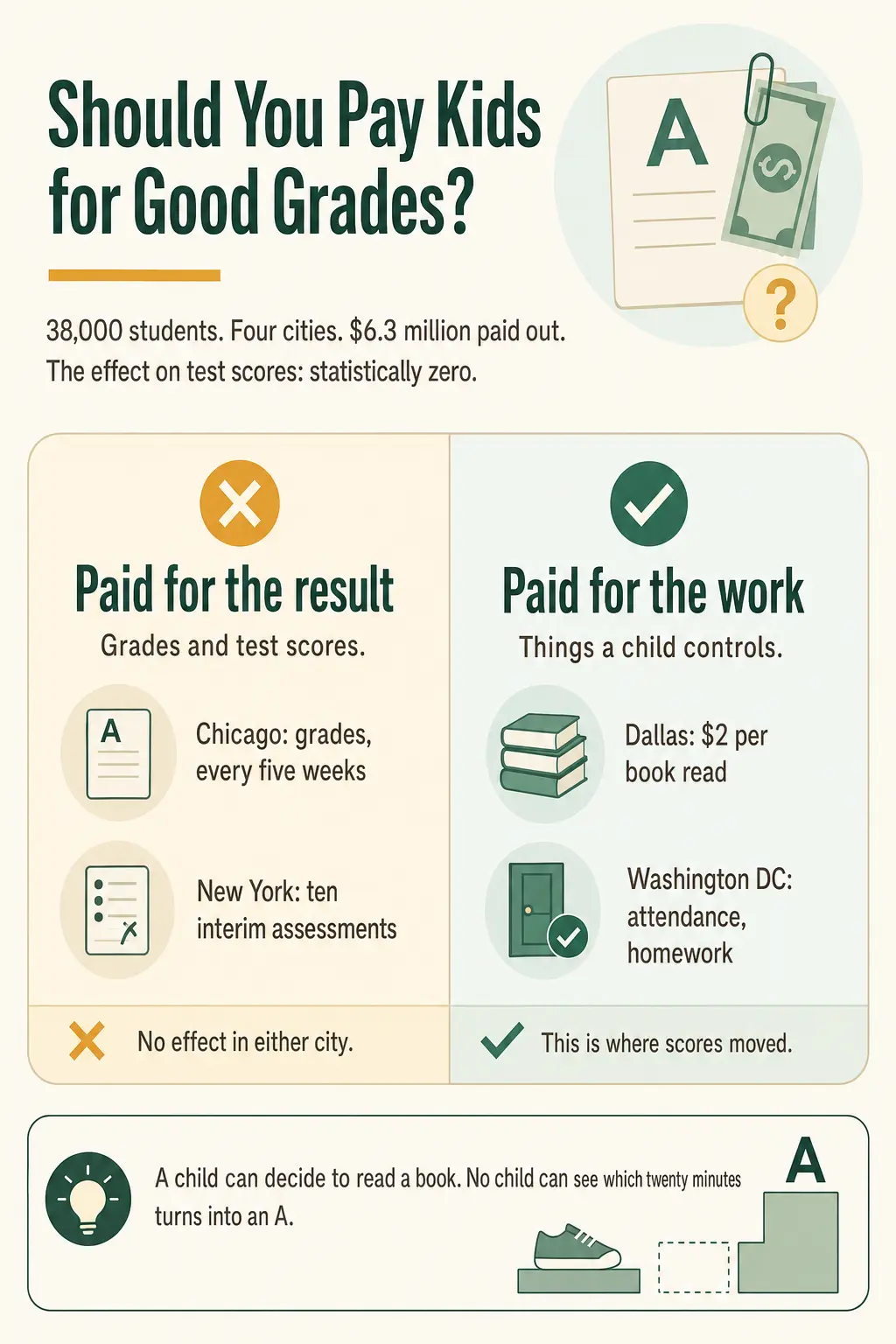
It has been tested, though — at a scale no household could manage. Between 2007 and 2009 the economist Roland Fryer ran a set of randomised experiments across more than 250 urban schools in four cities, enrolling 38,000 students and paying out $6.3 million. The headline result: the effect on state test scores was statistically zero.
That is not the end of it, and what comes next is the part worth acting on. Fryer’s conclusion was not that money has no effect on children. It was narrower and much more useful: rewards tied to outputs did nothing, and rewards tied to inputs did something.
What the experiments actually paid for
Fryer’s four cities were not running the same programme, and that accident of design is what makes the study useful to a parent: it separates paying for a result from paying for the work that might produce one. The last two rows below are separate studies, included because they bracket the same question from either side.
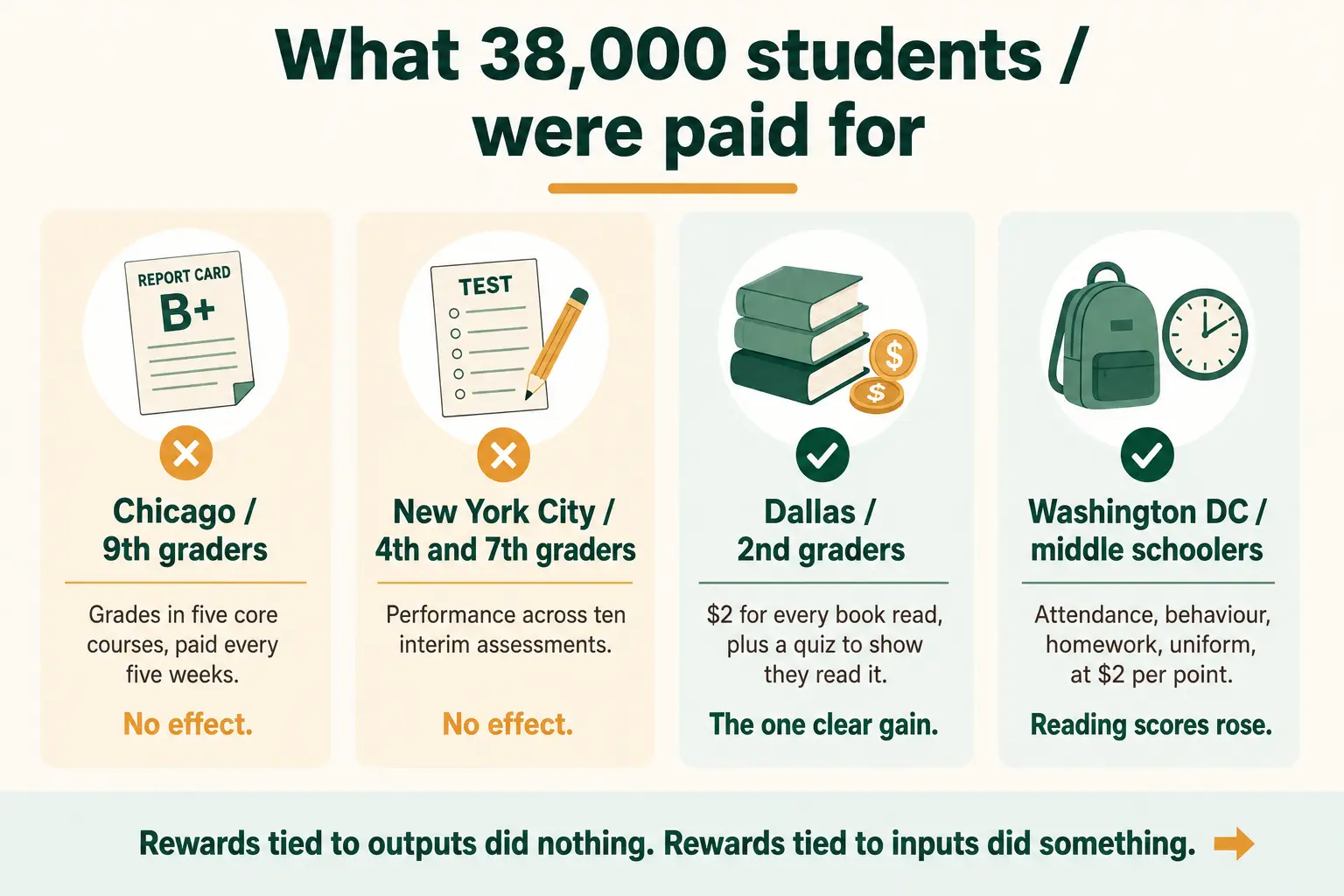
| Where | Who | What was paid for | What happened |
|---|---|---|---|
| New York City | 4th and 7th graders | Performance on ten interim assessments | No effect on state test scores |
| Chicago | 9th graders | Grades in five core courses, paid every five weeks | No effect on state test scores |
| Dallas | 2nd graders | $2 per book read, plus a quiz to show they read it | The one clear gain — among English-speaking students |
| Washington DC | ~3,000 middle schoolers | Attendance, behaviour, homework, uniform — $2 per point, paid fortnightly | Modest gains, concentrated in reading; small sample |
| Coshocton, Ohio (Bettinger) | Grades 3–6 | $15 per test scored proficient, up to $100, paid in vouchers | Maths up 0.15 SD; nothing in reading, science or social studies |
| Chicago area (Levitt et al.) | ~7,000 students, 30+ schools | Diagnostic test performance, cash and non-cash | Worked when paid immediately; nothing at all when delayed |
Read the two rows in the middle again. Dallas paid second-graders to read books — a thing a seven-year-old can simply decide to do — and it is the one place in Fryer’s trials where achievement moved. Washington DC paid for showing up, behaving, handing in homework and wearing the uniform, and reading scores rose, though Fryer is careful to note that 3,000 students is too small a sample to carry a strong conclusion. Chicago paid for grades. New York paid for test results. Both got nothing.
The honest counterweight is the Ohio study. Eric Bettinger looked at a district that paid children $15 for every test they passed at proficient — an output — and found maths scores up by about 0.15 of a standard deviation, which is not nothing. Reading, science and social studies did not budge. So output pay is not universally useless. It is just unreliable, subject-specific and much weaker than the marketing in your own head suggests.
Why paying for an A doesn’t work
The intuitive explanation — children are lazy and $16.60 isn’t enough — is wrong, and the experiments say so. Motivation went up. Students in the incentive groups wanted the money and said so. What did not happen was the conversion of that wanting into a better grade.
Fryer’s own account of it is the single most useful sentence in this literature: students do not know the educational production function — they have little idea how to turn enthusiasm about a reward into achievement. Ask an eleven-year-old to produce a B+ in maths and you have set them a goal with no visible first step. They cannot see which twenty minutes, which exercise, which re-read is the one that moves the grade. So the money sits there motivating nothing in particular.
A grade is also a noisy output. It depends on the teacher, the cohort, the marking scheme, which questions came up and whether the child was ill in the week the unit was taught. Paying for it asks a child to bet effort against a result they only partly control — and children work out the odds on that faster than adults expect.
“Read this book and answer three questions about it” has none of those problems. The child knows exactly what to do, can tell when it is done, and cannot be denied the payment by circumstances outside their control. That is the whole difference between the Dallas result and the Chicago one.
The cost that doesn’t show up on the receipt
There is also a price to paying for something a child was going to do anyway. Deci, Koestner and Ryan pooled 128 experiments on exactly this in Psychological Bulletin and found that rewards contingent on doing a task reduced people’s willingness to keep doing it once the reward stopped, with an effect size of −0.40. The undermining was stronger in children than in college students.
Reading is where this has been tested most directly, and the finding is unusually practical. Barbara Marinak and Linda Gambrell rewarded third-graders for reading in different ways and then watched what they chose to do next. Children given a book as the reward, and children given nothing at all, went back to reading more readily than children given a token. The closer the reward sits to the activity, the less damage it does. A prize unrelated to reading teaches that reading is the toll you pay to get the prize.
So the risk in report-card money is not that it fails. It is that it fails while quietly reframing school as paid work — and a child who has learned that school is paid work has a very reasonable question waiting for you the first term you stop paying.
What to pay for instead
The evidence points at four rules, and they are narrow enough to act on this week.
- Pay for inputs, never outputs. Something the child starts and finishes by their own decision: pages read, minutes practised, homework opened before dinner. The result is yours to celebrate, not to purchase.
- Pay immediately. Levitt and colleagues found that the whole effect of an incentive disappeared when the reward arrived later. A payment at the end of term is, behaviourally, not a payment.
- Keep the reward close to the activity. A book for reading beat a token for reading. For younger children, non-cash rewards were also more cost-effective than cash in the Chicago-area trials.
- Don’t pay for what already happens. If your child reads for pleasure, putting a price on it is the one intervention with a documented downside. Pay for the thing that isn’t happening.
| Instead of paying for | Pay for | Why |
|---|---|---|
| An A on the report card | Twenty minutes of reading, logged by them | The child controls it completely — and it is the one thing that moved achievement in Dallas |
| A good term overall | Homework started before dinner, four nights in five | An input, paid weekly, aimed at the actual bottleneck |
| Test results | Nothing — mark them another way | Output pay produced no effect across 38,000 students |
| Reading, in cash | Reading, with a book they choose | A reward tied to the activity undermines motivation far less than a token |
| Being top of the class | Attendance and turning up prepared | The Washington DC arm paid for exactly this, and reading scores rose |
Where grades belong instead: nowhere near payroll
Our chore chart guide argues for splitting household jobs into two lists — the ones that follow from living in a house, which are never paid, and the optional ones you would otherwise pay an outsider to do, which are priced properly. School belongs on the first list, and firmly. It is the child’s own work, the benefit of doing it accrues to them, and it is not a service rendered to the household.
That leaves the report card free to be what it should be: an occasion. Say what you noticed, be specific about the effort rather than the letter, and mark it in a way that has nothing to do with money — the meal they choose, the trip, the phone call to a grandparent. None of that carries the risk the cash does, and a child remembers it longer.
If you are already paying and want to stop, do not announce it as a withdrawal — a payment taken away lands as a punishment for a term that has not even happened yet. Change what the money is for instead. “From September, the money is for reading, not for grades” is a swap rather than a cut, and it moves you from the arrangement with no evidence behind it to the one with some.
What about money from grandparents?
Report-card money from outside the household is not yours to abolish, and it is not really an incentive scheme — it is a gift with an occasion attached, and it arrives too rarely and too late to shape anything. Treat it as a windfall rather than as wages.
The useful move is what happens next. A $20 bill for a good term is a far better teaching moment than the grade was: it is unearned, unexpected money, which is exactly the kind adults handle worst. Send it somewhere with a name on it — our guide to teaching kids to save covers why a single named goal roughly triples what actually gets saved.
How this works in CapKin
Straight about the limits first: CapKin has no chore list, no task tracker and nothing to do with school. There is no way to attach money to a grade in it, and that is deliberate rather than unfinished.
What it does is keep the books on the money a child already has. They get their own ledger inside the family budget: pocket money arrives on schedule, they log what they spend, they set their own cap, and they save toward goals a parent can lock. Every entry a child makes waits as pending until the household owner approves it, so the review becomes the weekly money conversation. There is no card, no bank connection, no ads, and no push notifications or emails to children.
The reward design follows the same logic as the research above. Badges go to money behaviour and nothing else — First earning, Goal reached, Saving streak, Under budget for spending less than you got. Never for grades, never for streaks of opening the app, never for time on screen. Alongside the tracking, children aged 6–8 read Beaver Trails, a hand-written illustrated story course with read-aloud narration — two of six planned chapters are published — and ages 8–12 get one money discovery a day plus a weekly three-question quiz. The CapKin for kids page walks through it age by age, and older teenagers move up to running a real monthly budget of their own.
Sources
- Fryer, R. G. (2011). Financial Incentives and Student Achievement: Evidence from Randomized Trials. Quarterly Journal of Economics, 126(4), 1755–1798. 38,000 students in 250+ urban schools across New York City, Chicago, Dallas and Washington DC; $6.3 million in incentives paid during the 2007–08 and 2008–09 school years.
- Bettinger, E. P. (2012). Paying to Learn: The Effect of Financial Incentives on Elementary School Test Scores. Review of Economics and Statistics, 94(3), 686–698. Coshocton, Ohio, grades 3–6.
- Levitt, S. D., List, J. A., Neckermann, S., & Sadoff, S. (2016). The Behavioralist Goes to School: Leveraging Behavioral Economics to Improve Educational Performance. American Economic Journal: Economic Policy, 8(4). Almost 7,000 students in more than 30 schools in and around Chicago.
- Deci, E. L., Koestner, R., & Ryan, R. M. (1999). A Meta-Analytic Review of Experiments Examining the Effects of Extrinsic Rewards on Intrinsic Motivation. Psychological Bulletin, 125(6), 627–668.
- Marinak, B. A., & Gambrell, L. B. (2008). Intrinsic Motivation and Rewards: What Sustains Young Children’s Engagement with Text? Literacy Research and Instruction, 47(1), 9–26.
- Talker Research for Acorns Early. Survey of 2,000 US parents of school-aged children, 22–29 September 2025.
- American Institute of CPAs, survey conducted by Harris Interactive (2012). 48% of parents pay for good grades, averaging $16.60 per A.
Frequently asked questions
- Should you pay kids for good grades?
- The evidence says no, or at least not the way most families do it. Roland Fryer's randomised trials paid 38,000 students across four US cities $6.3 million, and the effect on state test scores was statistically zero — including in Chicago, where ninth graders were paid every five weeks for grades in five core subjects. The version that worked paid for inputs instead: Dallas second graders earned $2 per book read, and that is the one arm where achievement clearly moved.
- How much do parents pay for good grades?
- More than they realise. A Talker Research survey of 2,000 US parents in September 2025 put report-card money at an average of $12 — the second-highest item parents pay for, above yard work and housecleaning. An American Institute of CPAs survey found 48% of parents paying for grades at an average of $16.60 per A, which for a child bringing home five A's a term across four terms comes to well over $300 a year.
- Does paying for grades actually improve grades?
- Mostly not. Across Fryer's trials, incentives raised how much students wanted the reward but not what they achieved, because — in his own explanation — students do not know the educational production function and cannot see how to convert enthusiasm into a better grade. One study is an exception: Eric Bettinger found maths scores up about 0.15 of a standard deviation in an Ohio district that paid $15 per test passed, with no effect on reading, science or social studies.
- What should I pay my child for instead of grades?
- Inputs they fully control and can finish by their own decision: pages or books read, minutes of practice, homework opened before dinner, attendance. Pay quickly — Levitt and colleagues found the entire effect of an incentive vanished when the reward was delayed. And keep the reward close to the activity: in Marinak and Gambrell's study, third graders rewarded with a book went back to reading more readily than those rewarded with a token.
- Is it bad to reward good grades at all?
- Rewarding them is fine; paying for them is the problem. Mark a good report card with something that is not money — a meal they choose, an outing, saying specifically what you noticed about the work rather than the letter. That keeps the recognition without turning school into paid employment, which is the arrangement that leaves you exposed the first term you decide to stop paying.
- Should I pay my child to read?
- It is the best-supported thing on this list, with one caveat. Paying per book read plus a short comprehension check is exactly what Dallas did, and it produced the clearest gain in Fryer's experiments. The caveat is Deci, Koestner and Ryan's meta-analysis of 128 experiments: paying for something a child already does willingly reduces their willingness to keep doing it, and the effect is stronger in children than in adults. If your child already reads for pleasure, leave it alone.
- My child is already paid for grades. How do I stop?
- Swap it rather than cut it. Announcing that report-card money is ending reads as a punishment for a term that has not happened yet, and it invites a negotiation you cannot win. Say instead that from the new term the money is attached to something else — reading, practice, homework handed in on time — so the amount your child can earn stays roughly the same while what it rewards changes to the thing the evidence supports.
- Does paying for effort work better than paying for results?
- Yes, provided effort is defined as something observable. 'Try harder' is not payable, because neither of you can tell when it has happened. 'Twenty minutes, four evenings a week, ticked off by you' is. That is effectively what the Washington DC arm of Fryer's study paid for — attendance, behaviour, homework and uniform, on a $2-per-point system — and reading scores there rose, on a sample Fryer himself flags as too small for strong conclusions.
- Does paying for grades work for teenagers?
- The clearest null result in the whole literature is a teenage one: Chicago ninth graders paid every five weeks for grades in five core courses showed no effect on state test scores. Older students also respond less well to non-financial rewards than younger ones, according to the Chicago-area trials, so the cheap substitutes work less well too. For teenagers the better lever is handing over a real budget with real consequences rather than paying for school outcomes.
- What about money grandparents give for a report card?
- That is a gift with an occasion attached, not an incentive scheme, and it arrives too rarely to shape behaviour either way. It is also not yours to abolish. The useful part is what happens after: unearned, unexpected money is the kind adults handle worst, so treat it as a chance to practise. Put it toward one named savings goal, which is the single change that most reliably increases how much a child actually saves.