5 August 2026 · 10 min read · Updated 5 September 2026
Do Kids Need a Debit Card to Learn About Money?
Card apps for children charge somewhere between $72 and $240 a year, and most of them will happily sign up a six-year-old. But before you pick one, it is worth asking a question the marketing often skips: what is the card actually teaching?
The short version
- No. A debit card solves a logistics problem — reaching a child remotely and letting them buy things alone — not a teaching one.
- Card apps cost $72–$240 a year: Greenlight runs $5.99–$19.98 a month and Acorns Early $8. That is fair value for a working teenager and poor value for a nine-year-old whose money is pocket money.
- Most families reach the logistics problem between twelve and fifteen; below about twelve a card usually changes the parent's convenience rather than the child's understanding.
- What builds understanding is money that is clearly theirs, a decision made before spending, a record the child keeps themselves, and a conversation afterwards — none of which requires a card.
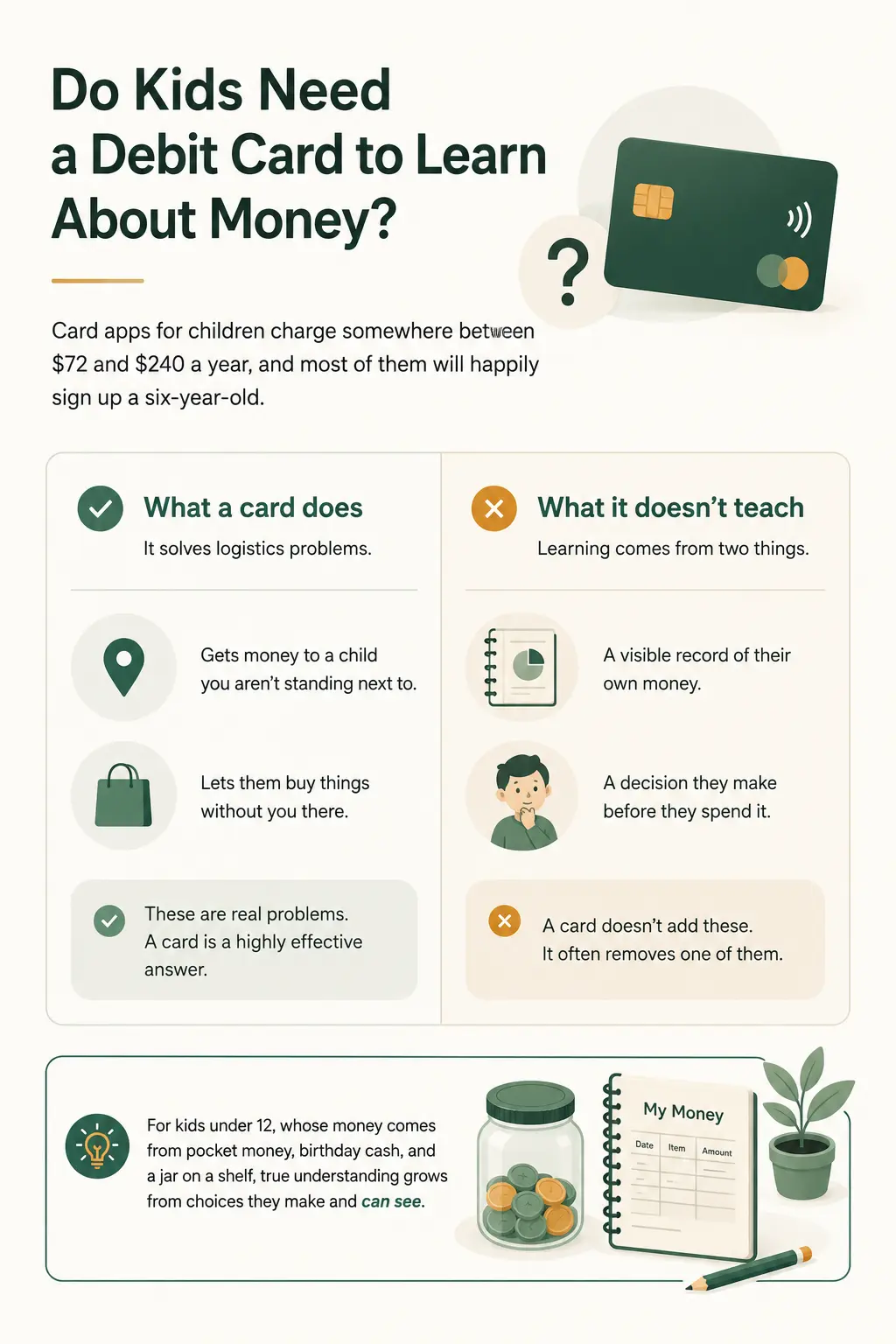
The short answer? Not much about learning. A debit card solves a logistics problem: it gets money to a child you aren’t standing next to, and it lets them buy things without you there. Those are real problems, and a card is a highly effective answer to them.
But neither of those is a teaching problem. For a child under the age of twelve, whose entire financial life consists of pocket money, birthday cash, and a jar on a shelf, the thing that builds true understanding is a visible record of their own money and a decision they make before they spend it. A card doesn’t add either of those elements. In fact, it often removes one of them.
Here is the full case — including the situations where getting a card is absolutely the right call.
What the research actually says about cards and spending
Let’s start with the uncomfortable bit that card apps rarely advertise: the way you pay changes how much you spend.
In a well-known study published in Marketing Letters, MIT researchers Drazen Prelec and Duncan Simester ran real auctions for real tickets. They found that willingness to pay rose by up to 100% when bidders were told to pay by credit card rather than cash. The researchers specifically concluded that a lack of available cash didn’t explain this spike. Paying by card simply hurt less.
Priya Raghubir and Joydeep Srivastava found the exact same pattern in the Journal of Experimental Psychology: Applied. Across several experiments, they discovered that the more transparent the form of payment, the more frugal the spender. People handed $50 in cash spent less than people handed a $50 gift certificate.
To be completely honest, these are adult studies; nobody has run this exact experiment on eight-year-olds. And spending more isn’t automatically a bad thing — sometimes it is just convenient.
But look at what this mechanism means for a child. The friction of paying — that specific moment where money visibly leaves their hands and the purchase feels like it truly cost something — is not a flaw that a card fixes. For an adult, removing that friction is a feature. For a child who is just learning what things cost, that friction is the entire lesson. Card apps then have to sell lessons back to you, often as digital modules inside the app, to make up for the natural learning moment the card took away.
The takeaway is simple: a card teaches tapping. A ledger teaches deciding.
Three jobs a debit card genuinely does
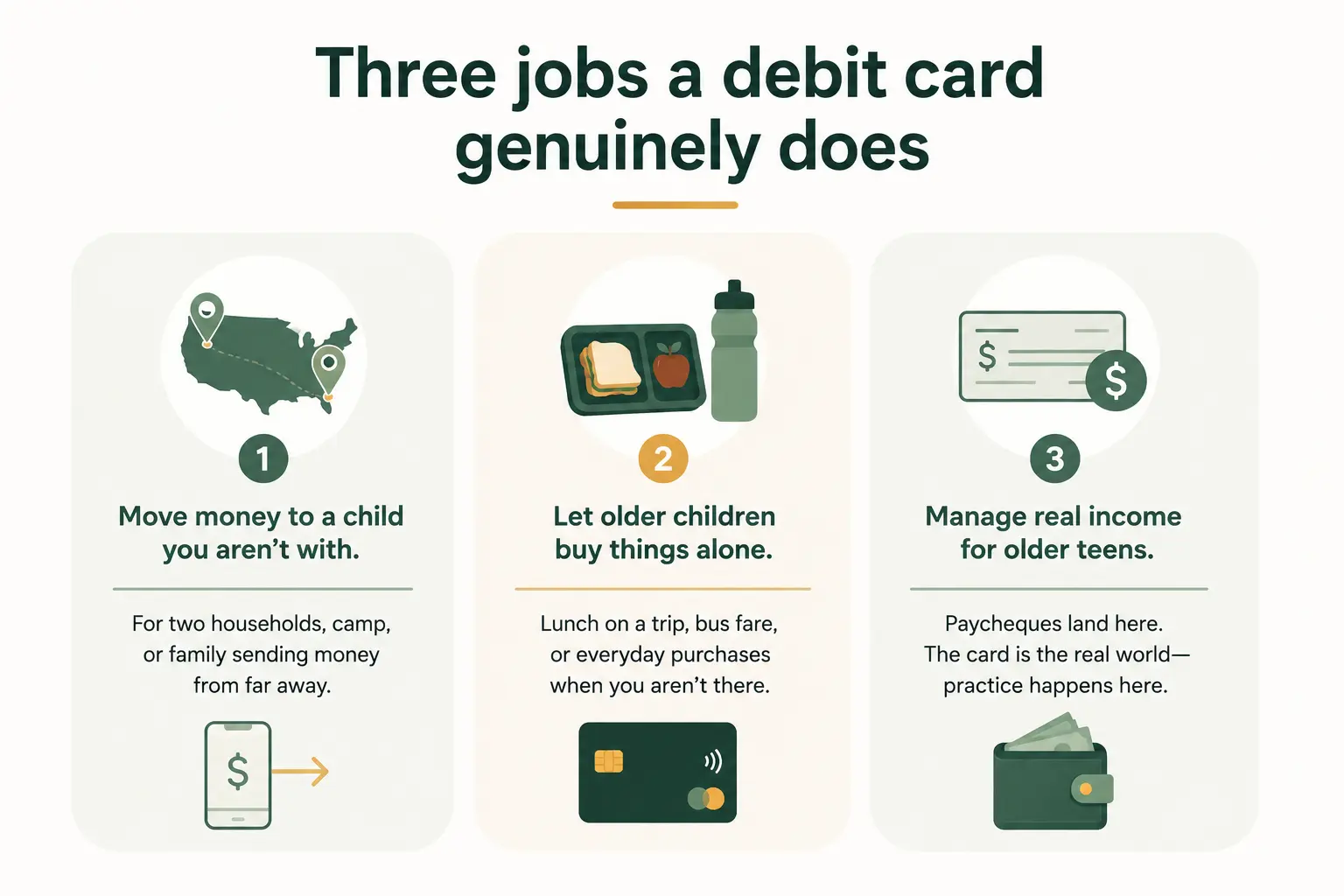
This is not an argument that cards are bad. Debit cards actually do three things incredibly well, and if your family needs them, you should absolutely get one — no app can replace it, including ours.
First, they move money to a child you aren’t physically with. If you navigate two households, have a kid away at camp, or have grandparents who want to send birthday money from another state, cash can’t easily cross that distance. A card can. Second, they let older children buy things alone. A twelve-year-old buying lunch on a school trip or a teenager paying for a bus fare needs a way to pay when you aren’t there. Finally, cards manage real income for older teens. A sixteen-year-old with a part-time job needs somewhere for a paycheque to land and a card to spend from. At that point, the card is the real world, and practicing in it is the entire point.
Notice what all three scenarios have in common: they are about a child transacting independently. None of them are about a child understanding money better. Those are two very different needs.
What a card doesn’t do
While convenient, debit cards have distinct blind spots. First, they cannot see cash. Most young children’s money is physical — the birthday twenty, coins from grandpa, the jar on the shelf. A card app is blind to all of it, which means the record it keeps is only a partial one. For a seven-year-old, it might only capture the smaller half of their financial picture.
More importantly, a card cannot put a decision before the purchase. With a card, the money is gone before any parent sees the entry. You receive a notification about a decision that has already been made. Reviewing something after it happened is a report; being asked beforehand is a lesson.
Lastly, it doesn’t hand the child the record. Somebody logs every purchase, but with a card, that somebody is the bank. The child just receives a statement. When a child keeps the record themselves, the physical act of logging “ice cream, 2” is the exact moment they notice their money going down. That noticing is the habit you are trying to build.
At what age should a kid get a debit card?
The card companies’ own answer is: whenever you like. Greenlight states plainly that its app is “for kids and grownups of all ages,” while Acorns Early (formerly GoHenry) starts at age six.
A much more useful answer is: when your child regularly needs to buy something while you are not there. For most families, that arrives somewhere in the twelve-to-fifteen range alongside first solo trips into town, school trips, or a part-time job. Before that point, the card mostly changes the parent’s convenience, rather than the child’s understanding.
This matters because the years before that transition are the ones that truly count. Habits around money form far earlier than most parents expect, and they form around whatever the child can actually see happening.
Signals to read
| Your child probably needs a card | Your child probably needs a ledger |
|---|---|
| Buys things regularly without you there | Nearly all spending happens with a parent present |
| Money has to reach them remotely (two homes, camp, distant relatives) | Money changes hands at home, in cash |
| Has real income from a job | Income is pocket money, gifts and odd jobs |
| Is 13+ and heading toward a bank account | Is under about 12 |
| Needs to pay online for themselves | You want to see the decision before it happens |
If you are reading both columns and recognising your family in each, that is completely normal. Plenty of households run a card for the practical side and a ledger for the teaching side. They are not in competition.
How to teach kids about money without a debit card
Strip away the financial products, and there are four core pillars that actually do the teaching. None of them require a debit card. First, they need money that is unmistakably theirs — not a vague share of the family’s money, but a set amount that arrives predictably and runs out. Pocket money is the classic vehicle for this. Second, you need a decision that happens before the spending. A cap they set themselves or a savings goal they picked forces them to ask, “Do I spend it now, or put it toward my goal?” A child who answers that question fifty times has learned something no digital course can deliver.
Third, they need a record they keep themselves. Having them log what they spent — whether spoken or typed — creates the moment where the “noticing” happens. This is precisely the step a card automates away. Finally, you need a conversation afterwards. This doesn’t mean a lecture; a simple, “I said no to this one because it’s the third snack this week” teaches volumes because it is specific and comes directly from you.
Cash, a notebook, and consistency will accomplish all four of these things perfectly. The reason apps exist is simply that the notebook usually goes missing by week three, and the balance ends up stuck in a parent’s head.
What the card costs, briefly
Card apps like Greenlight generally run from $5.99 to $19.98 a month, while Acorns Early sits around $8. That equates to roughly $72 to $240 a year for the family. Set that against what a young child’s allowance actually is: at $5 a week, you would be paying a quarter to a third of your child’s annual pocket money just for the infrastructure to manage it.
To be entirely fair, those fees buy real banking infrastructure: a live card, an insured balance, fraud handling, and support. For a seventeen-year-old with a job, it is absolutely worth paying for. But for a nine-year-old whose entire financial world revolves around a Lego set they are saving toward, you are essentially buying a global payments network to solve a basic note-keeping problem.
Why CapKin doesn’t have a card
We looked closely at building a card and ultimately decided against it, for a reason that comes down to what we would have to take away.
The most valuable part of CapKin is that a child’s entry waits for a parent before it counts. A child logs “sweets, 3,” it sits as pending, and a parent approves it, corrects it, or declines it with a quick note. That specific loop is where the teaching lives, and a card destroys it. With a card, the money leaves the account before anyone can have a conversation about it. You cannot have both the mindful approval and the frictionless tap.
Because of this, CapKin is a shared ledger, not a bank. It never touches your money, holds no balance, connects to no bank account, and issues nothing your child can spend from. Pocket money arrives as a number on a schedule you set. Children get their own categories, their own spending cap, and savings goals they can manage safely. To help build these habits, we’ve integrated a storybook money course for ages 6–8 and daily discovery quizzes for older kids, drawing lessons from their own real numbers. For your peace of mind, there are no ads, no data selling, and no notifications pushed to children.
If what you actually need is a card because your child buys things when you are not there, buy the card! But keep the ledger anyway. Let the card handle the money, and let the ledger be where the learning happens.
Sources
- Prelec, D., & Simester, D. (2001). Always Leave Home Without It: A Further Investigation of the Credit-Card Effect on Willingness to Pay. Marketing Letters, 12(1), 5–12.
- Raghubir, P., & Srivastava, J. (2008). Monopoly Money: The Effect of Payment Coupling and Form on Spending Behavior. Journal of Experimental Psychology: Applied, 14(3), 213–225.
Frequently asked questions
- Do kids need a debit card to learn about money?
- No. A debit card solves a logistics problem — reaching a child remotely and letting them buy things alone — not a teaching one. What builds understanding is money that is clearly theirs, a decision made before spending, a record the child keeps themselves, and a conversation afterwards. None of those requires a card.
- At what age should a kid get a debit card?
- When they regularly need to buy things while you aren’t there — for most families somewhere between twelve and fifteen. Card apps themselves set no meaningful floor: Greenlight has no minimum age at all and Acorns Early starts at six, but below about twelve a card usually changes the parent’s convenience rather than the child’s understanding.
- Are kids’ debit cards worth the monthly fee?
- It depends on what you need. Greenlight runs $5.99–$19.98 a month and Acorns Early $8, which is $72–$240 a year for real banking: a live card, real transactions, an insured balance. That’s good value for a teenager with a job and poor value for a nine-year-old whose money is pocket money and a jar.
- Does paying by card make people spend more?
- Research on adults suggests yes. Prelec and Simester found willingness to pay rose by up to 100% when bidders paid by credit card rather than cash, and Raghubir and Srivastava found that the more transparent the payment form, the more frugal the spender. The studies were not run on children, but reducing the felt cost of paying is what a card is designed to do.
- What can I use instead of a kids’ debit card?
- Cash plus a record. That can be a notebook or a jar system, or an app that tracks pocket money, spending and savings goals without holding money — CapKin does this, with parent approval on every entry and no card involved.
- Is CapKin a debit card or a bank?
- Neither. CapKin is a shared household budget with a ledger for each child. It never moves money, holds no balance, connects to no bank account, and issues no card. Pocket money appears as a number on the schedule you set; the actual money stays wherever your family already keeps it.