By Artem Panasiuk · 25 November 2026 · 10 min read
How to Tell Your Kids Christmas Will Be Smaller This Year
Plenty of families are planning a smaller Christmas this year, and the hard part is often saying so to the children. This guide covers when to tell them, what to say at each age, what to do about Santa, how to set a cap per child and how to make a shorter list feel like a good Christmas. It uses US survey data from this season and dollar amounts.
The short version
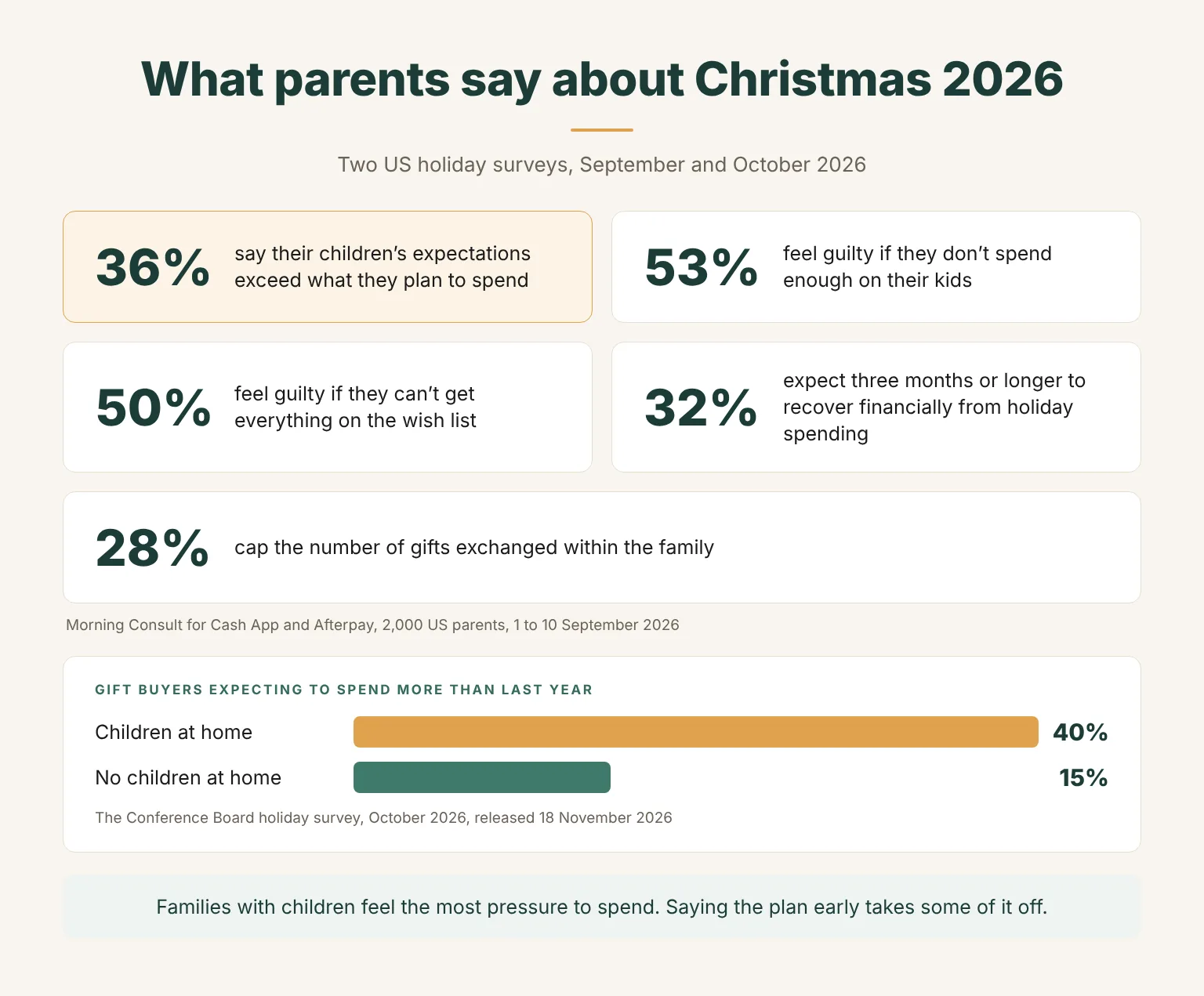
- 36% of US parents say their children’s holiday expectations somewhat or significantly exceed what they plan to spend, according to a Morning Consult survey of 2,000 parents for Cash App and Afterpay (fielded 1 to 10 September 2026). 53% said they feel guilty if they don’t spend enough on their kids.
- Tell children about a smaller Christmas before the wish lists are finished, ideally in late November or early December. A plain statement of the plan, given early, is easier on a child than a surprise on Christmas morning.
- Match the conversation to age: children under about 6 need reassurance and no figures, school-age children can choose between options, and preteens and teenagers can be shown the actual budget and help plan it.
- Experiential gifts strengthened relationships more than material gifts across four studies by Cindy Chan and Cassie Mogilner (Journal of Consumer Research, 2016), and teenagers who kept a gratitude journal donated 60% more money to charity in research from the University of Illinois (2018).
To tell your kids Christmas will be smaller, say it early, keep it short and calm, give a reason they can understand at their age, and tell them what will stay the same. Then let them help with the plan. The sections below take each part in turn. This is general information, not financial advice.
How do you tell kids Christmas will be smaller this year?
Pick a quiet moment, tell them what is changing in one or two sentences, and move straight on to what is not changing. Children take their cue from your tone. If you sound settled, most of them will be too.
A short script has four parts:
- What is changing. “This year there will be fewer presents than last year.”
- Why, in one line. “Prices have gone up, and we’re spending less on presents so we can keep paying for the things we need.”
- What stays the same. “We’ll still have the tree, the cookies and the morning in pajamas.”
- A job for them. “Can you help me pick which things matter most on your list?”
You are not the only parent having this conversation. In a Morning Consult survey of 2,000 US parents for Cash App and Afterpay, fielded 1 to 10 September 2026, 36% said their children’s expectations somewhat or significantly exceed what they plan to spend. Half (50%) said they feel guilty if they can’t get everything on their children’s wish lists, and 53% feel guilty if they don’t spend enough on their kids. Families with children are also the ones under most pressure to spend more: in The Conference Board’s October 2026 survey, 40% of gift buyers with children at home expected to spend more than last year, against 15% of buyers with no children at home.
Guilt pushes toward spending money you do not have. In the same survey, 32% of parents expected it to take three months or longer to recover financially from holiday spending, and 26% planned to use buy now, pay later (BNPL), where a purchase is split into installments paid after the holiday.
When should you tell your children about a smaller Christmas?
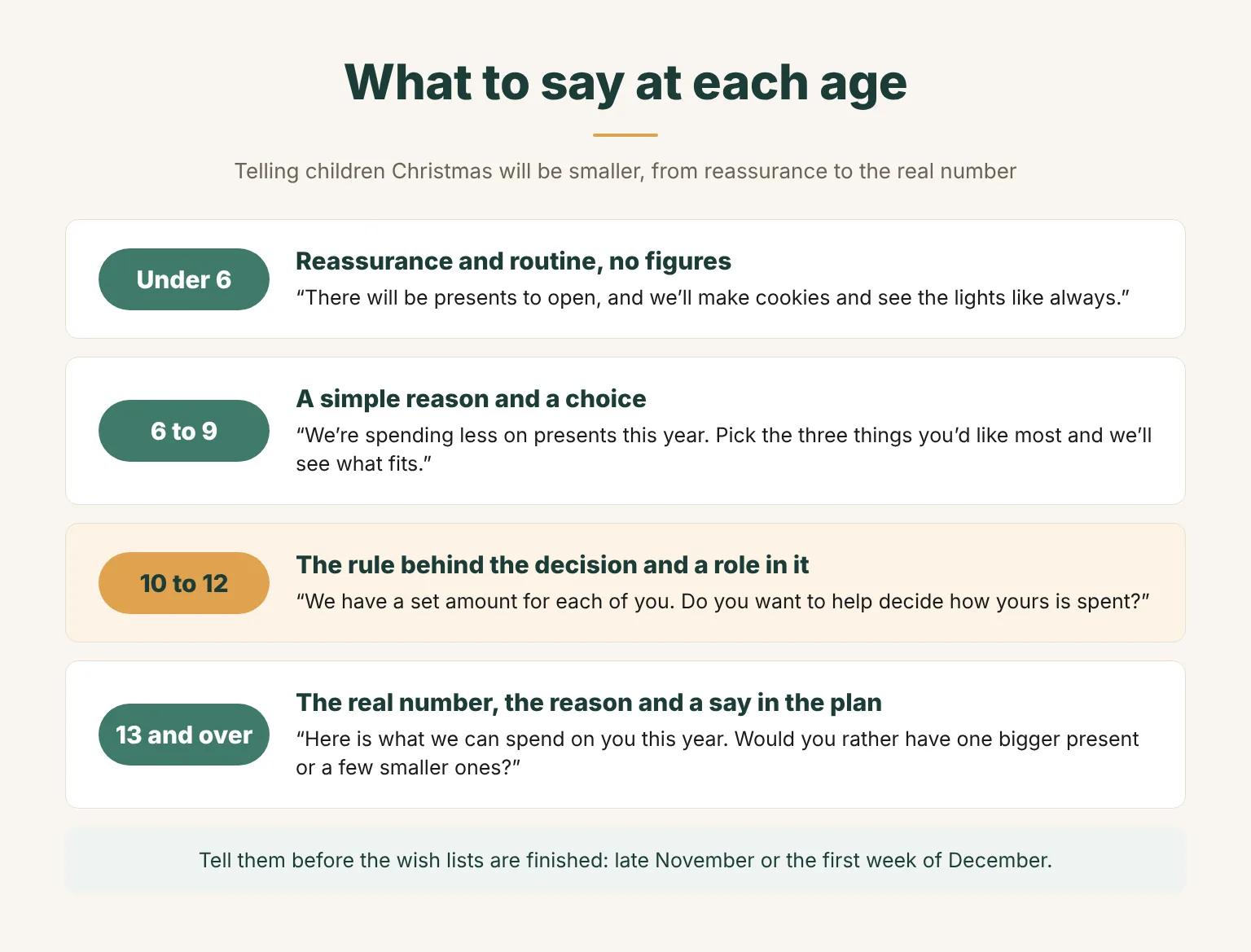
Tell them before the wish lists are finished, which for most families means late November or the first week of December. Once a child has written a long list and talked about it at school, every item you then cross out feels like a loss.
Parents on Mumsnet describing a 7-year-old with an expensive list made the same point: warn children gently beforehand about anything that will not arrive, “so they aren’t devastated on Christmas morning”. Telling them early also gives you time to change the plan together, which is harder to do on 23 December.
If you have a regular time to talk about money, use it. Our guide to running a family money meeting has a short agenda that fits this conversation. If not, a car ride or a walk tends to be easier than sitting across a table.
What should you say to a child at each age?
Younger children need reassurance, school-age children can handle trade-offs, and teenagers can see the real numbers. Eugene Beresin, a psychiatrist writing in Psychology Today on 21 November 2026, put it this way: younger kids “don’t need details about the family budget, but they do need reassurance”, school-age kids “often like being part of the solution”, and teenagers are the most likely “to feel the sting of comparison with peers”.
The table below turns that into words you can use. It is editorial guidance, not research data. Move your child up or down a row depending on how they handle money the rest of the year.
| Age | What they need | What you might say |
|---|---|---|
| Under 6 | Reassurance and routine; no figures | “There will be presents to open, and we’ll make cookies and see the lights like always.” |
| 6 to 9 | A simple reason and a choice | “We’re spending less on presents this year. Pick the three things you’d like most and we’ll see what fits.” |
| 10 to 12 | The rule behind the decision and a role in it | “We have a set amount for each of you. Do you want to help decide how yours is spent?” |
| 13 and over | The real number, the reason and a say in the plan | “Here is what we can spend on you this year. Would you rather have one bigger present or a few smaller ones?” |
Whatever the age, avoid lines that make money sound frightening or mysterious, such as “we’re broke” or “money doesn’t grow on trees”. A child who hears that tends to worry about the family and learns nothing about budgets. Keep it factual: there is a set amount, and this is how we are using it.
Older children can take more. A teenager who sees the household’s actual Christmas number, and what it competes with in the month’s budget, learns more from the conversation than a younger sibling can. Our guide to teaching a teenager about money covers how much of the family budget to share at that age.
How do you explain Santa’s budget to kids who still believe?
Most families keep Santa’s part small and steady, and let changes in spending show up in the presents from family. That way a smaller Christmas does not turn into a question of whether Santa likes some children more than others, which is a real worry when classmates compare gifts in January.
Parents in the same Mumsnet thread offered two lines that many families use: “Santa brings one present. The rest come from people.” and “Santa has so many children to bring gifts for.” If you adopt the first rule this year, it also gives you a fixed point for future years, whatever the budget.
If a child’s list has one expensive item on it, say before Christmas that Santa does not usually bring big things like that. It is kinder than letting them find out on the morning.
How many presents should a child get for Christmas?
There is no right number, so set a dollar cap per child first and decide the number of presents inside it. A rule that many families use is four presents: something they want, something they need, something to wear and something to read. It keeps the list short and the categories give younger children a clear idea of what to expect.
Limiting the number of gifts is common. In the Morning Consult survey for Cash App and Afterpay, 28% of parents said they cap the number of gifts exchanged within the family. The Conference Board’s holiday survey of October 2026 put the average planned gift budget at $683 across all US gift buyers, up 5.0% from $650 in 2025, but that average covers everyone a household buys for, not just children.
Here is how the four-present rule works for a family cutting the budget per child from $300 last year to $180 this year. The amounts are an illustration, not a recommendation.
| Present | Example | Share of $180 |
|---|---|---|
| Something they want | The one item at the top of their list | $90 |
| Something they need | New sneakers or a school bag | $35 |
| Something to wear | Pajamas or a winter hat | $30 |
| Something to read | A book or a comic annual | $25 |
| Total | Four presents | $180 |
Write the cap per child down before anyone starts shopping, including any second parent or grandparent who buys for the children. Our guide to how much a family should spend on Christmas shows how to arrive at the household total that the caps come from.
How can you make a smaller Christmas still feel special?
Move some of the budget from things to experiences, and keep the traditions that cost little.
In four studies published in the Journal of Consumer Research in 2016, Cindy Chan of the University of Toronto and Cassie Mogilner of UCLA found that experiential gifts (an outing, a class, a ticket) strengthened the relationship between giver and recipient more than material gifts did. Emotionally meaningful objects, such as a framed photo, had a similar effect. Yet 78% of respondents in their research said the last gift they bought was a material one.
- A voucher for time. A day out with one parent, a baking afternoon or a trip to see the lights, written on a card the child unwraps.
- A shared present. One board game or a family pass that all the children share.
- Free traditions. A Christmas Eve walk, a film night with homemade popcorn or decorating the tree together.
- Presents they make. Children can make or buy small gifts for others. Our guide to kids buying Christmas presents with their own pocket money has a weekly plan.
What if your child is upset or compares with friends?
Let them be disappointed, say you understand, and do not reopen the budget. A child who sees that a sad face changes the plan learns to use one. Listen first, then repeat the plan in the same calm words.
Comparison with friends hits teenagers hardest. Two things help. First, give them a real choice inside the budget: one bigger present, several small ones, or cash toward something they are saving for. Second, make some of December about other people. In research from the University of Illinois published in The Journal of Positive Psychology in 2018, adolescents who kept a gratitude journal donated 60% more money to charity than those in a control group, and the authors linked gratitude to lower materialism. Our guide to teaching kids about giving has ideas by age.
If relatives usually send cash, agree in advance what happens to it, so a smaller Christmas from you does not become a large spending spree in late December. Our post on what to do with money kids get as gifts walks through the options.
How can kids help with the Christmas budget?
Give them a number they can see and a part of the plan they own. A child who knows there is $180 for their presents can rank their list, compare prices online with you and decide between one big thing and several small ones. A child who buys presents for others from their own money learns the same lesson from the other side.
Keeping the running total where everyone can see it also helps the adults. In the Morning Consult survey, 20% of parents said tracking the holiday budget and spending takes the most mental energy of all the planning tasks. When two parents and a grandparent buy separately, nobody knows the total until the card statements arrive.
CapKin is a shared household budgeting app where each adult logs spending by voice, text or receipt photo against caps the household sets, so a Christmas category shows one total for everyone who is buying. A child can log their own present purchases by text, or by voice if a parent turns that on, and each entry waits for a parent’s approval before it counts. CapKin does not connect to a bank, issue a card or move money. The pocket money tracker page shows how child entries work, and the product facts page lists what CapKin does and does not do.
Sources
- Cash App and Afterpay, “More Than 1 in 3 Parents Say Their Kids’ Holiday Wish Lists Exceed Their Budget” (21 October 2026; Morning Consult survey of 2,000 US parents, 1 to 10 September 2026)
- The Conference Board, “Holiday Spending Plans Rise in 2026” (18 November 2026)
- Eugene Beresin, “The Holidays on a Tight Budget”, Psychology Today (21 November 2026)
- Mumsnet, “How to explain budget when they still believe in Santa?” (thread started 13 October 2024)
- University of Toronto, “The science of gift giving” on Chan and Mogilner, Journal of Consumer Research (16 December 2016)
- University of Illinois News Bureau, “Fostering gratitude reduces materialism, increases generosity in adolescents” (12 November 2018)
Frequently asked questions
- How do I tell my child we can’t afford a big Christmas?
- Tell them early, in one or two calm sentences: there will be fewer presents this year because the family is spending less. Then say what stays the same, such as the tree, the food or a favorite outing, and give them a job, like choosing the items on their list that matter most. Keep figures out of it for children under about 6.
- When should I tell my kids Christmas will be smaller?
- Before their wish lists are finished, which for most families is late November or the first week of December. Once a child has written a long list and talked about it with friends, each item you cross out feels like a loss. Telling them early also leaves time to change the plan together, well before Christmas Eve.
- How do you explain to kids that Santa has a budget?
- Many families keep Santa’s part small and the same every year, for example one present from Santa and the rest from family, so changes in spending show up only in family presents. That avoids a child wondering why Santa brought a friend more. If a list includes an expensive item, say before Christmas that Santa does not usually bring big things like that.
- How many Christmas presents should a child get?
- There is no right number. Set a dollar cap per child first, then decide the number of presents inside it. A common rule is four presents: something they want, something they need, something to wear and something to read. In a September 2026 Morning Consult survey for Cash App and Afterpay, 28% of US parents said they cap the number of gifts within the family.
- Is it bad to give kids fewer Christmas presents?
- No. In four studies published in the Journal of Consumer Research in 2016, Cindy Chan and Cassie Mogilner found that experiential gifts, such as an outing or a class, strengthened relationships more than material gifts. Research from the University of Illinois in 2018 linked gratitude in teenagers to lower materialism and more giving. A shorter list with shared time can be a good Christmas.
- What should I say if my teenager compares presents with friends?
- Listen first and say you understand, then repeat the plan without reopening the budget. Give them a real choice within it, such as one bigger present, several smaller ones or cash toward something they are saving for. Teenagers can usually be shown the actual Christmas number and what it competes with in the family budget, which makes the decision feel less arbitrary.