By Artem Panasiuk · 11 November 2026 · 9 min read
How to Teach Kids About Giving: Ages, Amounts and a GivingTuesday Plan
Most children already give in some way, and children whose parents talk to them about giving are more likely to keep doing it. This guide covers what the research found, what to expect at each age, how much of an allowance to set aside, how to choose and check a charity with your child, and a five-step plan for GivingTuesday on 1 December 2026. It uses US sources and dollars, with a note for families in England and Wales.
The short version
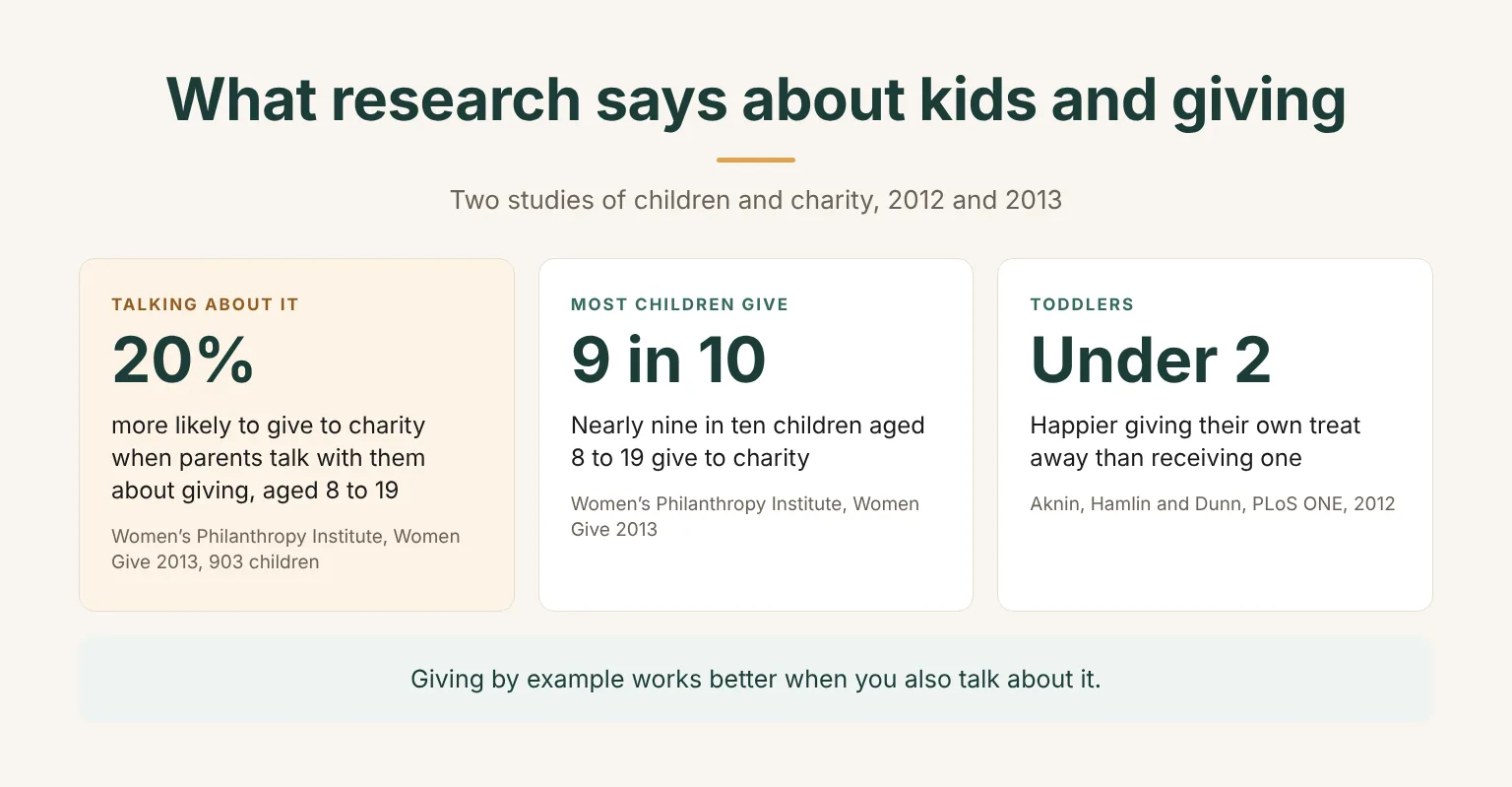
- Children aged 8 to 19 whose parents talk with them about giving are 20% more likely to give to charity than children whose parents do not, regardless of sex, age, race or family income (Women’s Philanthropy Institute, Women Give 2013, a study of 903 children).
- Nearly nine in ten children aged 8 to 19 give to charity, and the same study found that parents giving by example, without talking about it, did not work as well as talking (Women’s Philanthropy Institute, 2013).
- In a 2012 experiment published in PLoS ONE, toddlers under two were happier giving a treat away than receiving one, and happiest when the treat they gave was their own (Aknin, Hamlin and Dunn).
- No study sets the right share of an allowance for giving. A common convention is about 10% for older children, so $1 of a $10 weekly allowance, or $52 over a year.
- GivingTuesday 2026 is Tuesday 1 December. In 2025, 38.1 million people in the US took part and gave $4.0 billion, and 11.1 million volunteered (GivingTuesday, 3 December 2025). The Federal Trade Commission’s rule for donors: if someone wants a donation in cash, by gift card or by wire transfer, do not give it.
To teach a child about giving, give them a small amount of their own to give, let them choose where it goes, and talk about the choice with them. The sections below cover the research, ages, amounts, how to check a charity and a plan for GivingTuesday. This is general information and not financial or tax advice.
Does talking to kids about giving make them more generous?
Yes. In Women Give 2013, the Women’s Philanthropy Institute at the Indiana University Lilly Family School of Philanthropy followed the same 903 children aged 8 to 19 through two waves of the Panel Study of Income Dynamics, in 2002 to 2003 and 2007 to 2008. Children whose parents talked with them about giving were 20% more likely to give to charity than children whose parents did not. The result held across sex, age, race and family income.
The same study found that role-modeling alone, meaning parents who give without discussing it, was less effective than talking. Its authors recommend doing both throughout childhood and the teenage years. Most children already give something: nearly nine in ten in the sample gave to charity. Boys and girls were equally likely to give money, and girls were more likely to volunteer.
Younger children seem to enjoy it too. In a 2012 experiment published in PLoS ONE, Lara Aknin, Kiley Hamlin and Elizabeth Dunn gave toddlers aged about 22 months some treats and then asked them to give one to a puppet. Observers rated the toddlers happier when they gave a treat away than when they received one, and happiest when the treat came from their own pile. The main study had 20 children, so treat it as a small, early result.
At what age should you start teaching kids about giving?
You can start as soon as a child can hand something over, at around two, and add money once they understand that coins buy things, usually by five or six. The table below is editorial guidance, not research data. It follows the same pattern as our financial literacy activities by age: one habit, with a bigger job for the child each year.
| Age | What the child does | What you talk about |
|---|---|---|
| 2 to 4 | Shares a snack, puts a toy in a donation bag | Who gets it and how they might feel |
| 5 to 7 | Puts a few coins from their own money in a giving jar | What the money will buy for someone else |
| 8 to 10 | Picks a cause from two or three you suggest | Why they chose it, and what the charity does with gifts |
| 11 to 13 | Sets their own giving share and researches a charity | How to check a charity is real |
| 14 and over | Gives from earnings, volunteers, runs a collection | Giving time and goods as well as money |
How much of their allowance should kids give?
No study sets a percentage, so any figure is a family convention. A common one, from Ron Lieber’s book The Opposite of Spoiled, is about 10% to giving for older children and equal thirds of spend, save and give for young ones. Our guide to teaching kids to save money explains why a giving jar should sit apart from a savings goal.
| Weekly allowance | Giving share at 10% | Given over a year |
|---|---|---|
| $5 | $0.50 | $26 |
| $10 | $1 | $52 |
| $15 | $1.50 | $78 |
Set the share once and take it off the top when the money arrives, so giving does not depend on what is left at the end of the week. If you have not settled the allowance itself, see how much allowance to give by age. Gift money from birthdays and holidays can follow the same split, which the post on what to do with money kids get as gifts covers.
How do you help a child choose a charity?
Start from something the child already cares about, such as animals, a sick friend, the local park or the school library, and turn it into two or three organizations for them to choose between. Then let the child make the final choice.
- Ask what they would change if they could fix one thing, and write the answer down in their words.
- Find two or three organizations that work on it, ideally one local, so the child can see the result.
- Read each charity’s page with them and look for one concrete thing a gift pays for.
- Let the child decide, and let them split the money between causes if they want to.
- Afterwards, ask what they think the money did. This is the kind of conversation the 2013 study linked to more giving.
How do you check a charity is real before your child gives?
Search the charity’s name together with the words “complaint”, “review”, “rating” or “scam”, as the Federal Trade Commission (FTC) advises, and then check the organization’s registration. The FTC also points to the IRS Tax Exempt Organization Search to confirm a gift is tax-deductible, to your state charity regulator, and to ratings from BBB Wise Giving Alliance and CharityWatch.
| FTC advice | What it means for a family |
|---|---|
| If someone wants donations in cash, by gift card or by wiring money, don’t do it | A child should never buy a gift card for a stranger who says it is for charity |
| To be safer, pay by credit card or check | An adult makes the payment, and the child hands over their share in cash at home |
| Don’t let anyone rush you into making a donation | Decide before the day, so a countdown on a website changes nothing |
| Check your statement afterwards | Look for a repeat donation you did not choose |
In England and Wales, the Charity Commission’s register of charities lets you search by name or charity number. Most charities with an income under £5,000 a year do not have to register, so a small local group may not appear there.
What can kids give besides money?
Time, goods and their voice all count, and GivingTuesday counts all three. In 2025, more people in the US spoke out about a cause on GivingTuesday than made a financial donation.
| How people took part in GivingTuesday 2025 (US) | People |
|---|---|
| Made a financial donation | 19.1 million |
| Spoke out about a cause | 20.9 million |
| Gave goods | 13.5 million |
| Volunteered | 11.1 million |
For a child, that might be sorting outgrown clothes for a shelter, baking for a school sale, writing a card for a care home or helping a neighbor. A teenager can run a collection or volunteer with a group that accepts young people. These count as giving, and they suit children who have little money of their own.
How can your family take part in GivingTuesday on 1 December 2026?
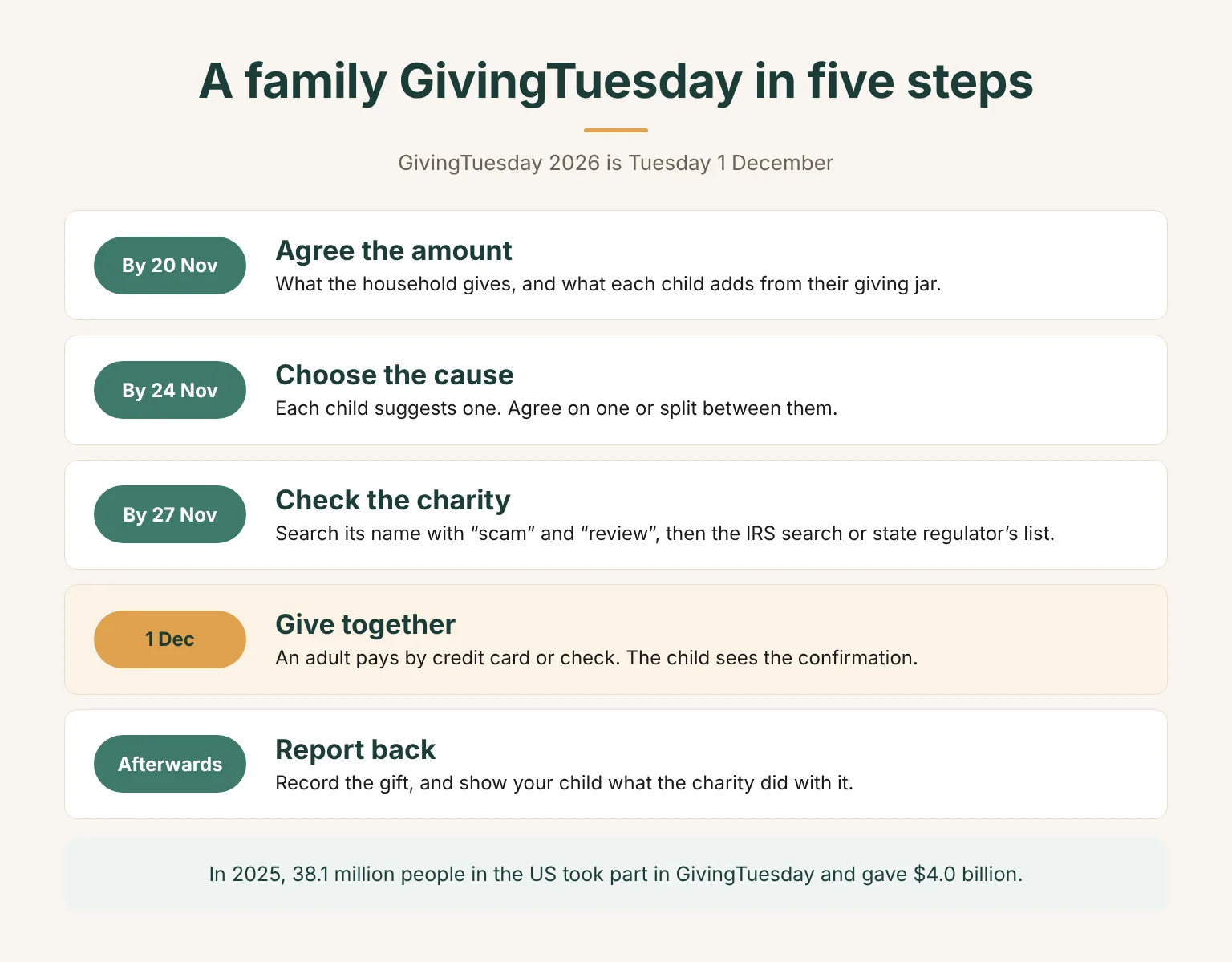
GivingTuesday is held on the Tuesday after US Thanksgiving, so in 2026 it falls on 1 December, the day after Cyber Monday. In 2025, 38.1 million people in the US took part, up 6% on 2024, and gave $4.0 billion, up 13%. The plan below takes about three weeks and works back from 1 December.
- Agree the amount by 20 November. Settle what the household will give and what each child will add from their giving jar.
- Choose the cause by 24 November. Each child suggests one, and you agree on one or split between them.
- Check the charity by 27 November. Search the name with “scam” and “review”, and look it up on the IRS search or the state regulator’s list.
- Give together on 1 December. An adult pays by credit card or check, and the child sees the confirmation.
- Report back afterwards. Record what was given, and when the charity reports what it did, show your child.
If the household is already watching spending after Black Friday, decide the GivingTuesday amount as part of the same November plan in our Black Friday family budget guide, so the two do not compete for the same money. A short family money meeting is a good place to agree the amount and the cause.
How do you keep track of what a child gives?
Write each gift down when it happens, with the amount and the cause, and look back at the list with your child at the end of the year. A record turns a few scattered coins into something a child can see: “we gave $52 to the animal shelter this year.”
CapKin is a shared household budgeting app with a pocket money ledger for each child. A child can set a savings goal, for example one named after the charity they chose, and move pocket money toward it. A parent can lock the money in a goal, so taking it out needs a request the parent approves. When the child gives, they log it by text, or by voice if a parent has switched voice on for them, and the entry waits for a parent’s approval before it counts. CapKin never moves money, holds no bank account and issues no card, so the gift itself is made the usual way. See the pocket money tracker page and the product facts for exactly what it does and does not do.
Are fewer American families giving than before?
Yes, by share of households, though the total given keeps rising. The Lilly Family School of Philanthropy found that 66.2% of American households gave to charity in 2000 and 49.6% in 2018, using the Philanthropy Panel Study. Giving USA estimates total US giving at $617.2 billion in 2025, up 5.7% in current dollars and 3.0% after inflation, with $394.2 billion from individuals.
Sources
- Indiana University Lilly Family School of Philanthropy, “Women Give 2013: New research on charitable giving by girls and boys” (12 September 2013)
- Aknin, Hamlin and Dunn, “Giving Leads to Happiness in Young Children”, PLoS ONE 7(6): e39211 (14 June 2012)
- GivingTuesday, “GivingTuesday 2025 results” (3 December 2025)
- Federal Trade Commission, “Donating safely and avoiding scams” (consumer advice, read 11 November 2026)
- Federal Trade Commission, “Give to a charity, not a scam” (26 November 2024)
- GOV.UK, “Find charity information” (Charity Commission register, read 11 November 2026)
- Indiana University Lilly Family School of Philanthropy, “Latest data shows new low in share of Americans who donated to charity” (27 July 2021)
- Giving USA Foundation, “Giving USA: charitable giving rose to $617.20 billion in 2025” (Giving USA 2026)
- Lieber, R. (2015). The Opposite of Spoiled: Raising Kids Who Are Grounded, Generous, and Smart About Money.
- CapKin, product facts (last verified 4 November 2026)
Frequently asked questions
- How do I teach my child about giving to charity?
- Give your child a small amount of their own money to give, let them choose the cause from two or three you suggest, and talk about why they chose it. A 2013 study of 903 children aged 8 to 19 found that children whose parents talk with them about giving are 20% more likely to give than those whose parents do not.
- What percentage of allowance should a child give to charity?
- No study sets a percentage, so treat any number as a family rule. A common convention is about 10% for older children, so $1 a week from a $10 allowance, or $52 a year. For young children, some families split money into equal thirds for spending, saving and giving. Take the giving share off the top when the money arrives.
- At what age should kids start giving to charity?
- Children can start sharing at around two, and a 2012 PLoS ONE study found toddlers under two were happier giving a treat away than receiving one. Most children can understand giving money by five or six. From about eight, a child can choose between causes, and from eleven they can help research whether a charity is real.
- When is GivingTuesday 2026?
- GivingTuesday 2026 is Tuesday 1 December, the Tuesday after US Thanksgiving and the day after Cyber Monday. In 2025, 38.1 million people in the US took part and gave $4.0 billion, according to GivingTuesday’s results published on 3 December 2025. A family can take part with money, goods, volunteering or speaking up for a cause.
- How can I check that a charity is legitimate?
- Search the charity’s name with words like “complaint”, “review” or “scam”, as the Federal Trade Commission advises. Look it up on the IRS Tax Exempt Organization Search and your state charity regulator’s list, or on the Charity Commission register in England and Wales. Never give by cash, gift card or wire transfer to someone who asks for it.
- Can kids give without money?
- Yes. Children can donate outgrown clothes or toys, volunteer, bake for a sale, write cards or help a neighbor. GivingTuesday counted 13.5 million people in the US who gave goods and 11.1 million who volunteered in 2025, alongside 19.1 million who gave money. Non-money giving suits young children who have little money of their own.
- Should my child give their own money or mine?
- Use some of the child’s own money, even a small amount, because giving up something of their own is what makes the choice real. The household can add to it. Online, an adult should make the payment by credit card or check, and the child can hand their share over in cash at home.