By Artem Panasiuk · 26 October 2026 · 14 min read
Financial Literacy Activities for Kids: 24 Things to Do at Home, by Age
The best money lessons happen at the supermarket, the kitchen table and the bus stop, with real money and a parent nearby.
The short version
- Financial literacy for kids is three things learned in order: self-control first, then money habits, then knowledge and decisions. The US Consumer Financial Protection Bureau places their main windows at ages 3 to 5, 6 to 12 and 13 to 21.
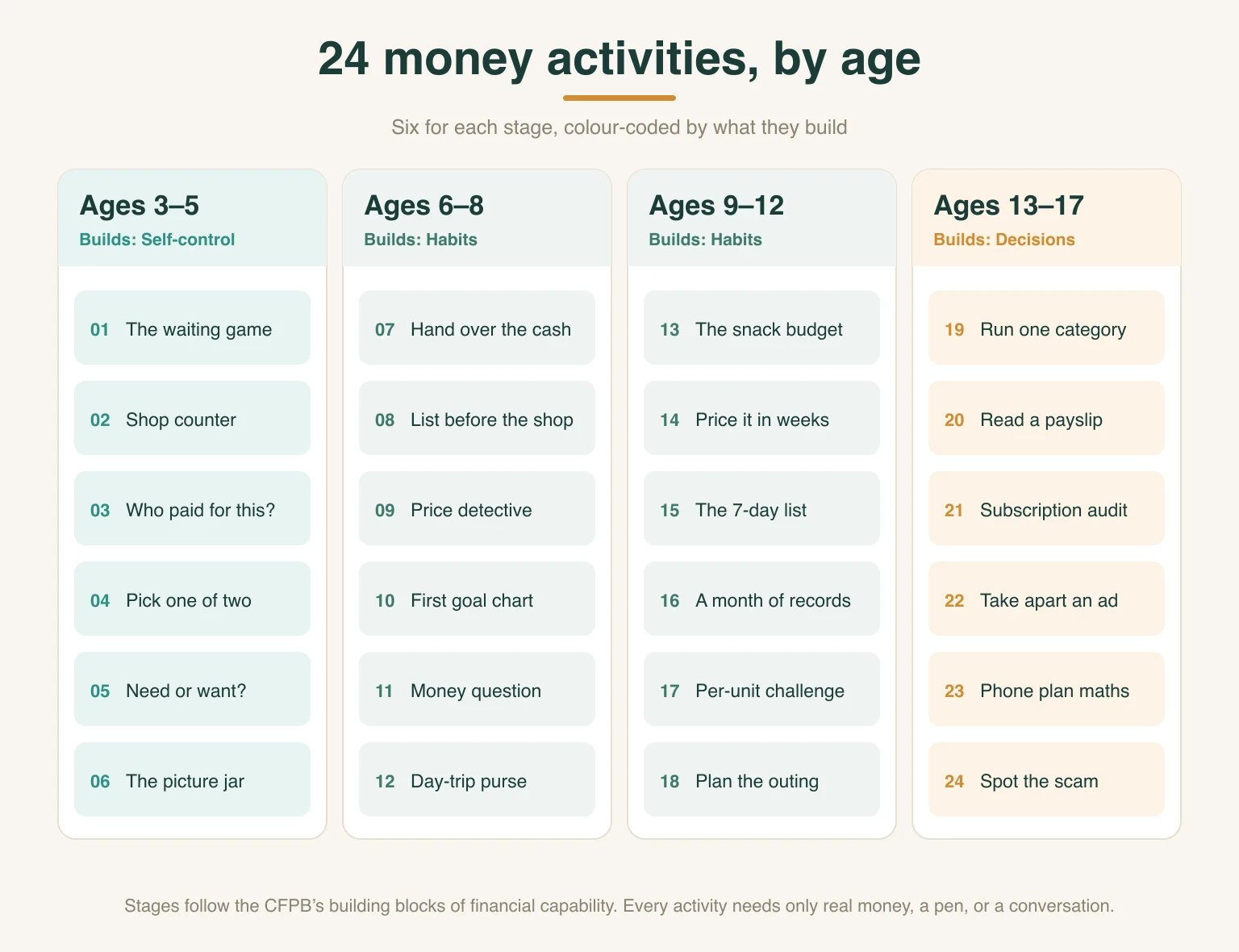
- Each age band below has six activities that need only real money, a pen or a conversation. Most take under fifteen minutes and fit into a shop, a meal or a car journey.
- Parents rate doing above telling. They rank earning their own income (63%), honest conversations (58%) and saving for something (57%) as the most effective ways children learn, in an Intuit survey of 2,000 US parents in March 2026.
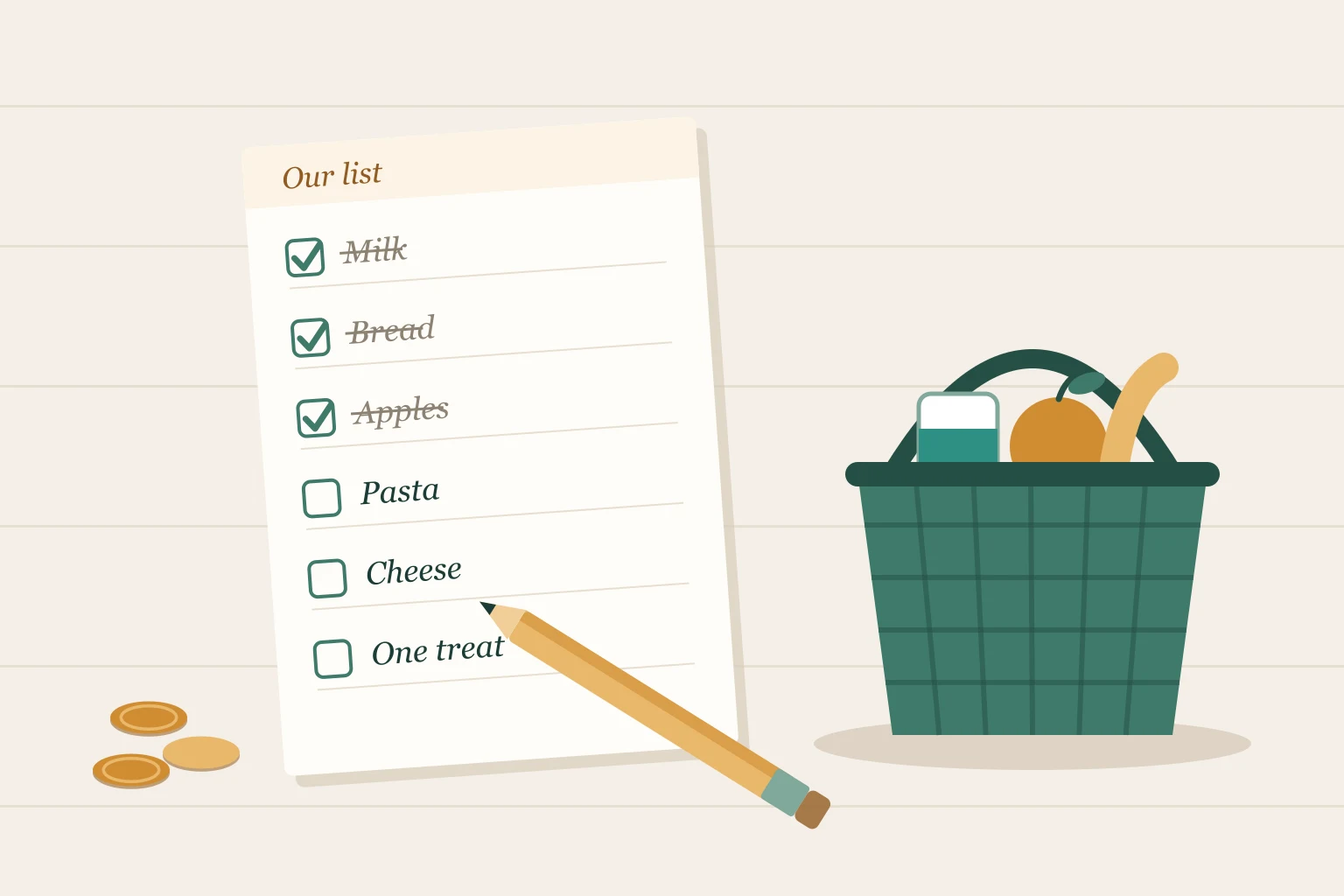
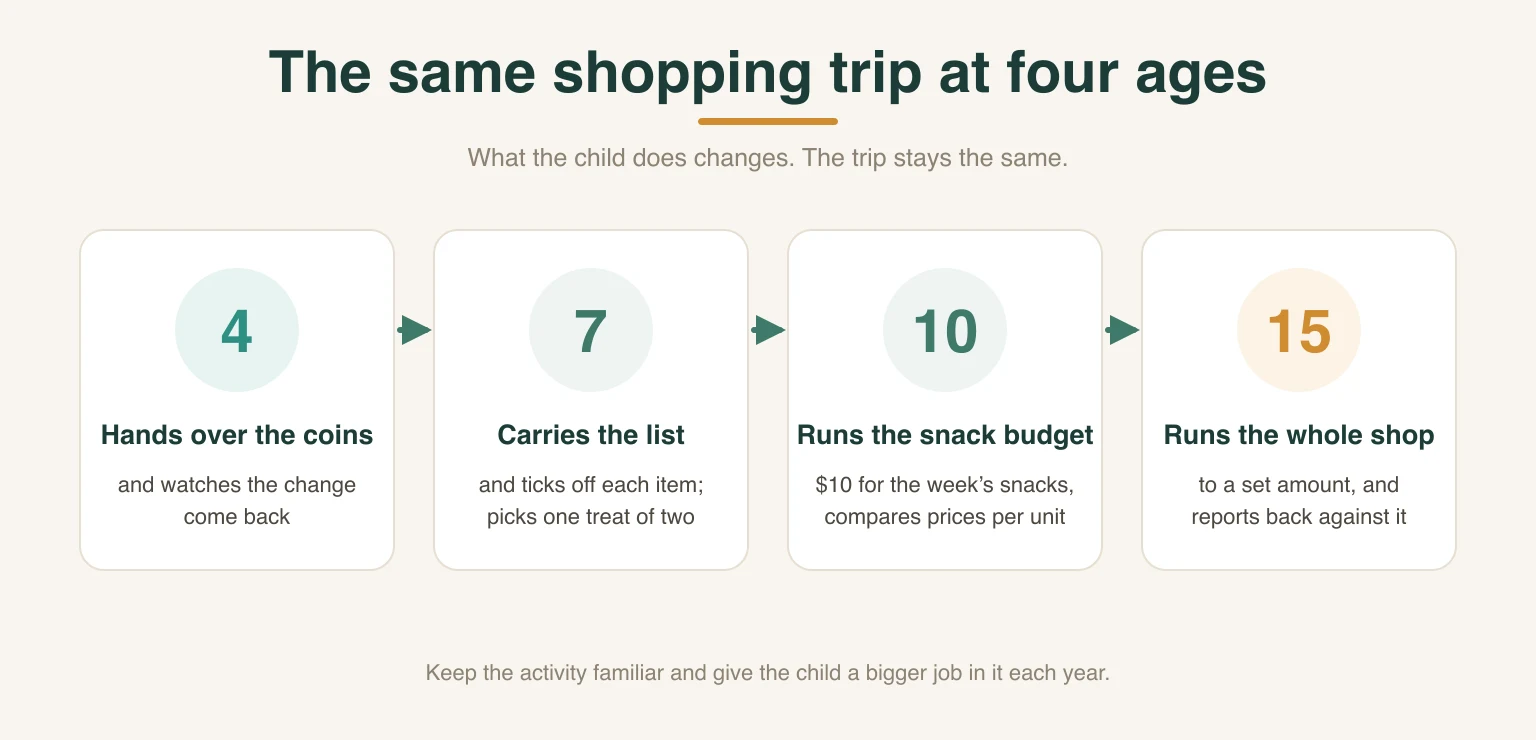
- Repeat one activity and give the child a bigger job in it each year. The same shopping trip teaches coins at four, a list at seven, a budget at ten and the whole shop at fifteen.
- Talk is part of every activity. Only 15% of US parents talk about money with their child weekly (YouGov for Greenlight, October 2025), and the activities give the conversation something concrete to be about.
Financial literacy activities for kids are short, practical things a child does with real money or real prices, at home or out with a parent, that build one money skill at a time. They differ from a lesson in one way that matters: the child acts, and the result is theirs. A five-year-old who waits ten minutes for a treat, a nine-year-old who runs out of snack money on Thursday and a fifteen-year-old who finds the family’s forgotten subscriptions have each learned something a worksheet cannot give them.
This guide has 24 of them, six for each stage from three to seventeen. Each comes with the time it takes, what you need and what it builds. The stages follow the framework the US Consumer Financial Protection Bureau (CFPB) built from its research on how children become financially capable adults. The skills inside each stage follow the six national standards for personal financial education. None of the activities needs an app, a card or a subscription.
What financial literacy means for a child
For adults, financial literacy is usually defined as knowledge: what interest is, how a budget works, why diversification matters. For children the CFPB uses a wider model. Its 2016 report, Building blocks to help youth achieve financial capability, describes three blocks that develop in sequence and keep developing into adulthood.
- Executive function. In the CFPB’s words, “the thinking skills and abilities needed to plan ahead, focus attention, remember information”. It begins to form at ages 3 to 5, and it is what a child later draws on to wait, save and stick to a plan.
- Financial habits and norms. “The values, standards, routine practices, and rules to live by used to navigate day-to-day financial life.” These take shape in middle childhood, ages 6 to 12, largely as children “observe how family members and peers interact with money”.
- Financial knowledge and decision-making. “The knowledge and skills needed to understand the financial world and make informed financial decisions.” Teenagers and young adults, ages 13 to 21, are the ones who “solidify” this block.
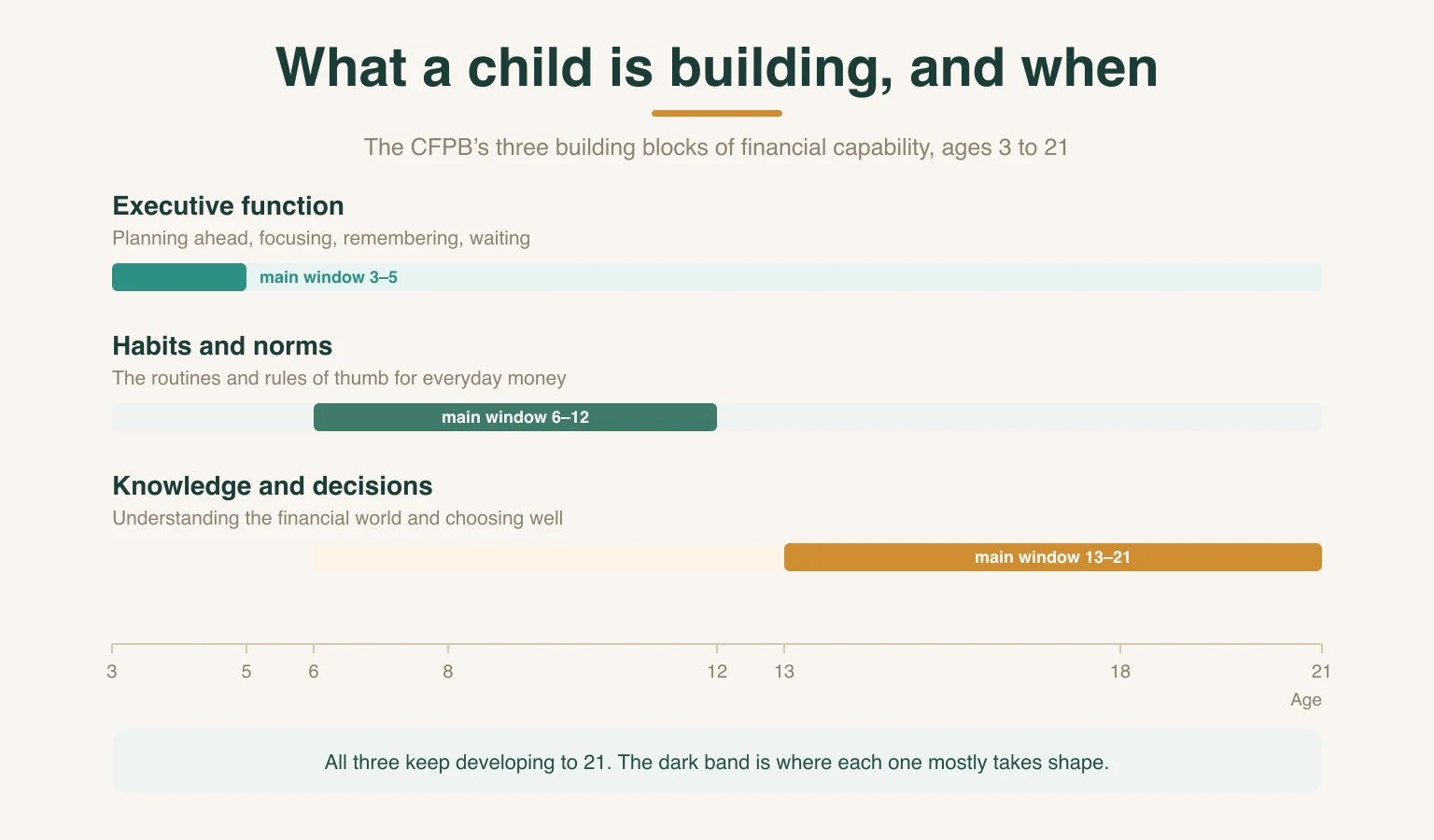
The model explains why a lecture about compound interest does little for an eight-year-old, while letting the same child hand over cash at a till does a lot. At eight the job is habits, and habits come from doing. It also matches the University of Cambridge research for the UK Money Advice Service, which found children’s core money habits largely formed by about seven; our guide to when to teach kids about money goes through what that means age by age.
Inside each block, the content comes from the National Standards for Personal Financial Education, published in 2021 by the Jump$tart Coalition and the Council for Economic Education. They name six areas: earning income, spending, saving, investing, managing credit and managing risk. The activities below cover all six, weighted toward the ones a child can practise at each age: earning, spending and saving early, credit and risk in the teenage years.
Why doing teaches more than telling
Parents already suspect this. In Intuit’s survey of 2,000 US parents in March 2026, the methods they rated most effective were all things a child does: earning their own income (63%), honest conversations (58%), saving for something non-essential (57%) and an allowance (57%). The same parents described what they actually do: 57% involve their children in grocery shopping, 38% show them household bills and 35% explain loans, cards and interest.
The behavioural evidence points the same way. In Dilip Soman’s 2001 experiments, people who wrote down what they had spent rated their appetite for the next purchase at 3.80 out of 10, against 5.26 for people who paid by card on identical spending. Recording is itself the lesson, which is why several activities below are about writing things down.
Conversation is the part most families skip. A YouGov survey of 1,028 US parents for Greenlight in October 2025 found only 15% talk about money with their child weekly, and LeBaron and Kelley’s 2021 review of a decade of research concluded that parents are the primary source of children’s financial learning. Every activity here comes with something to say, because the activity gives the talk a subject. More figures are in our kids and money statistics.
Ages 3 to 5: activities that build self-control
At this age the target is waiting, choosing and noticing that things cost money. Keep everything physical: coins a child can hold, a jar they can see through, a choice between two things they can point at. The CFPB lists persistence, a child who “focuses and keeps going on hard tasks”, as one of the money milestones for this stage.
| Activity | How it works | Time | Builds |
|---|---|---|---|
| 1. The waiting game | Offer a small treat now, or a slightly bigger one after a timer. Start at two minutes and stretch it over weeks. | 5 min | Waiting, saving |
| 2. Shop counter | Run a pretend shop at home with real coins and price tags. Take turns being the shopkeeper. | 15 min | Spending, counting |
| 3. Who paid for this? | On a walk, point at things and ask who paid: the swings, the bus, the lights. Answer together: work, taxes, the family. | 10 min | Earning |
| 4. Pick one of two | At the shop, the child chooses one treat from two. The other goes back on the shelf. | 2 min | Spending, trade-offs |
| 5. Need or want? | Sort pictures or real items into two piles: food, a coat, a toy, a sweet. Talk about the hard ones. | 10 min | Spending |
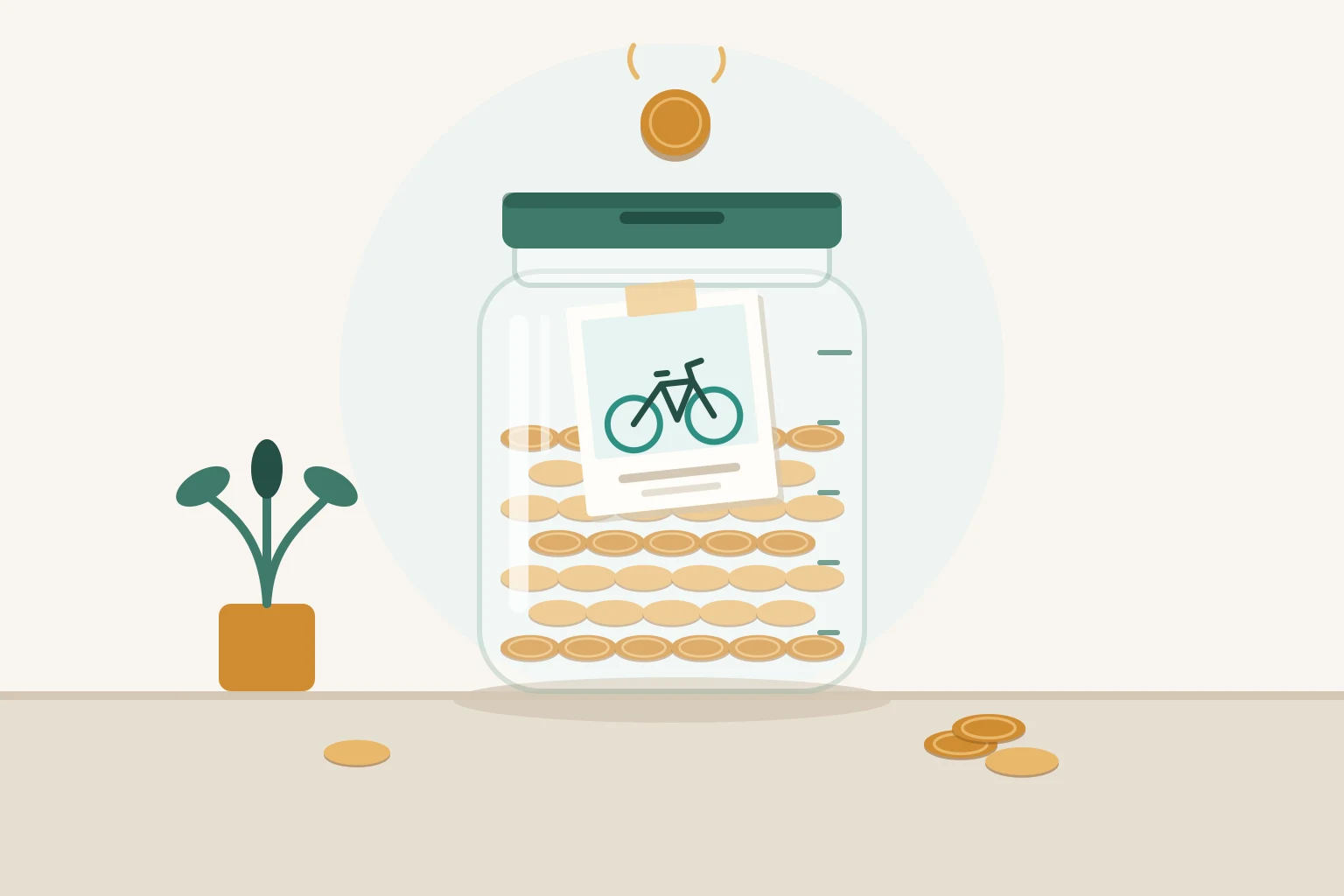
| 6. The picture jar | A clear jar with a photo of one thing the child wants taped to it. Coins go in; the child watches the level rise. | Ongoing | Saving |
Two of these matter more than the rest. The waiting game trains the skill every later money habit rests on, and it works with anything the child wants, from a biscuit to the next turn on a swing. Pick one of two is the first budget a child ever runs: a fixed limit, two options and a real loss when they choose. Let the choice stand, including the one they regret on the way home.
Ages 6 to 8: activities that build habits
Now the child can count, read prices and keep a goal in mind for a few weeks. This is the habit window, and the activities are built around routines that repeat: the same list before the same shop, the same chart on the same fridge. The CFPB’s Money as You Grow guidance for this stage includes making a plan before spending, with the suggestion to “practice making a list before you go to a store”. A small regular allowance turns most of these from games into practice; our allowance by age guide has typical amounts.
| Activity | How it works | Time | Builds |
|---|---|---|---|
| 7. Hand over the cash | Pay with cash sometimes and let the child hand it over and check the change. Say the sum out loud. | 2 min | Spending, maths |
| 8. List before the shop | Write the shopping list together. In the shop the child ticks items off and spots anything not on the list. | 10 min | Planning |
| 9. Price detective | Give the child one item to find on the shelf and ask which of two brands costs less. | 5 min | Spending |
| 10. First goal chart | Draw a bar on paper for one goal a few weeks away. The child colours in each amount saved. | Ongoing | Saving |
| 11. Money question | Once a week at dinner, ask one money question everyone answers, adults included: what would you do with ten dollars right now? | 5 min | Talk, values |
| 12. Day-trip purse | Before an outing, give the child a small fixed amount in an envelope for treats. When it is gone, it is gone. | A day | Spending, limits |
The day-trip purse is often the first time a child runs out of money with nobody to top it up. A child who spends everything at the first kiosk and watches a sibling buy ice cream at four o’clock has learned what a budget is for. The money question costs nothing and attaches to a meal you are already having, which makes it easy to keep up. The adults answering too is what makes it work. More questions and a way to run a short monthly version are in how to run a family money meeting.
Ages 9 to 12: activities with their own numbers
From about nine, children can think about money they cannot see: a balance, a goal a month away, a price expressed in something else. This is where they start keeping their own records, and where the CFPB adds two more topics to the list: borrowing, with the line that a loan means “you pay back what you borrow, plus more”, and protecting, keeping “important personal information private”.
| Activity | How it works | Time | Builds |
|---|---|---|---|
| 13. The snack budget | Give the child a fixed weekly amount for their own snacks and treats. They decide; you do not top it up. | Weekly | Spending, planning |
| 14. Price it in weeks | When they want something, work out together how many weeks of pocket money it costs. | 5 min | Trade-offs |
| 15. The 7-day list | Anything they want to buy goes on a list. If they still want it a week later, it might be worth it. | Ongoing | Saving, impulse control |
| 16. A month of records | The child writes down everything they spend for one month, then you look at the list together. | 2 min a day | Spending, records |
| 17. Per-unit challenge | In the supermarket, compare the price per kilo or per item on two pack sizes. Which is cheaper, and is it worth it? | 10 min | Spending, maths |
| 18. Plan the outing | Hand the child a set amount for a family outing and let them plan it: tickets, food, travel. Then go. | 1 hour | Planning, budgeting |
A month of records has the clearest behavioural evidence behind it, from Soman’s experiments with adults, and it is the one children often resist at first. Keep it short: a notebook, one line per purchase, two minutes a day. At the end of the month, ask what surprised them, and leave the judgement out. Price it in weeks is the quickest way to make opportunity cost real: a $30 game that equals six weeks of snack money is a different decision from a $30 game. Our guide on how to teach kids to save money covers the saving side in more depth.
Ages 13 to 17: activities with real stakes
Teenagers are in the knowledge-and-decisions window, and they learn fastest when the decision is real and the money is not pretend. The activities move from the child’s own pocket money into the family’s money and the adult world: payslips, contracts, advertising and fraud. This is also where credit and risk, the last two national standards, get practical.
| Activity | How it works | Time | Builds |
|---|---|---|---|
| 19. Run one category | Hand the teenager one real household category for a month, such as their clothes or phone, with a cap. They report back against it. | A month | Budgeting |
| 20. Read a payslip | Go through a real or sample payslip line by line: gross, tax, deductions, net. Then their own, once they have a job. | 20 min | Earning, tax |
| 21. Subscription audit | Ask them to find every subscription the household pays, with the monthly cost, and total it for a year. | 30 min | Spending |
| 22. Take apart an ad | Pick an influencer post or an in-game offer. What is being sold, who pays for the post, and what is the real price? | 15 min | Spending, risk |
| 23. Phone plan maths | Compare two phone plans over 12 or 24 months, including the handset. Which is cheaper in total? | 20 min | Spending, credit |
| 24. Spot the scam | Show three real messages, one genuine and two scams. How can they tell? What should they never share? | 15 min | Managing risk |
Running one category is the strongest of the six, because it is the only one where the teenager owns a real number for a month and lives with the result. Start with something they already care about and set the cap together. The subscription audit has a side benefit: teenagers tend to be thorough when the target is someone else’s spending, and the family may find money it forgot it was paying. The wider teenage plan, from the first payslip to stepping back, is in how to teach a teenager about money.
How to make an activity stick
- Use real money. Play money is fine for a four-year-old’s shop. From six, the lessons hold when the coins, the pocket money and the goal are the child’s own.
- Repeat it, and grow the job. A habit comes from repetition, so keep a few activities going for years. The shopping trip in the diagram above is the model: same trip, bigger role each year.
- Let the mistake happen. A blown snack budget at ten costs a few dollars. Stepping in to rescue it removes the only part that teaches.
- Say your own decisions out loud. The CFPB suggests thinking out loud about your money and time decisions so a child can follow the reasoning. “Let’s check the budget first” said in front of a child is an activity too.
- Keep the record. Whether it is a jar, a paper chart or an app, a child needs to see what came in, what went out and what is left. Without a record, the activities are separate events; with one, they add up.
Where CapKin fits
Most of these activities need nothing but money and a parent. The one that gets harder as children grow is keeping the record: who has how much, what was spent and how a goal is going. CapKin is a shared household budgeting app that keeps that record inside the family budget, with no card and no bank connection.
A child gets their own ledger. Pocket money arrives on a schedule, they log what they spend, and every entry waits for a parent’s approval before it counts, so a month of records happens without a notebook. Savings goals can be locked by a parent, which turns the picture jar and the goal chart into something that survives a good week at the shop. For ages 6 to 8 there is a hand-written story course, Beaver Trails, and every level ends with a “try it” task to do away from the screen and a question to ask at dinner. For 8 to 12 there is a money discovery a day and a weekly quiz. Once a week the whole family gets the same money question, which a child and a parent each answer before seeing the other’s answer. The CapKin for kids page shows how it works at each age.
Sources
- Consumer Financial Protection Bureau. Building blocks to help youth achieve financial capability: A new model and recommendations, September 2016, and the CFPB page “Learn about the building blocks of financial capability”, read 26 October 2026.
- Consumer Financial Protection Bureau. Money as You Grow, pages for young children and for school-age children and preteens, read 26 October 2026. Adapted with permission from Money as You Grow by Beth Kobliner, recommended by the President’s Advisory Council on Financial Capability in 2010.
- Jump$tart Coalition for Personal Financial Literacy and Council for Economic Education. National Standards for Personal Financial Education, 2021: earning income, spending, saving, investing, managing credit and managing risk, with benchmarks at grades 4, 8 and 12.
- Whitebread, D. & Bingham, S. (2013). Habit Formation and Learning in Young Children. University of Cambridge for the Money Advice Service.
- Soman, D. (2001). Effects of Payment Mechanism on Spending Behavior: The Role of Rehearsal and Immediacy of Payments. Journal of Consumer Research, 27(4), 460–474.
- Intuit. Money Mentorship: How Today’s Parents are Prioritizing Financial Literacy for Their Kids, 31 March 2026. Survey of 2,000 US parents with children under 18, fielded through Pollfish.
- Greenlight / YouGov. Survey of 1,028 US parents, 10–23 October 2025, in the Greenlight Family Trends report, December 2025.
- LeBaron, A. B. & Kelley, H. H. (2021). Financial Socialization: A Decade in Review. Journal of Family and Economic Issues, 42(S1), 195–206.
Frequently asked questions
- What are good financial literacy activities for kids at home?
- Activities that use real money and a real choice. For ages 3 to 5: a waiting game, a pretend shop with real coins, picking one treat of two and a clear savings jar. For 6 to 8: handing over cash, writing the shopping list together, a goal chart and a fixed purse for a day trip. For 9 to 12: a weekly snack budget, pricing things in weeks of pocket money and a month of written records. For teenagers: running one household category, reading a payslip, a subscription audit and spotting scams.
- At what age should kids start financial literacy activities?
- Around three. The CFPB places the first building block, executive function, at ages 3 to 5, and activities at that age are about waiting and choosing, with no arithmetic. Habits take shape from 6 to 12, and University of Cambridge research for the UK Money Advice Service found core money habits largely formed by about seven.
- What are the six areas of financial literacy?
- The National Standards for Personal Financial Education, published in 2021 by the Jump$tart Coalition and the Council for Economic Education, name six: earning income, spending, saving, investing, managing credit and managing risk. Young children practise earning, spending and saving; credit and risk become practical in the teenage years.
- How do you teach financial literacy to elementary students at home?
- Through routines that repeat. Write the shopping list together before each shop, let the child pay with cash and check the change, keep one savings goal on a chart on the fridge, and ask one money question at dinner each week that the adults answer too. From about nine, add a weekly budget for their own snacks and a month of written records.
- Do kids need an app to learn about money?
- No. Every activity in this guide works with coins, paper and a parent. An app helps with one thing: keeping the record of what came in, what went out and how a goal is going, which gets harder once a child has pocket money, birthday money and a goal running at the same time.
- How do I teach my teenager about money with activities?
- Give them real stakes. Hand them one household category, such as their clothes or phone, with a monthly cap and let them report back against it. Go through a payslip line by line, have them audit the household’s subscriptions, compare two phone plans over two years and practise spotting scam messages.