By Artem Panasiuk · 18 November 2026 · 9 min read
How Kids Can Buy Christmas Presents With Their Own Pocket Money
Buying presents with their own money can be a child’s first real budget. This guide works out how much pocket money a child of each age will have before Christmas, using the NatWest Rooster Money Pocket Money Index 2026, then shows how to turn that into a gift list with a cap per person, a weekly plan and a rule for when the money runs short. It uses UK figures and pounds.
The short version
- Children in the UK received an average of £3.94 a week in regular pocket money and £9.74 a week in total once chores and top-ups are counted, according to the NatWest Rooster Money Pocket Money Index 2026 (data from March 2025 to February 2026, more than half a million Rooster Card users).
- Between 19 November and Christmas Eve 2026, a child paid weekly gets five payments, or six if payday is a Thursday. On the Rooster Money averages for regular pocket money, that is about £13.45 at age 6, £16.35 at age 10 and £25.50 at age 14.
- A simple cap per present: take the money your child will have, keep back a pound or two for cards and wrapping, and divide the rest by the number of people on the list. A 10-year-old buying for four people ends up with £3.58 each.
- Adults who were asked to spend money on other people were happier than those asked to spend it on themselves, in research published in Science in 2008 (Dunn, Aknin and Norton), and toddlers under two were happiest giving away a treat from their own pile (Aknin, Hamlin and Dunn, PLoS ONE, 2012).
To help a child buy Christmas presents with their own money, work out what they will have by the week before Christmas, write the list with them, agree a cap per person and let them pay. The sections below take each step in turn with UK pocket money figures by age. This is general information, not financial advice.
Should kids buy Christmas presents with their own money?
Yes, for a small share of the family’s presents, from about the age a child can count coins and wait a few weeks for something. Parents still buy the main presents. What the child buys is one or a few small gifts for the people closest to them, chosen and paid for out of their own pocket money.
There is some evidence that children get something out of it. In a 2012 experiment published in PLoS ONE, Lara Aknin, Kiley Hamlin and Elizabeth Dunn gave toddlers aged about 22 months some treats and asked them to give one to a puppet. Observers rated the toddlers happier when they gave a treat away than when they received one, and happier still when the treat they gave came from their own pile. The main study had 20 children, so it is a small result.
Adults show the same pattern. In a paper published in Science in March 2008, Elizabeth Dunn, Lara Aknin and Michael Norton found that people who spent more of their income on others reported greater happiness, and that participants randomly assigned to spend money on someone else were happier than those assigned to spend it on themselves. A present bought with a child’s own coins is a small version of that experiment, and it also teaches the parts of budgeting that are hard to explain in the abstract: a fixed amount, several people to buy for and a deadline.
If your child already puts money aside for charity, keep that pot separate. Our guide to teaching kids about giving covers giving to people outside the family. Presents for family and friends come out of spending money.
How much pocket money will your child have before Christmas?
Between 19 November and Christmas Eve, a child paid weekly gets five payments, or six if payday is a Thursday. Multiply the weekly amount by five and you have their Christmas budget, before anything they have already saved or any birthday money.
The NatWest Rooster Money Pocket Money Index 2026 gives average amounts by age. It covers 1 March 2025 to 28 February 2026 and draws on more than half a million Rooster Card users in the UK. It reports two figures: regular pocket money, the fixed weekly amount, and overall income, which adds money for chores, boosts and top-ups. The averages were £3.94 and £9.74 a week. The table below applies five weeks to both. These are averages from one app’s users, so treat them as a reference point for your own child’s amount.
| Age | Regular pocket money a week | Five weeks of regular pocket money | Overall income a week | Five weeks of overall income |
|---|---|---|---|---|
| 6 | £2.69 | £13.45 | £4.58 | £22.90 |
| 8 | £2.88 | £14.40 | £5.10 | £25.50 |
| 10 | £3.27 | £16.35 | £6.08 | £30.40 |
| 12 | £4.01 | £20.05 | £9.15 | £45.75 |
| 14 | £5.10 | £25.50 | £13.97 | £69.85 |
| 16 | £6.68 | £33.40 | £21.26 | £106.30 |
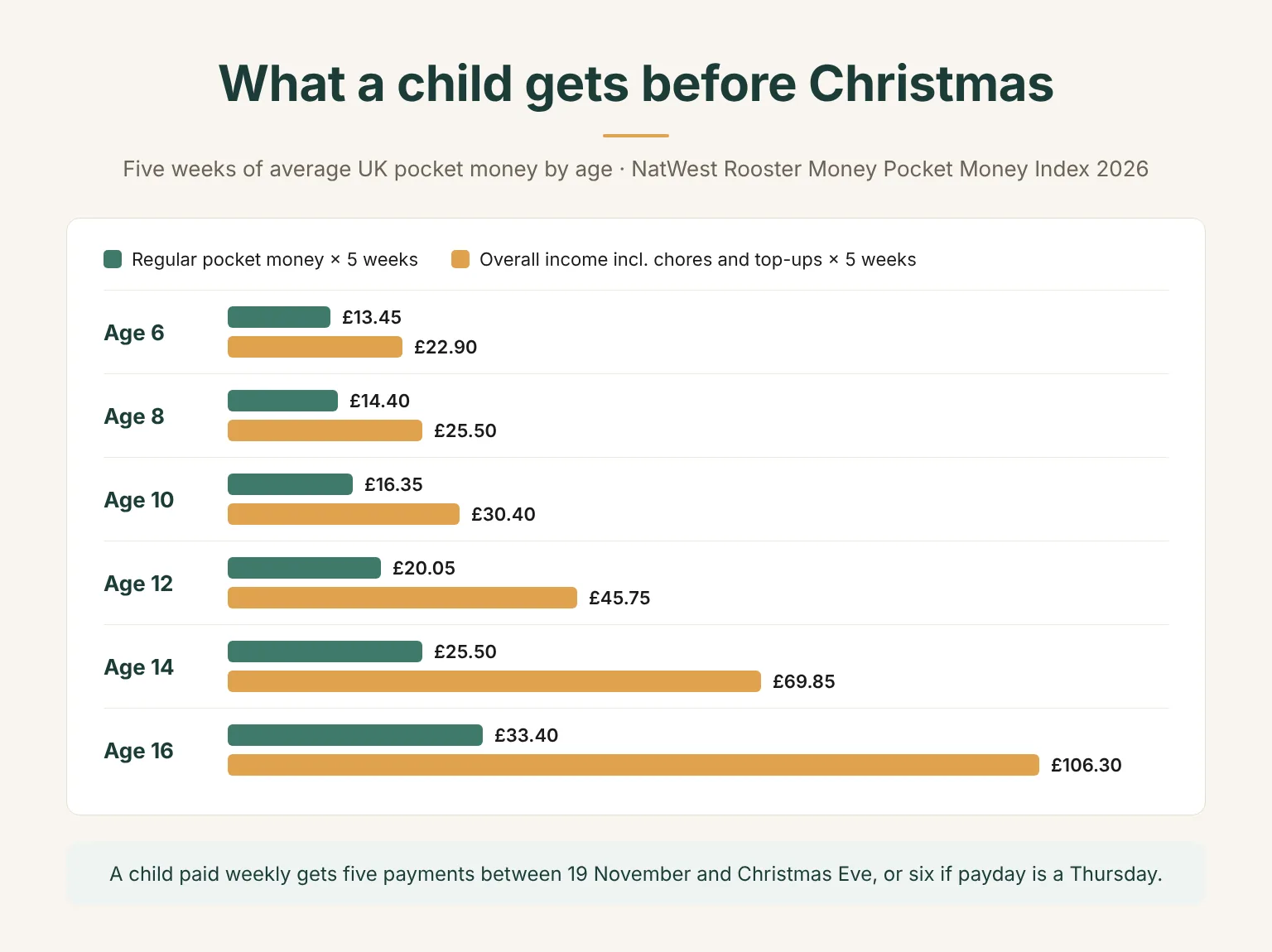
The gap between the two columns is mostly chores. In the same index, almost a third (30%) of UK children complete chores as a condition of getting their pocket money. If your family has not set an amount yet, our guide to how much pocket money to give by age compares the published averages.
At what age can a child buy Christmas presents on their own?
Most children can choose and pay for a small present with you beside them from about seven, and plan a whole list by ten or eleven. The table below is editorial guidance and not research data. Move a child up or down a row depending on how they handle money the rest of the year.
| Age | What the child does | What you do |
|---|---|---|
| 4 to 6 | Makes a card or a present, or picks one small item in a shop | Pays, or lets the child hand over a few coins at the till |
| 7 to 9 | Buys two to four small presents with their own cash | Goes to the shop with them and helps count the change |
| 10 to 12 | Writes the list, sets a cap per person, compares prices and pays | Checks the list once and agrees any top-up |
| 13 and over | Plans and buys for family and friends, in shops or online | Agrees how online orders are paid for and delivered |
Cash helps younger children most because they watch the money leave. Our post on teaching kids about money in a cashless world explains why a tap of a card teaches less at that age.
How much should a child spend on each present?
Divide what the child will have, minus a small amount for cards and wrapping, by the number of people on their list. That figure is the cap for each present. A child can spend under it on one person and over it on another, as long as the total stays inside the budget.
| Child | Money by Christmas (five weeks, regular) | Kept back for cards and wrapping | People on the list | Cap per present |
|---|---|---|---|---|
| Age 8 | £14.40 | £1.50 | 3 | £4.30 |
| Age 10 | £16.35 | £2 | 4 | £3.58 |
| Age 14 | £25.50 | £3 | 6 | £3.75 |
The caps are small. A cap of under £4 makes a child look at prices, choose between two ideas and think about what the person would like. A long list with a small budget is also the moment to ask who really needs to be on it. Grandparents and parents usually stay. A whole class of friends often does not.
Adults face the same sum on a larger scale. If you are setting your own limit as well, our guide to how much a family should spend on Christmas works through the household version.
How do you make a Christmas gift list with your child?
Sit down once in the week of 23 November with paper or a phone and write a list with four columns: who, idea, price and paid. Then follow it week by week until Christmas.
- Week of 23 November: the list. Count the money already saved, add five weeks of pocket money and write down who the presents are for. Set the cap per person.
- Week of 30 November: ideas and prices. Next to each name, write one or two ideas and look up what they cost. Cross out anything over the cap or swap it for something homemade.
- Weeks of 7 and 14 December: buy. Buy one or two presents a week with the money that has come in. After each purchase, write the actual price in the paid column and work out what is left.
- Week of 21 December: wrap and check. Wrap the presents, write the cards and compare the total spent with the budget. Anything left over goes back into savings.
- After Christmas: look back. Ask which present they were happiest to give and whether the cap felt right. Keep the list for next year.
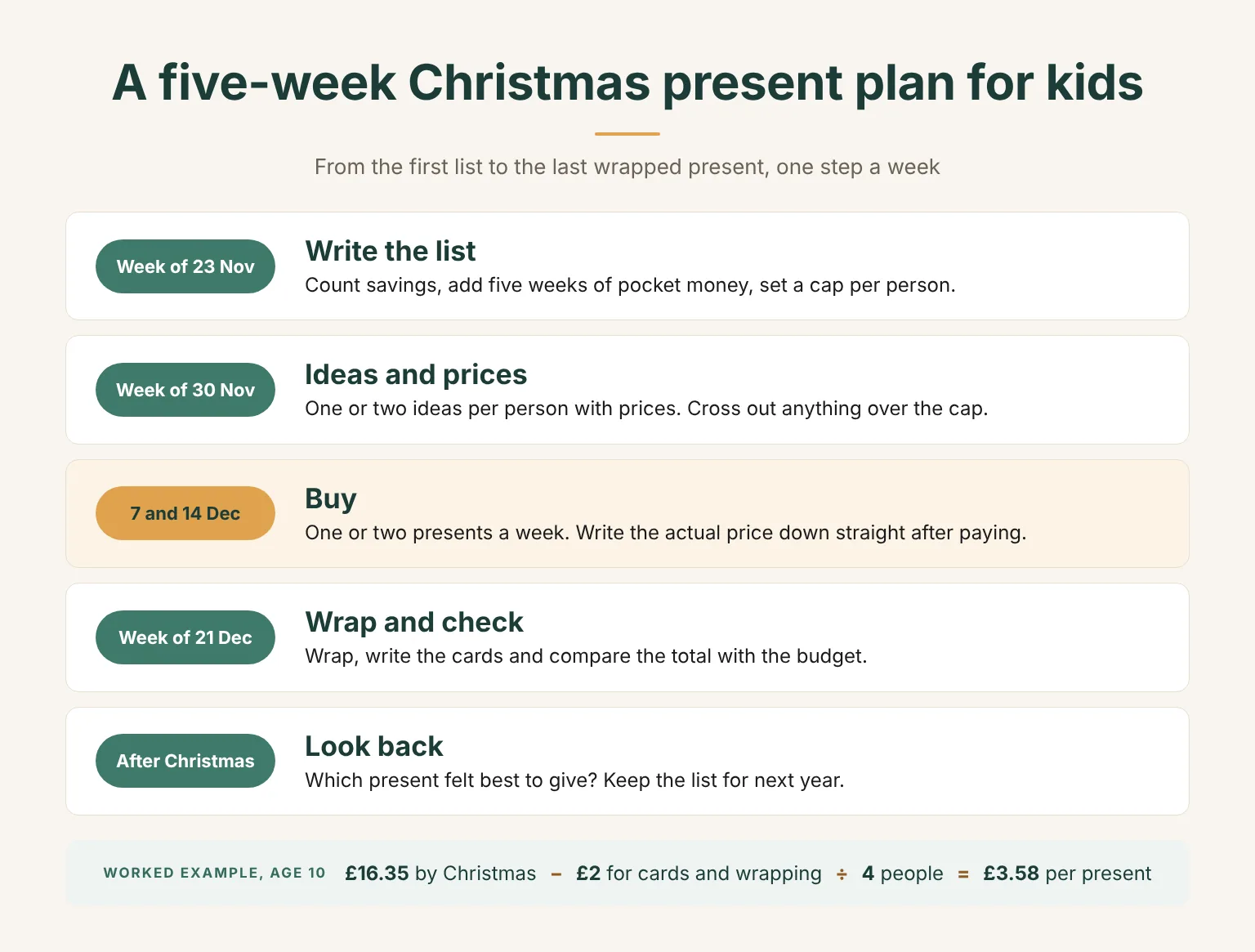
Ask your child to write the price down straight after paying. A running total on paper shows them what is left while there is still time to change the plan.
What if their pocket money will not stretch?
Cut the list, make some presents or let the child earn more. Most families use more than one of the options below.
- Sibling Secret Santa. Each child draws one brother or sister and buys a single present for that person. Three children then buy one present each and the cap per present can triple.
- One shared present. Two or three children pool their money for one gift for a parent or grandparent.
- Homemade presents. A drawing, biscuits, a decorated photo frame or a voucher for washing the car costs little and counts as a present.
- Paid jobs. Extra chores in December can raise the budget. The Rooster Money index found outdoor jobs such as mowing the lawn pay best, and our guide to how much to pay kids for chores has amounts by age.
- Gift money. Birthday money averaged £46.41 in the Rooster Money index. Whether some of it can go on presents is a family decision, which our post on what to do with money kids get as gifts helps you make.
Should parents top up a child’s Christmas present budget?
A small, agreed top-up is fine as long as the child knows the amount in advance and still makes the choices. A top-up that appears at the till whenever the money runs out removes the lesson. The four common approaches compare like this.
| Approach | How it works | What the child learns | Watch out for |
|---|---|---|---|
| No top-up | The child spends only their own money | The full trade-off between people on the list | Very small presents for young children on low pocket money |
| Match pound for pound | You add £1 for every £1 the child saves for presents | Saving earlier gives them more to spend | It costs you as much as the child saves |
| You cover extras | You pay for wrapping, cards and postage | The presents themselves stay their choice | The child may not see what extras cost |
| Earn the top-up | Extra paid jobs in December | More money comes from more work | Agree the jobs and rates before December starts |
Whichever you pick, say it before the list is written. A child who knows the budget is £16 plus £1 for every pound they save plans differently from one who hopes you will cover the gap.
How can you keep track of what your child spends on presents?
A paper list on the fridge works, as long as the child writes the price down after each purchase. If your family already keeps a shared budget, the child’s purchases can go in the same place so you both see them. CapKin is a shared household budgeting app where a child logs their own spending by text, or by voice if a parent turns that on, for example “socks for Grandad £3.20”, and the entry waits for a parent’s approval before it counts toward any total.
CapKin does not hold or move money and needs no card or bank connection, so the pocket money stays as cash or wherever you keep it now. If the present is for the parent who approves entries, the child can log it as “present for Mum” and keep the surprise. Our pocket money tracker page shows how child entries work, and the product facts page lists what CapKin does and does not do.
If the presents leave your child with nothing in reserve, January is a good time to restart a savings habit. Our guide to teaching kids to save money covers savings goals and jars.
Sources
- NatWest Rooster Money, Pocket Money Index 2026 (data 1 March 2025 to 28 February 2026)
- NatWest Group, “Mow money, no problems: ‘great out-chores’ boost kids’ pay packets” (30 June 2026)
- Dunn, Aknin and Norton, “Spending money on others promotes happiness”, Science 319(5870): 1687–1688 (21 March 2008)
- Aknin, Hamlin and Dunn, “Giving Leads to Happiness in Young Children”, PLoS ONE 7(6): e39211 (14 June 2012)
Frequently asked questions
- Should kids buy Christmas presents with their own money?
- Yes, for a few small presents, from about the age they can count coins and wait a few weeks. Parents still buy the main presents. Buying for family with their own pocket money gives a child a fixed amount, several people to buy for and a deadline. Research on toddlers (PLoS ONE, 2012) and adults (Science, 2008) found people happier giving to others than receiving or spending on themselves.
- How much should a child spend on a present for a sibling?
- Work it out from their own budget. Take the pocket money they will have by Christmas, keep back a pound or two for cards and wrapping, and divide the rest by the number of people on their list. A 10-year-old with £16.35 buying for four people has a cap of £3.58 per present. Sibling Secret Santa, one present per child, raises the cap.
- How much pocket money does a 10-year-old get in the UK?
- The NatWest Rooster Money Pocket Money Index 2026 puts regular pocket money for a 10-year-old at £3.27 a week, and overall income including chores and top-ups at £6.08 a week. The data covers March 2025 to February 2026 and more than half a million Rooster Card users. Across ages 6 to 17, the averages were £3.94 regular and £9.74 overall.
- What can kids give for Christmas if they have no money?
- Homemade presents cost almost nothing: a drawing, a card, baked biscuits, a decorated photo frame or a voucher for a job such as washing the car. Children can also pool money with brothers and sisters for one shared present, or earn a little extra with paid jobs in December. Agree any paid jobs and their rates before the month starts.
- Should I give my child extra money for Christmas presents?
- A small top-up works if you agree it before the list is written and the child still makes the choices. Common approaches are matching each pound they save, paying for wrapping and postage, or offering extra paid jobs. A top-up that appears at the till whenever the money runs out removes the budgeting lesson, so keep the amount fixed.
- How do I teach my child to budget for Christmas presents?
- Count what they will have by Christmas, write a list with columns for who, idea, price and paid, and set a cap per person. Buy one or two presents a week from late November and write each price down straight after paying, so the child sees what is left. After Christmas, talk about how it went and keep the list.