By Artem Panasiuk · 27 November 2026 · 10 min read
Joint or Separate Bank Accounts? How Couples With Kids Share Money
Most couples now keep at least some of their money apart, and couples raising children are the ones most likely to share an account. This guide sets out what US couples actually do, what the research on joint accounts found, how the three common setups compare, and how to split family costs fairly when one partner earns more. It uses US data and dollar amounts.
The short version
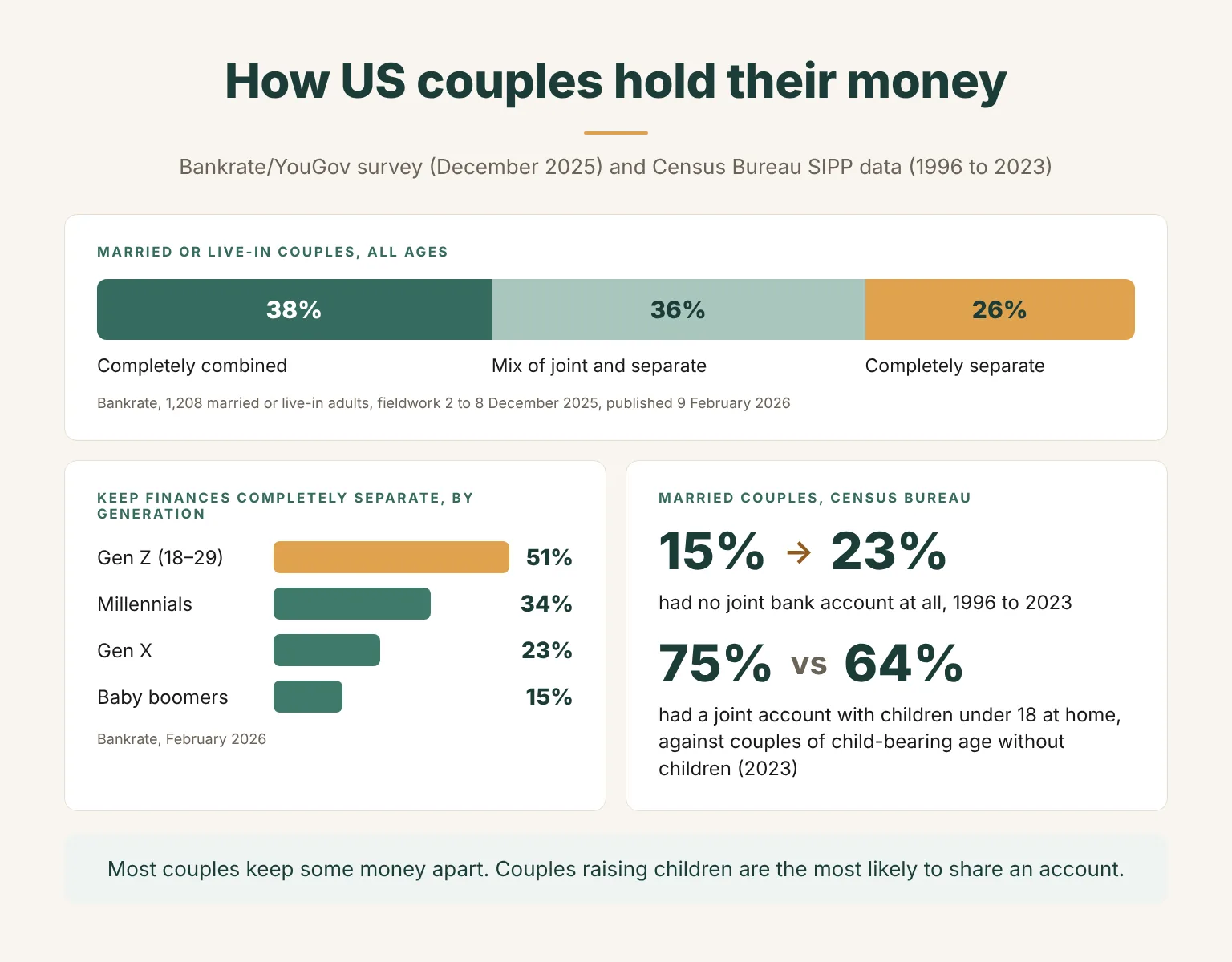
- 38% of US couples completely combine their finances, 36% use a mix of joint and separate accounts and 26% keep everything separate, according to a Bankrate survey of 1,208 married or live-in adults by YouGov (2 to 8 December 2025, published 9 February 2026).
- The share of married couples with no joint bank account rose from 15% in 1996 to 23% in 2023, Census Bureau data from the Survey of Income and Program Participation shows. In 2023, 75% of married couples with children under 18 at home had a joint account, against 64% of couples of child-bearing age without children.
- Newlywed couples randomly assigned to merge their money in a joint account kept their relationship quality steady over two years, while couples told to keep separate accounts showed the usual decline, in a study of 230 couples published in the Journal of Consumer Research in 2023.
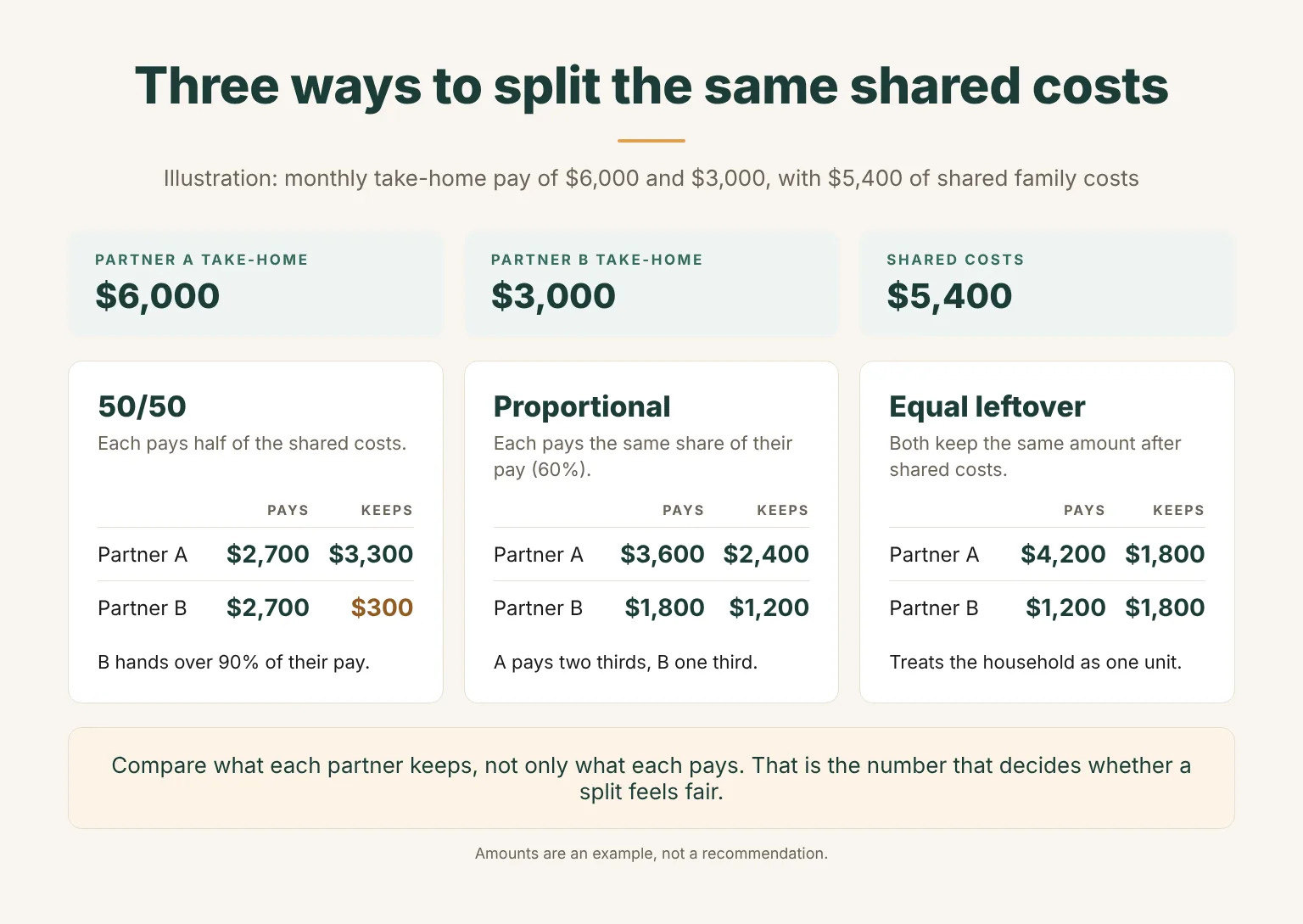
- When incomes differ, a 50/50 split can leave the lower earner with very little. With take-home pay of $6,000 and $3,000 and $5,400 of shared costs, 50/50 leaves one partner $300; a proportional split leaves $2,400 and $1,200; an equal-leftover split leaves each partner $1,800.
There is no single right answer to joint or separate accounts, but couples with children tend to need some shared money, because so many of their costs are shared. A common setup is “yours, mine and ours”: one joint account for family costs and a personal account each. The sections below show what other couples do, what the research says and how to set it up. This is general information, not financial advice.
Should couples have joint or separate bank accounts?
Either can work, as long as both of you agree on the rules and both of you can see what the household spends. The account type settles where the money sits. The harder questions are how much each of you puts in, who decides on large purchases and how much each of you can spend without asking.
Three setups cover almost every couple. With fully joint finances, both paychecks go into shared accounts and everything is paid from there. With fully separate finances, each partner keeps their own accounts and you settle up for shared costs. In between is the hybrid, usually called “yours, mine and ours”: each of you pays an agreed amount into a joint account for shared costs and keeps the rest in your own.
For couples with children the hybrid is often the easiest place to start, because childcare, groceries, school costs and housing are plainly shared, while each adult still has money of their own. The research in the next sections found that couples who pooled their money did better, so if you are undecided, lean toward a larger shared pot.
How many couples have joint bank accounts in 2026?
Most US couples keep at least some money separate. In Bankrate’s survey of 1,208 married or live-in adults, carried out by YouGov from 2 to 8 December 2025 and published on 9 February 2026, 38% said they completely combine their finances, 36% use a mix of joint and separate accounts and 26% keep their accounts completely separate.
Age makes a large difference. In the same survey, 51% of Gen Z couples (ages 18 to 29) kept their finances completely separate, against 34% of millennials, 23% of Gen X and 15% of baby boomers. Income matters too: 39% of couples with household income under $50,000 kept everything separate, compared with 17% of couples on $100,000 or more, and 47% of the higher-income couples used a mix of joint and separate accounts.
Government data shows the same trend over a longer period. Among married couples, the share with no joint bank account at all rose from 15% in 1996 to 23% in 2023, according to the Census Bureau’s Survey of Income and Program Participation (SIPP), a large national household survey. Fidelity’s 2026 Couples & Money study, a survey of 3,193 married or partnered adults by Versta Research (14 October to 2 November 2025), found 42% combine their finances in joint accounts, about one in five keep everything separate, and two thirds say keeping some financial autonomy is important.
Does a joint bank account make couples happier?
In a randomized two-year study, pooling money helped. Jenny Olson of Indiana University, Scott Rick of the University of Michigan, Deborah Small of Yale and Eli Finkel of Northwestern followed 230 engaged or newly married couples for two years, in research published in the Journal of Consumer Research in 2023. Couples were randomly assigned to merge their money into one joint account, keep separate accounts, or choose for themselves.
All three groups started with similar relationship quality. The separate-account group and the choose-for-yourself group declined over the two years, which is the usual pattern for newlyweds. The joint-account group did not decline and reported more financial harmony. A second study of 507 people married for about 15 years on average found that those with merged accounts reported more closely aligned financial goals.
The study has limits. Partly merging money, a joint account alongside separate ones, was not linked to the same benefits, and Finkel said more research was needed on that point. Kellogg Insight’s report on the study also notes that a joint account means giving up some independence, and that it may not suit couples whose relationship or finances are on shaky ground, where shared money can be used to control a partner. Whatever you choose, each adult should keep access to some money of their own.
Many couples avoid the conversation altogether. In Fidelity’s 2026 study, 49% of couples said they avoid money conversations to prevent arguments, 50% wished they talked more about day-to-day finances, and almost one in four admitted hiding a financial secret from their partner.
What are the pros and cons of joint, separate and yours-mine-ours accounts?
Joint accounts are simplest and give the most shared visibility, separate accounts keep the most independence, and the hybrid trades a little of each. The table compares them for a household with children.
| Setup | How it works | Works well when | Watch out for |
|---|---|---|---|
| Fully joint | Both paychecks go into shared accounts; all bills and spending come from there | You have similar spending habits, or one partner earns most or all of the income while the other cares for the children | No money of your own unless you agree on personal spending amounts; either owner can withdraw the whole balance |
| Fully separate | Each keeps their own accounts; you divide shared bills between you and settle up | You are newly together, have very different habits, or bring large debts or assets from before | Nobody sees the family total; constant settling up over groceries, childcare and school costs |
| Yours, mine and ours | Each pays an agreed amount into one joint account for shared costs and keeps the rest | You have children and both earn, or you want shared bills covered and some independence | Choosing how much each puts in, and deciding what counts as shared |
Know what a joint account means legally before you open one. The Federal Deposit Insurance Corporation (FDIC), which insures US bank deposits, only treats an account as joint for insurance when all co-owners have equal rights to withdraw. In practice, either of you can take money out without the other. Each co-owner’s share of all joint accounts at the same insured bank is covered up to $250,000, according to the FDIC’s guide “Your Insured Deposits” (updated 1 April 2024).
Does having kids change how couples should share money?
Yes, and the data shows parents act on it: they are more likely to share an account. In the Census Bureau’s 2023 SIPP figures, 75% of married couples with children under 18 at home had a joint account, against 64% of couples of child-bearing age without children. Among unmarried couples living together, 16% had a joint account, rising to 25% among those living with children under 18.
Children change the arithmetic in three ways. First, a much larger part of spending becomes shared: childcare, school costs, clothes, activities and a bigger grocery bill. Second, incomes move. Parental leave, reduced hours or one parent staying home can cut one income for months or years, and a split that was fair before the baby may not be fair after it. Third, unpaid work grows. A parent who earns less because they do more of the childcare is still contributing to the household.
Unequal contributions are common, and they can cause friction. In Fidelity’s 2026 study, 58% of couples said they do not contribute equally to household finances, and nearly one in four said the imbalance affects their relationship. What usually helps is a split you both chose on purpose, written down, with a date to look at it again. A new account on its own changes little.
How do you split shared bills fairly when incomes differ?
Pick one of three models, and judge it by what each of you keeps afterward as well as by what each of you pays. With a 50/50 split, each pays half. With a proportional split, each pays the same percentage of take-home pay. With an equal-leftover split, contributions are set so that both of you keep the same amount after shared costs.
Here is how they compare for a couple with monthly take-home pay of $6,000 and $3,000 and $5,400 of shared family costs. The amounts are an illustration, not a recommendation.
| Model | Partner A pays | Partner A keeps | Partner B pays | Partner B keeps |
|---|---|---|---|---|
| 50/50 | $2,700 | $3,300 | $2,700 | $300 |
| Proportional (60% each) | $3,600 | $2,400 | $1,800 | $1,200 |
| Equal leftover | $4,200 | $1,800 | $1,200 | $1,800 |
Under 50/50, partner B hands over 90% of their pay and keeps $300 for the month, while partner A keeps $3,300. The proportional split asks each partner for 60% of pay, so A pays two thirds of the shared costs. The equal-leftover split treats the household as one unit, which suits couples where one parent earns less because they do more of the childcare.
To run your own numbers, the split expenses by income calculator shows all three models side by side, and your incomes stay in your browser. Many couples take a fixed personal cost, such as a student loan or child support from an earlier relationship, off that partner’s income before working out the split.
How do you set up a yours, mine and ours system?
List what counts as shared, agree each person’s contribution, automate the transfers and review the system on a fixed date. Seven steps cover it:
- List the shared costs. Housing, utilities, groceries, childcare, children’s clothes and activities, insurance and the family car are the usual ones. Our list of family budget categories helps you put a monthly number on each.
- Choose the split. Pick 50/50, proportional or equal leftover, and write down the amount each of you pays in.
- Open the joint account. Set up automatic transfers on payday so the shared account is filled before anyone spends.
- Agree personal spending money. Many couples give each partner the same amount for personal spending, whatever they earn, so nobody needs permission for a haircut or a gift.
- Set a limit for big purchases. Agree an amount above which you talk first, whether the money comes from the joint account or a personal one.
- Keep a shared safety net. Decide whether the emergency fund sits in the joint account. Our guide to how much emergency fund a family needs has the numbers.
- Review monthly and reset at big changes. Look at the shared spending once a month, and redo the split after a new baby, parental leave, a job change or a raise. A short family money meeting is a good place for it.
How can you see shared spending without merging everything?
Keep one shared record of what the household spends, separate from where the money sits. When both partners pay for family things from different accounts and cards, no single bank statement shows the family total, and that is where most “who paid for what” arguments start. A shared budget with category limits gives you that total whatever your account setup is. Our guide to creating a shared family budget walks through setting one up.
CapKin is a shared household budgeting app built for this. Both partners log spending by voice, text or receipt photo against monthly caps you set together, so groceries bought on one partner’s card and school shoes bought on the other’s land in the same category total. CapKin does not connect to a bank, so neither of you hands over a login or shares a bank statement; you each see what was logged. It does not move money or give financial advice. The budgeting app for couples page explains how two partners use one budget, and the product facts page lists what CapKin does and does not do.
Sources
- Bankrate, “Most Couples Keep At Least Some Of Their Money Separate” (press release, 9 February 2026; YouGov survey of 1,208 married or live-in adults, 2 to 8 December 2025)
- US Census Bureau, “Almost a Quarter of Married Couples Didn’t Have Joint Accounts in 2023, Up From 15% in 1996” (24 September 2025)
- US Census Bureau, “Joint Bank Account Ownership Within Couples: 1996-2023” (SIPP tables, September 2025)
- Fidelity Investments, “Most Couples Feel Confident About Money, But There Could Be More To Talk About” (2026 Couples & Money Study, 19 May 2026)
- Kellogg Insight, “One Key to a Happy Marriage? A Joint Bank Account” on Olson, Rick, Small and Finkel, Journal of Consumer Research (9 May 2023)
- FDIC, “Your Insured Deposits” (updated 1 April 2024)
Frequently asked questions
- Do most married couples have joint bank accounts?
- Yes, but fewer than before. Census Bureau data shows 77% of married couples with accounts at financial institutions held at least one joint account in 2023, down from 85% in 1996, and the share with no joint account rose from 15% to 23%. In a Bankrate survey from December 2025, 38% of US couples said they completely combine their finances.
- Is it better to have joint or separate accounts when you have kids?
- Many parents choose a joint account for family costs and keep a personal account each. Children make much of the spending shared, from childcare to groceries. In 2023 Census data, 75% of married couples with children under 18 at home had a joint account, against 64% of couples without children. The right setup is the one both partners agree on and can see.
- What is a yours, mine and ours account system?
- It is a hybrid setup. Each partner pays an agreed amount into one joint account that covers shared costs such as housing, groceries and childcare, and keeps the rest in their own account for personal spending. The contribution can be equal, proportional to income, or set so both partners keep the same amount after shared costs.
- How do you split bills with a partner who earns more?
- Compare three models: 50/50, proportional to income, and equal leftover. For take-home pay of $6,000 and $3,000 with $5,400 of shared costs, 50/50 leaves the lower earner $300, a proportional split leaves $2,400 and $1,200, and equal leftover leaves each partner $1,800. Judge each model by what both of you keep afterward.
- Can my partner take all the money out of a joint account?
- Usually, yes. The FDIC only insures an account as joint when all co-owners have equal rights to withdraw, so either owner can normally take money out without the other’s signature. Each co-owner’s share of joint accounts at one insured bank is covered up to $250,000. Agree a limit above which you talk before spending.
- Do joint bank accounts make marriages happier?
- Research points that way. In a two-year study of 230 engaged or newly married couples, published in the Journal of Consumer Research in 2023, couples assigned to a joint account kept their relationship quality steady, while couples with separate accounts showed the usual decline. Partly merged accounts were not linked to the same benefit, and Kellogg Insight’s report on the study notes that joint accounts are not for everyone.